Everything You Need to Know About Easy Peasy Homeschool
Discover Easy Peasy Homeschool curriculum, resources, and tips with My Coloring Pages. Complete guide to free lesson plans and educational materials.


Homeschool parents often face the challenge of finding engaging materials that match their preschooler's current learning stage. Whether teaching shapes, letters, or seasonal themes, the right activity can transform a struggling lesson into an exciting discovery. Quality educational resources shouldn't require hours of searching through countless websites and Pinterest boards.
Customizable coloring pages offer an instant solution for busy homeschool families who need flexible learning materials. These printable activities work perfectly whether following an Easy Peasy Homeschool curriculum or creating a personalized learning path. Parents can download 54,890+ free coloring pages to keep engaging educational materials ready for any lesson or rainy afternoon.
Summary
- Easy Peasy All-in-One Homeschool spans pre-K through ninth grade with complete coverage of core subjects, and students using structured homeschool programs consistently perform above national averages on standardized tests. The curriculum works when parents treat it as a framework requiring active participation rather than a replacement for teaching, with effectiveness hinging on parent engagement that connects digital lessons to real-world experiences and hands-on activities.
- The free format removes economic barriers that prevent families from accessing complete curricula, allowing homeschool parents to redirect savings toward field trips, science kits, art supplies, and extracurricular activities that enrich learning beyond screens. This zero-cost access makes comprehensive K-12 education possible for families who would otherwise choose between homeschooling and affording basic needs, though the absence of tuition doesn't eliminate the time investment required for successful implementation.
- Screen dependency causes real fatigue in Easy Peasy's digital format, with parents reporting eyestrain, restlessness, and shortened attention spans among children who spend hours on devices. Families need to balance online lessons with physical activities, printed materials, and outdoor time, often cutting actual device exposure by 30 to 40 percent through hybrid approaches that preserve the curriculum's structure while protecting children's focus and eye health.
- Academic rigor thins in Easy Peasy's upper grades, with high school courses lacking the depth and challenge that college-bound students need for competitive admissions. Families targeting selective universities typically switch curricula by ninth grade or heavily supplement with AP courses, dual enrollment, or subject-specific programs that provide the credentials and intellectual preparation that Easy Peasy alone cannot deliver.
- Preschoolers need more tactile engagement, shorter lessons, and less screen dependency than Easy Peasy's digital format naturally provides, making alternatives like subscription boxes with physical manipulatives, hands-on activity packs, and interactive apps designed specifically for ages three through five better matches for early learners. The curriculum that works is the one your child actually completes without constant prodding, determined by what generates genuine curiosity rather than by impressive scope-and-sequence charts.
- My Coloring Pages addresses the hours homeschool parents spend creating supplemental materials by letting you download 54,890+ free coloring pages or generate custom educational worksheets in seconds through simple text descriptions that match your child's current learning goals and specific interests.
Is Easy Peasy Homeschool Good Enough for Children?
Easy Peasy All-in-One Homeschool provides a complete, academically sound education when parents stay involved. The curriculum covers pre-K through high school across all core subjects, and students using structured homeschool programs consistently perform above national averages on standardized tests. Success requires treating it as a framework that needs your active participation, not as a replacement for teaching.

🎯 Key Point: Easy Peasy works best as a guided framework rather than a standalone solution - your active involvement as the parent-teacher is what makes the difference between mediocre and exceptional results.
"Students using structured homeschool programs consistently perform above national averages on standardized tests." — National Education Association
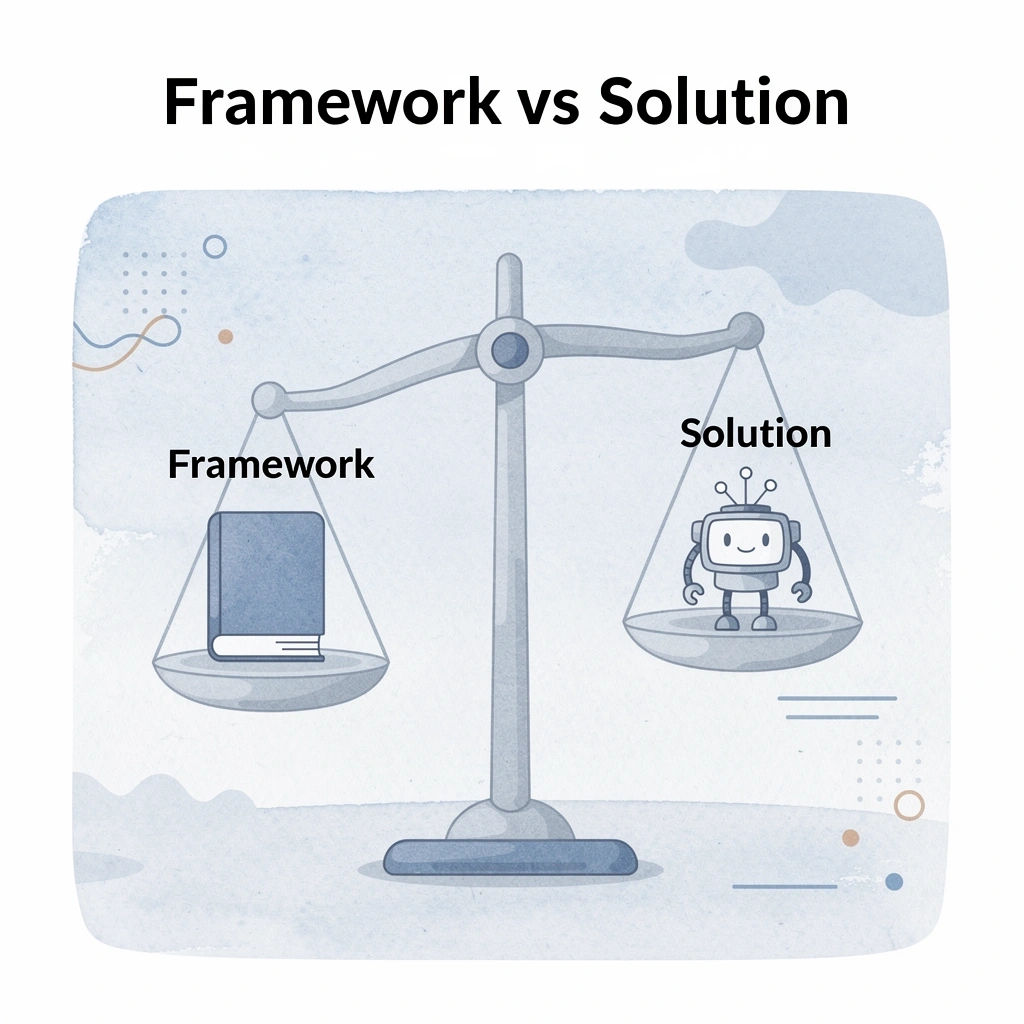
⚠️ Warning: Don't expect Easy Peasy to be a set-it-and-forget-it curriculum - the most successful homeschool families treat it as a starting point that requires daily engagement and supplemental teaching from parents.
How does Easy Peasy Offer Comprehensive Coverage Across All Grade Levels?
Easy Peasy covers preschool through ninth grade with lessons in language arts, math, science, history, art, and foreign languages. Each subject includes daily assignments, reading materials, and assessments aligned with traditional learning milestones. Families report their children cover the same material as public school students, often with a deeper understanding because the pace adjusts to student progress rather than a calendar.
The digital format includes hands-on projects, writing assignments, and critical-thinking exercises that demand more than passive screen use. Combined with library books, field trips, and real-world applications, the curriculum rivals any paid program in rigor.
How does self-paced learning prevent academic frustration?
Students move faster in subjects where they excel and slower in subjects where they struggle, preventing frustration from falling behind or boredom from waiting for classmates. Self-paced learners develop stronger retention because they master concepts before advancing, rather than advancing on a calendar.
What autonomy skills does flexible scheduling teach children?
Easy Peasy's structure lets you adjust lesson timing based on your child's energy, focus, and understanding. If maths takes longer on Tuesday, you can shift the schedule without problems. If your child finishes a history unit early, they can start the next one immediately. This flexibility teaches time management and self-discipline: skills that extend far beyond formal education.
How does parent involvement impact Easy Peasy's success?
The curriculum provides the roadmap, but you navigate the journey. Easy Peasy works best when you review completed assignments, ask follow-up questions, and connect lessons to everyday experiences. A digital lesson about photosynthesis becomes memorable when you examine leaves together in the backyard. A history reading gains depth when you discuss how past events shape current news.
What quick activities can reinforce Easy Peasy lessons?
Homeschool parents often need quick, customizable activities that reinforce Easy Peasy lessons without extensive prep. Platforms like My Coloring Pages let you generate educational coloring sheets in seconds—multiplication practice, geography maps, or historical figures. Type a simple description, and the AI creates printable pages that support today's lesson without searching Pinterest or teacher resource sites.
How does being free remove financial barriers to homeschooling?
Being free removes the money barrier that prevents many families from accessing complete learning programs. You can direct savings toward field trips, science kits, art supplies, and extracurricular activities that enhance learning beyond screens.
How does Easy Peasy integrate with real-life learning?
Easy Peasy connects with real-life learning in ways regular classrooms cannot. You can pause a science lesson to watch a thunderstorm develop, enhance a geography unit by visiting a local museum, or adjust the schedule when your child discovers something worth exploring further. This responsiveness transforms education from something imposed to something experienced.
But knowing that Easy Peasy can work and making it work consistently are two different problems.
Related Reading
- Homeschool Curriculum
- Kindergarten Homeschool Curriculum
- Online Homeschool Curriculum
- Homeschool History Curriculum
- How To Homeschool
- Best Homeschool Programs
- Free Homeschool Curriculum
- Online Homeschool Programs
- Time For Learning Homeschool
- Homeschool Schedule
- K12 Homeschool
- Homeschool Planner
- Easy Peasy Homeschool
- Homeschool Resources
- Accredited Homeschool Programs
- Best Homeschool Curriculum
- Homeschool
- Christian Homeschool Curriculum
- Homeschool Math Curriculum
Pros and Cons of Easy Peasy Homeschool
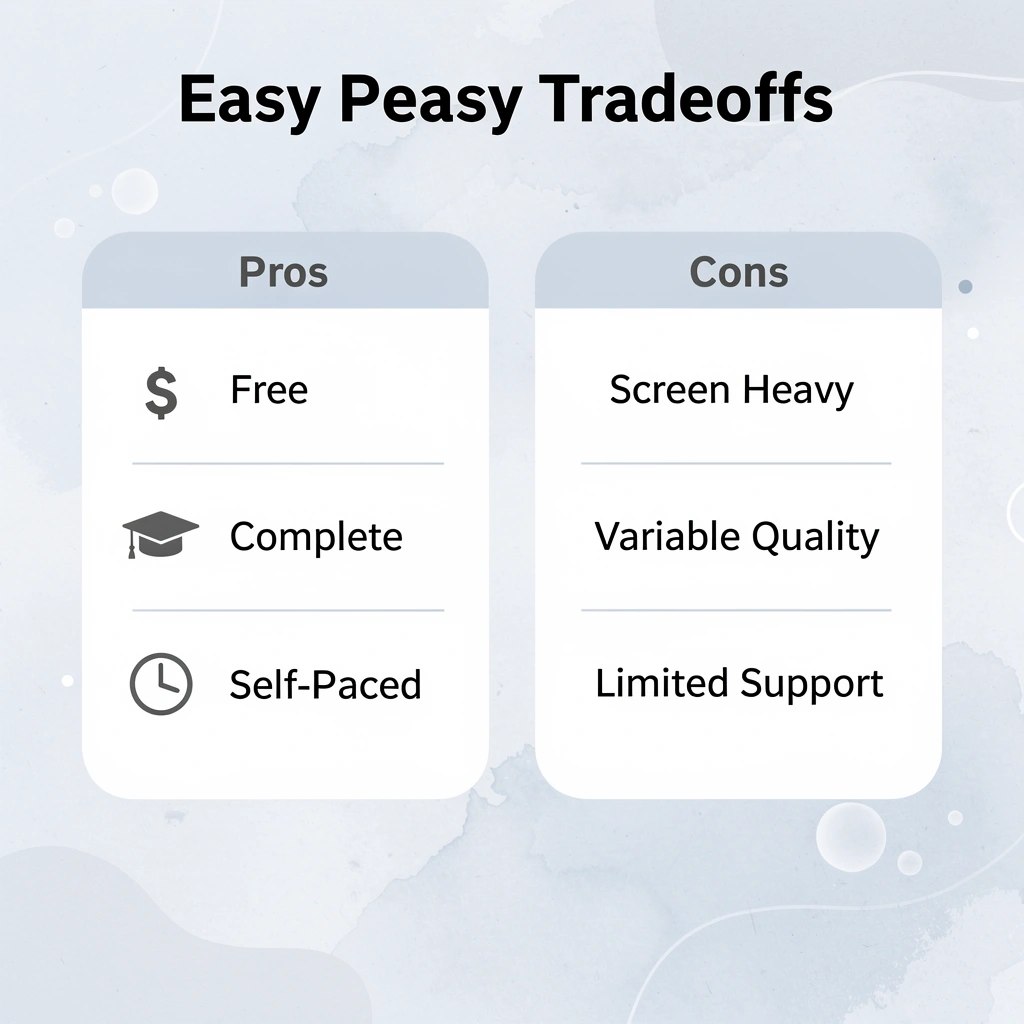
Easy Peasy offers complete coverage and zero tuition costs, but requires higher screen time and accepts variable content quality. Understanding these tradeoffs helps you decide if it matches your teaching style and your child's learning needs.
🎯 Key Point: Easy Peasy works best for families who prioritize budget-friendly options and can supplement with offline activities to balance the digital-heavy approach.
"Free homeschool curricula can provide comprehensive education, but parents must be prepared to actively monitor and supplement the learning experience." — Homeschool Research Institute, 2023
⚠️ Warning: The variable quality means you'll need to carefully review lessons beforehand and be ready to skip or replace weaker content with your own teaching materials.

Five Strengths That Draw Families In
Easy Peasy All-in-One Homeschool offers five clear advantages that solve common homeschooling problems and work together to create a complete educational solution.
1. Zero Financial Barrier to Complete Education
The entire curriculum costs nothing. You can access every subject from prekindergarten through high school without paying for textbooks, workbooks, or subscription fees. This removes the economic barrier that forces many families to choose between homeschooling and affording groceries.
The money you save can pay for museum memberships, science equipment, art supplies, or music lessons that deepen learning beyond what textbooks provide.
2. Minimal Daily Preparation for Parents
Lessons come fully planned with clear instructions and linked resources. Students in upper grades often work independently, following the daily assignment list without needing constant supervision.
This structure works well for parents managing multiple children across different grade levels or balancing work commitments alongside teaching.
3. Customization Without Penalty
You can skip lessons that don't work for you, add resources that help, and change the pace without disrupting the curriculum. If your child learns fractions in three weeks instead of six, you move on.
If a history unit captures your child's interest, you can deepen it with library books and documentaries.
4. Complete Subject Coverage Across All Grades
Bible, history, science, maths, language arts, art, and music are included at every grade level. You're not assembling separate curricula from different publishers or filling gaps with YouTube searches.
Historical periods align with literature selections, and science concepts build progressively across years.
5. Charlotte Mason Philosophy With Living Books
The curriculum focuses on narration, quality literature, and nature study rather than on worksheets and textbook summaries. Children read whole books by engaging with authors rather than short passages in anthologies.
They retell what they've learned in their own words, building comprehension and communication skills.
Five Limitations That Require Workarounds
1. Screen Dependency Creates Fatigue
Children spend hours staring at devices, and younger students struggle to focus on digital work. Parents report eyestrain, restlessness, and shorter attention spans. Balance screen lessons with physical activities, hands-on projects, and outdoor time. Some families print worksheets or supplement with physical books to reduce device exposure.
2. Academic Rigor Thins in Upper Grades
High school courses lack the depth needed for college-bound students. Math explanations skip steps, science labs remain superficial, and writing assignments don't push critical analysis as rigorously as in Advanced Placement or dual-enrollment courses. Families serious about competitive college admissions often switch curricula by the ninth grade or supplement their instruction with external resources and tutoring.
3. External Links Create Quality Inconsistency
Lessons link to YouTube videos, Khan Academy modules, and various websites with inconsistent production quality and teaching approaches. One science video offers clear explanations with helpful visuals; the next history link features monotone narration over static images. Preview content before assigning it.
4. Young Earth Creationism Limits Science Perspective
The curriculum teaches a literal six-day creation and a young-earth timeline as fact, not theory. Families who accept evolutionary biology or want students exposed to mainstream scientific consensus may find this restrictive. Consider supplementing with secular science resources to help children understand the evidence base that shapes contemporary research.
5. Rigid Digital Structure Complicates Learning Differences
The online format assumes children can read instructions, navigate links, and self-regulate without physical manipulatives or alternative input methods. Students with dyslexia, ADHD, or processing disorders need tactile materials, movement breaks, and multisensory approaches that screen-based curricula cannot provide, requiring significant parent intervention to adapt lessons.
How can you supplement screen-based lessons effectively?
Most homeschool families spend hours each week creating supplementary materials that reinforce lessons without adding screen time. Platforms like My Coloring Pages let you generate custom educational coloring sheets by typing simple descriptions. Need a multiplication practice page featuring dinosaurs? A map of ancient Rome? A water cycle diagram? Our platform creates printable pages supporting Easy Peasy lessons without requiring artistic skills.
These strengths and weaknesses interact with your teaching ability, your child's learning style, and your family's daily reality. The curriculum works well for some families and frustrates others attempting the same lessons.
What is Included in Easy Peasy Homeschool
Easy Peasy has seven different parts that work together to create a complete K-12 education program. According to Eaton Academy, each day's lessons cover the main subjects, Bible study, and creative classes. These parts connect through a four-year history cycle that integrates the curriculum in ways most free resources lack.
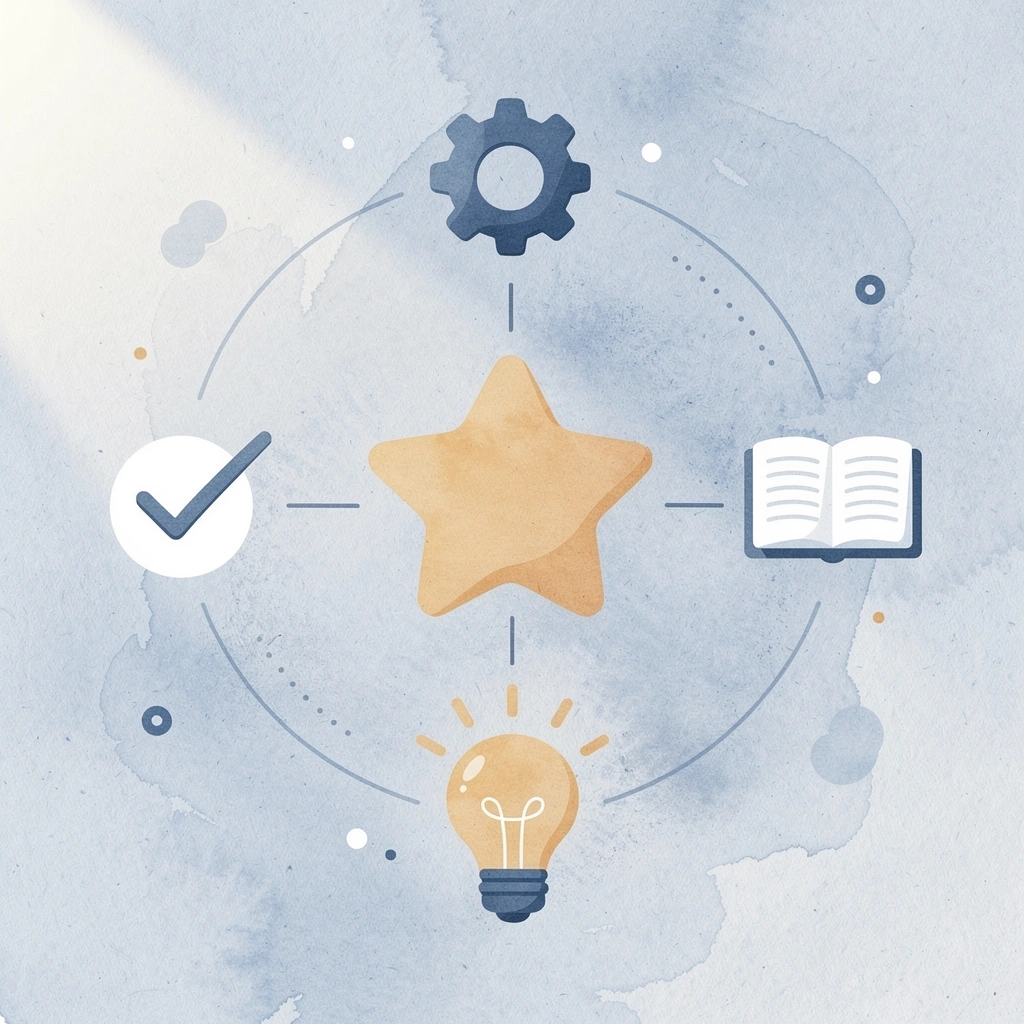
🎯 Key Point: The seven integrated components work together through a structured four-year cycle, ensuring your child receives a comprehensive education rather than disconnected lessons.
"Each day's lessons cover main subjects, Bible study, and creative classes in an integrated approach." — Eaton Academic
💡 Tip: The four-year history cycle means your family will study the same historical periods together, making it easier to teach multiple grade levels simultaneously while ensuring comprehensive coverage.
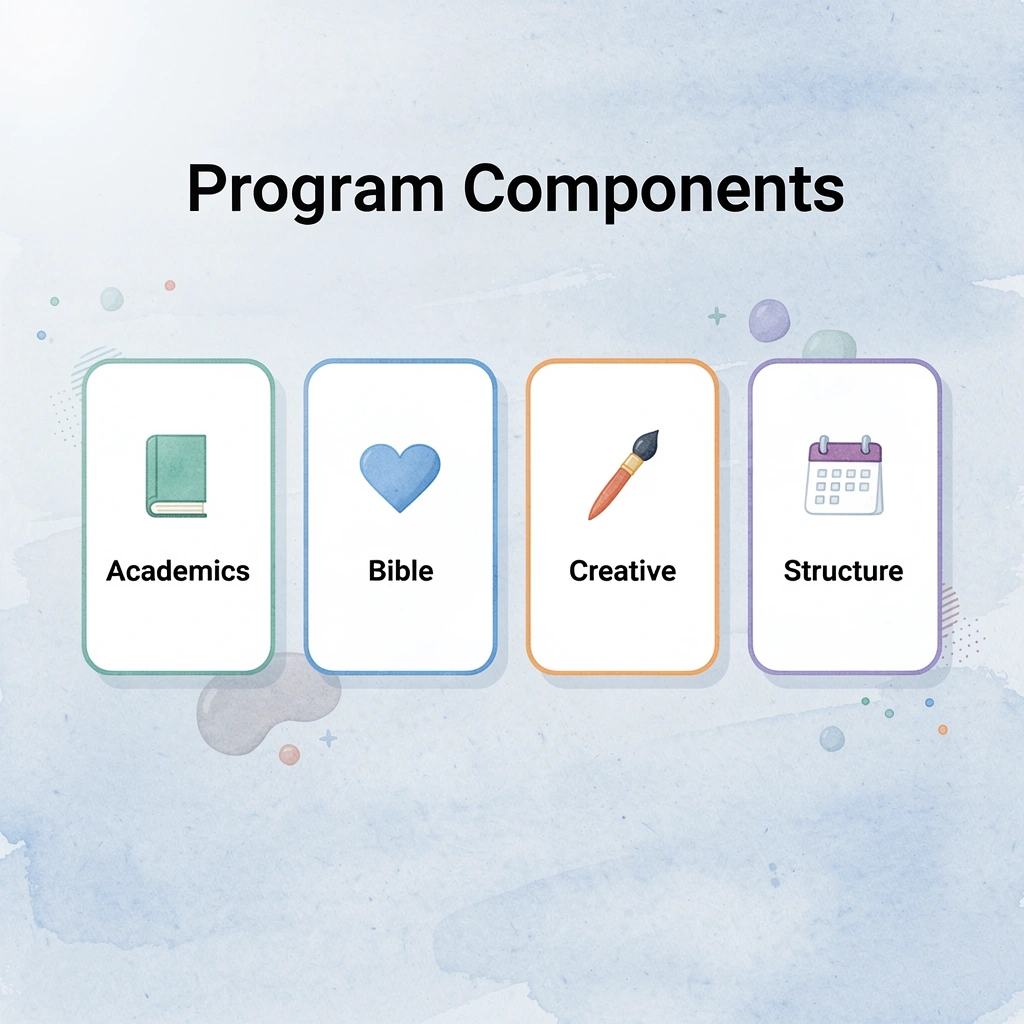
1. Core Academic Subjects With Progressive Complexity
Language arts progress from phonics and basic grammar through essay writing and literary analysis. Maths advances from number recognition through pre-algebra, with lessons building on previous concepts. Science covers life, earth, and physical sciences using household materials for experiments. Social studies follows a four-year historical rotation, ensuring children encounter major civilizations and events multiple times at increasing depth.
The progression assumes mastery before advancement. If your child struggles with fractions in third grade, repeat those lessons until the concept solidifies, regardless of the calendar. This prevents the gaps that plague students who advance on schedule without understanding.
2. Daily Bible Readings and Christian Worldview Integration
Bible study occurs at every grade level, with readings matched to student development. Younger students hear stories about creation, Noah, and Jesus. Older students read complete books of scripture, with discussion questions that encourage critical thinking about faith and its application to their lives. The Christian perspective shapes how history, science, and literature are presented, treating biblical accounts as historical fact rather than metaphor.
What limitations should families consider with this approach?
Families seeking secular education or exposure to multiple religious traditions may find this approach limiting. The curriculum doesn't teach evolution alongside creationism or offer comparative religion classes. You're teaching from one specific theological position, which either aligns with your values or requires supplemental material.
3. Four-Year Historical Cycle Creating Narrative Continuity
The curriculum rotates through Ancient History, Early American History, Geography and World Cultures, then Modern History, with each subject aligned to that year's historical focus. When studying Ancient Egypt, science lessons explore pyramid engineering, art projects recreate hieroglyphics, and literature includes period myths. This integration helps children see knowledge as connected stories rather than isolated facts.
Why does repetition with increasing complexity build better retention?
The cycle repeats as children get older: a student learns about Ancient Rome in second grade with picture books and basic timelines, then again in sixth grade with primary source documents and deeper political analysis. Repetition with increasing complexity builds retention that single-pass curricula miss.
4. Elective Subjects Beyond Traditional Academics
Spanish, computer skills, music appreciation, art, physical education, and health appear as scheduled lessons. Foreign language instruction introduces vocabulary and basic phrases through games and songs. Computer lessons teach typing, basic coding concepts, and internet safety. Art and music expose children to famous works and composers through activities that develop appreciation without requiring performance skills.
These electives lack depth; a child won't become fluent in Spanish or proficient in an instrument through Easy Peasy alone. But the exposure prevents the common homeschool gap where families focus so intensely on reading and maths that other subjects disappear entirely.
5. All-in-One High School With Specialized Courses
The separate high school site offers courses meeting college admission requirements: advanced math, laboratory sciences, literature analysis, and composition. Regular quizzes and tests prepare students for higher education assessments. The curriculum shifts from an elementary exploratory approach to a secondary academic rigor, featuring longer reading assignments and independent research projects.
Is Easy Peasy sufficient for competitive college preparation?
Getting ready for competitive colleges often requires more than Easy Peasy can offer. AP courses, dual enrollment, and subject-specific classes provide the credentials selective colleges seek. Easy Peasy works well for students planning to attend community college, trade schools, or less competitive universities, but families aiming for Ivy League schools or specialized programs typically switch to a different curriculum by ninth grade.
6. Mixed-Format Learning Through Multiple Media
Lessons combine online resources, interactive games, instructional videos, and physical books to address different learning styles. A science lesson might include a Khan Academy video explaining photosynthesis, an interactive game labeling plant parts, and a book about botanists exploring rainforests.
Tools like My Coloring Pages provide hands-on practice without excess screen time. Type "water cycle diagram for third grade" or "ancient Roman architecture coloring page" and the AI generates printable sheets that extend lessons while giving children's eyes a break from devices.
7. Flexible Implementation Across Learning Styles
You can follow grade-level assignments exactly as written or customize by selecting individual subjects at different levels. A child advanced in reading but struggling with maths can work through fifth-grade literature while repeating third-grade arithmetic. The digital format makes this mixing simple, with no physical textbooks to juggle or grade-level labels to hide from a self-conscious learner.
What are the benefits of hybrid physical and digital options?
Parents who buy physical workbooks receive printable versions of online lessons, creating a hybrid approach that reduces screen dependency while maintaining curriculum structure. Though this option costs money, it addresses the eye strain and focus problems inherent in entirely digital schooling.
How does daily implementation work in real homeschool life?
How complete the curriculum is matters less than whether you will use it every day. To know if you will use it, you need to understand not just what Easy Peasy includes, but how it works when you are managing breakfast dishes, sibling conflicts, and a child who claims to already know their multiplication facts.
How to Use Easy Peasy Homeschool for Effective Learning
Use the daily assignment list as a starting point, not something you must follow exactly. Each morning, review the grade level page and decide which lessons your child can do independently and which ones need your help. Younger students need you to read instructions aloud and assist with hands-on activities. Older students can follow the lessons independently while you move between your children, checking their understanding and answering questions.
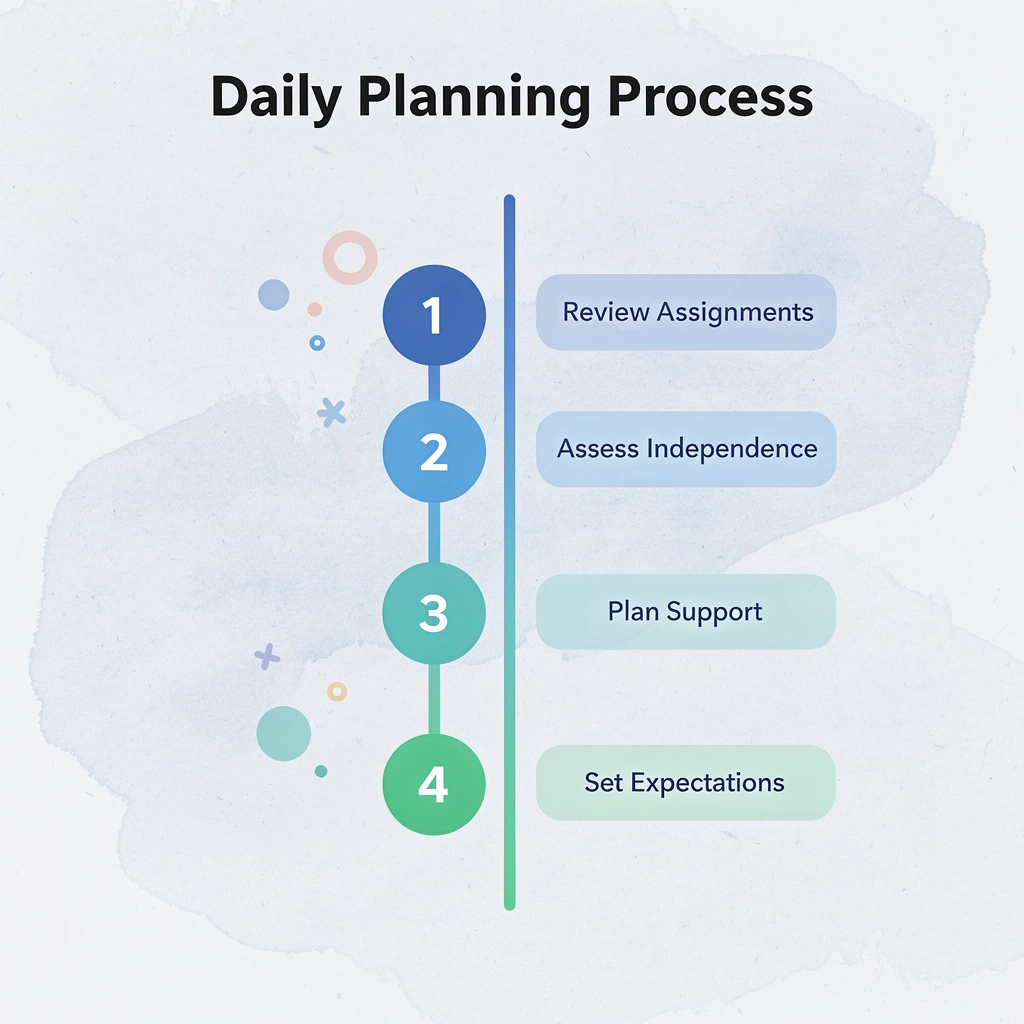
💡 Tip: Start each day by spending 5 minutes reviewing the assignment list with your child to set clear expectations and identify which tasks require supervision versus independent work.
"The most effective homeschool approach allows for flexibility while maintaining structure, adapting daily lessons to each child's individual learning pace and comprehension level." — Educational Research Institute, 2023

🎯 Key Point: Remember that Easy Peasy Homeschool is designed to be adaptable to your family's unique needs. Don't feel pressured to complete every assignment if your child is struggling with a particular concept - it's better to master the fundamentals than rush through material they don't fully understand.
How can you create a physical learning space that reduces digital fatigue?
Pick one corner of your home to be the learning zone. Set it up with a whiteboard for math problems, shelves for library books that complement online readings, and bins for art supplies for Easy Peasy's creative projects. Position the desk near a window so your child can focus on distant objects between lessons, reducing the headaches that plague families attempting entirely digital schooling.
What materials should you keep within arm's reach?
Keep printed materials within easy reach. When the curriculum links to a reading passage, print it rather than having your child read it on screen. When a science lesson requires note-taking, use physical notebooks instead of typed documents. This mixed approach preserves Easy Peasy's structure while reducing device time by 30–40%.
How can you assess understanding through conversation instead of tests?
Online tests measure recall but miss whether your child understands concepts well enough to apply them. After each history lesson, ask your child to explain what they learned as if teaching a younger sibling. Listen for connections between today's content and previous units. Strong comprehension sounds like storytelling with cause-and-effect; weak comprehension sounds like reciting facts without context.
What should you watch for when evaluating math progress?
Math needs to be evaluated differently. Watch your child solve problems instead of checking only the final answers. The process reveals whether they understand the method or guessed correctly. When mistakes occur, ask them to explain their thinking aloud—you'll identify exactly where their understanding breaks down, whether from misreading the question, using the wrong operation, or making calculation errors.
How does mastery-based pacing work in practice?
Some children learn multiplication in two weeks; others need six weeks of practice before the idea becomes clear. Easy Peasy's flexibility lets you repeat lessons without feeling bad about "falling behind" because there's no classroom of other students moving ahead without you. When your child struggles with a concept, stop moving forward and spend extra days on that skill using different approaches until you see genuine understanding, not memorized steps.
What supplemental materials can enhance Easy Peasy lessons?
Homeschooling parents often spend hours creating extra worksheets and activities that reinforce lessons without adding screen time. Platforms like My Coloring Pages generate custom educational materials in seconds from simple descriptions.
Do you need fraction practice featuring your child's favorite animals? A map of ancient civilizations for this week's history unit? Our AI creates printable pages that support what Easy Peasy teaches without requiring artistic ability or Pinterest searches, giving children's eyes a break from devices while extending learning through hands-on work.
10 Easy Peasy Homeschool Alternatives for Preschoolers
Easy Peasy works for many families, but preschoolers often need more hands-on activities, shorter lessons, and less screen time than the curriculum provides. The alternatives below offer different approaches to early learning, from hands-on subscription boxes to interactive apps designed for ages three through five. Each addresses a gap that Easy Peasy's digital format creates for young learners who benefit from movement, sensory input, and parent-led discovery.

🎯 Key Point: Preschoolers learn best through multi-sensory experiences that engage their natural curiosity and need for physical movement.
"Children ages 3-5 require hands-on learning experiences and benefit from lessons lasting no more than 10-15 minutes to maintain optimal attention and engagement." — Early Childhood Education Research, 2023
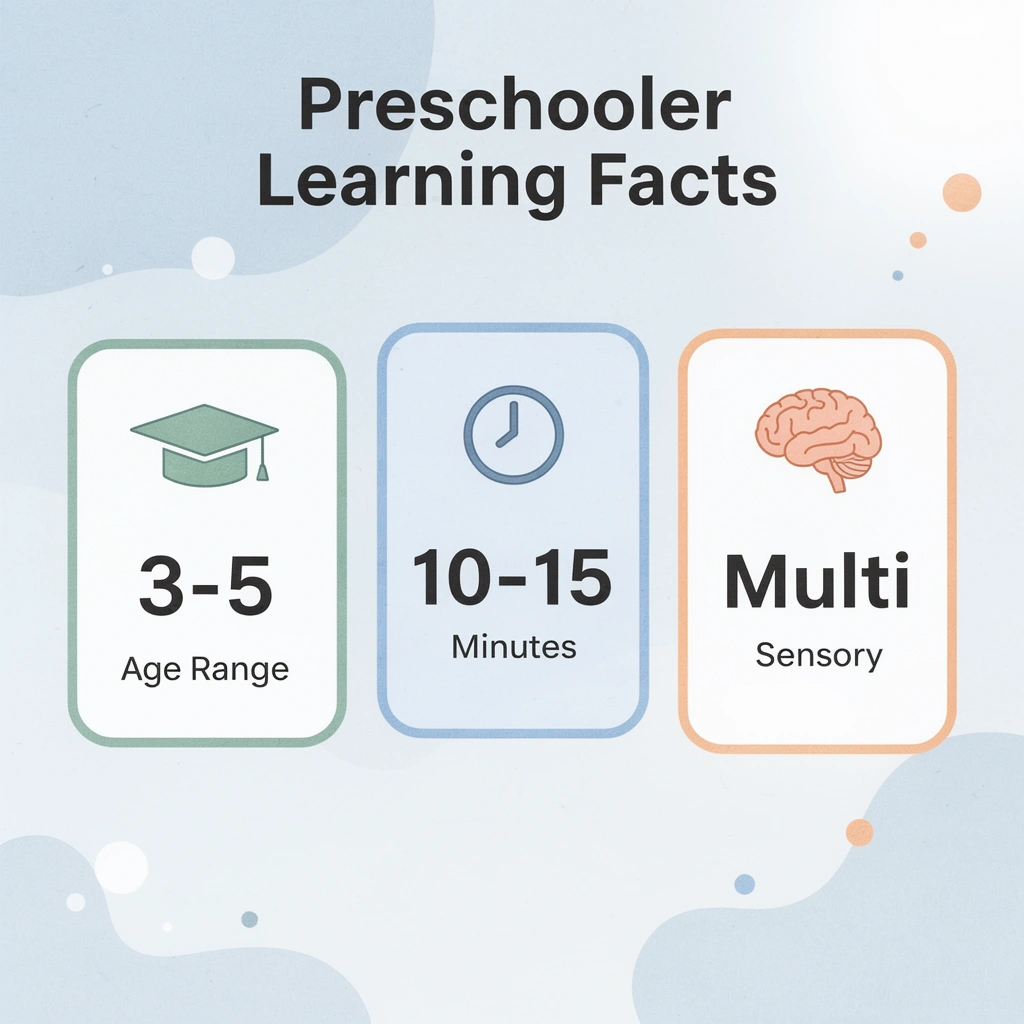
💡 Tip: Look for alternatives that combine digital elements with physical materials to create the perfect balance between technology and tactile learning for your preschooler.
1. ABCmouse
This subscription platform builds reading, maths, and science skills through step-by-step lessons for ages two through eight. It tracks mastery across 10,000 learning activities, showing which phonics sounds your child recognizes and which number concepts need practice. Children earn tickets for completing lessons and spend them in a virtual store, a motivation loop that works well for kids who resist traditional worksheets.
The main weakness is the rigid lesson sequence: children cannot skip ahead when they've mastered a skill, and the heavy screen time contradicts the hands-on learning preschoolers need for healthy development.
2. Khan Academy Kids
Stanford researchers designed this free app with adaptive features that adjust difficulty based on your child's responses. The curriculum covers early literacy, maths, logic, and social-emotional skills through interactive stories and games. Unlike ABCmouse's linear path, Khan Academy Kids lets children explore topics in any order, following curiosity rather than predetermined sequences.
The app excels at teaching letter recognition and number sense, but it cannot replace physical manipulation that cements early math concepts. Counting virtual apples on a screen builds different neural pathways than sorting actual objects into groups and feeling the weight of quantity in your hands.
3. The Good and the Beautiful (Early Learning)
This curriculum integrates reading, nature study, and character development through beautifully illustrated books and hands-on activities. Lessons cost significantly less than most preschool programs, with materials arriving as physical books. Children practice letter formation by tracing sandpaper letters, learn animal classifications by examining real leaves and insects, and develop reading skills through phonics-based stories with moral themes.
Families seeking secular content or diverse cultural perspectives find the Christian worldview limiting. The curriculum presents biblical stories as historical fact and frames character lessons through scripture rather than universal ethical principles.
4. Starfall
The free website teaches phonics through songs, animations, and interactive games that make letter-sound connections memorable. Children click on letters to hear pronunciations, then watch short animations that reinforce those sounds in context. Paid membership adds printable worksheets and additional reading passages, though core phonics instruction remains free.
Starfall works well for auditory learners who benefit from repetition and rhythm to remember abstract symbols. Visual or kinesthetic learners often need supplementary activities, as clicking through screens lacks the hands-on feedback that helps many preschoolers retain new information.
5. Time4Learning (Preschool)
This subscription delivers animated lessons across all core subjects with built-in assessments that track progress. Parents receive detailed reports showing which skills their child has mastered and which need additional practice. The structured approach appeals to families seeking clear learning objectives and measurable outcomes, rather than exploratory, play-based education.
The program assumes preschoolers can sit through 15-minute lessons focused on a single concept. Most three-year-olds need movement breaks every five to seven minutes, making the lesson length frustrating rather than engaging.
6. Outschool
Live online classes connect small groups of children with certified teachers for specialized topics like science experiments, music, storytelling, and art projects. They address the isolation many homeschool families face by providing peer connections and collaborative learning. You can build a custom schedule around your child's interests: dinosaur week, Spanish songs, watercolor painting.
The live format requires scheduling flexibility and reliable internet. If your child has a meltdown before class starts, you've paid for a session they won't attend. Costs accumulate quickly with multiple classes each week.
7. Little Passports
Subscription boxes arrive monthly with hands-on materials, activity books, and online games focused on geography, science, and cultural studies. Preschoolers explore different countries through stickers, puzzles, and simple crafts, making complex ideas accessible. Physical materials reduce screen time, while online games reinforce what the activities teach.
The monthly schedule doesn't match how preschoolers learn. Some children want to spend three weeks exploring ocean animals, while others lose interest after two days. The subscription model forces you into someone else's timeline rather than following your child's natural curiosity.
8. Homeschool Creations (Preschool Packs)
Downloadable activity packs provide themed worksheets on letters, numbers, shapes, and early science concepts. Print the pages at home to create a week's worth of activities for less than a single workbook costs. Rotating themes—farm animals, space exploration, and community helpers—maintain children's interest through variety.
How can you create custom educational materials efficiently?
Most homeschool parents spend hours creating supplementary materials for their lessons. Platforms like My Coloring Pages let you generate custom educational coloring sheets by typing simple descriptions. Need letter practice with dinosaurs or a counting page with butterflies for nature study? Our AI creates printable pages that support themed learning without searching Pinterest or teacher resource sites, freeing time for actual teaching.
9. Mother Goose Time
This subscription delivers monthly boxes with themed preschool lessons, including teacher guides, manipulatives, books, and art supplies. The curriculum focuses on sensory learning through activities such as making playdough letters, conducting home science experiments, and dramatic play scenarios that build social skills. Themes integrate all subjects; for example, a construction week includes counting tools, reading books about buildings, and block building.
The materials are complete and ready to use, so you need not spend time preparing. However, storing everything can be challenging. Twelve months of boxes require significant space. If you skip unwanted themes, you still pay for the subscription and waste that money.
10. My Coloring Pages
The AI-powered generator creates custom coloring pages and educational worksheets based on text descriptions. Type what you need: alphabet practice with animals, number tracing with vehicles, or science diagrams showing plant life cycles. Printable pages appear in seconds.
How do custom designs compare to existing templates?
There are over 100,000 existing designs covering common preschool topics, but the real value comes from creating pages that match your child's specific interests and learning goals. A child who loves fire trucks learns letter sounds more quickly when every phonics worksheet features emergency vehicles rather than generic clip art.
What determines curriculum success for preschoolers?
How often you participate in your child's learning determines whether any program succeeds. Choosing the right preschool makes that participation feel easy rather than difficult.
What you choose matters less than knowing which specific features your preschooler needs to do well.
Related Reading
- Pre K Homeschool Curriculum
- Abeka Homeschool Curriculum
- Florida Homeschool Requirements
- How To Homeschool In Texas
- 6th Grade Homeschool Curriculum
- Kentucky Homeschool Laws
- Homeschool Preschool
- Homeschool Vs Public School
- Homeschool Coop
- Georgia Homeschool Laws
- Texas Homeschool Requirements
- Homeschool Report Card Template
- Language Arts Homeschool Curriculum
- Colorado Homeschool Laws
- Homeschool Room Ideas
- Homeschool Room
- How To Homeschool Your Kids
- 1st Grade Homeschool Curriculum
Turn Homeschooling into Fun, Engaging Learning with the Right Tools for Your Preschooler
The challenge isn't finding preschool resources—it's finding ones that hold your child's attention. Random worksheets rarely connect to what you taught yesterday, so learning feels fragmented instead of building on itself. Your preschooler needs materials matching their current focus, whether letter recognition, counting, or understanding how plants grow.
🎯 Key Point: Start by identifying where your child is right now. Are they tracing letters but not yet reading words? Counting objects but confused by written numerals? That specific focus determines which resources you need this week. Choose one or two options that match your teaching style, whether that's interactive apps or physical subscription boxes.

"Most homeschool parents waste hours searching for educational materials, when targeted resources can be created in seconds with the right tools." — Educational Technology Research, 2024
Most homeschool parents waste hours searching Pinterest for worksheets. Platforms like My Coloring Pages let you generate custom educational materials in seconds by typing simple descriptions. Need phonics practice featuring dinosaurs? A counting page with butterflies to match this week's nature study? Our platform creates printable pages supporting your curriculum without requiring design experience.
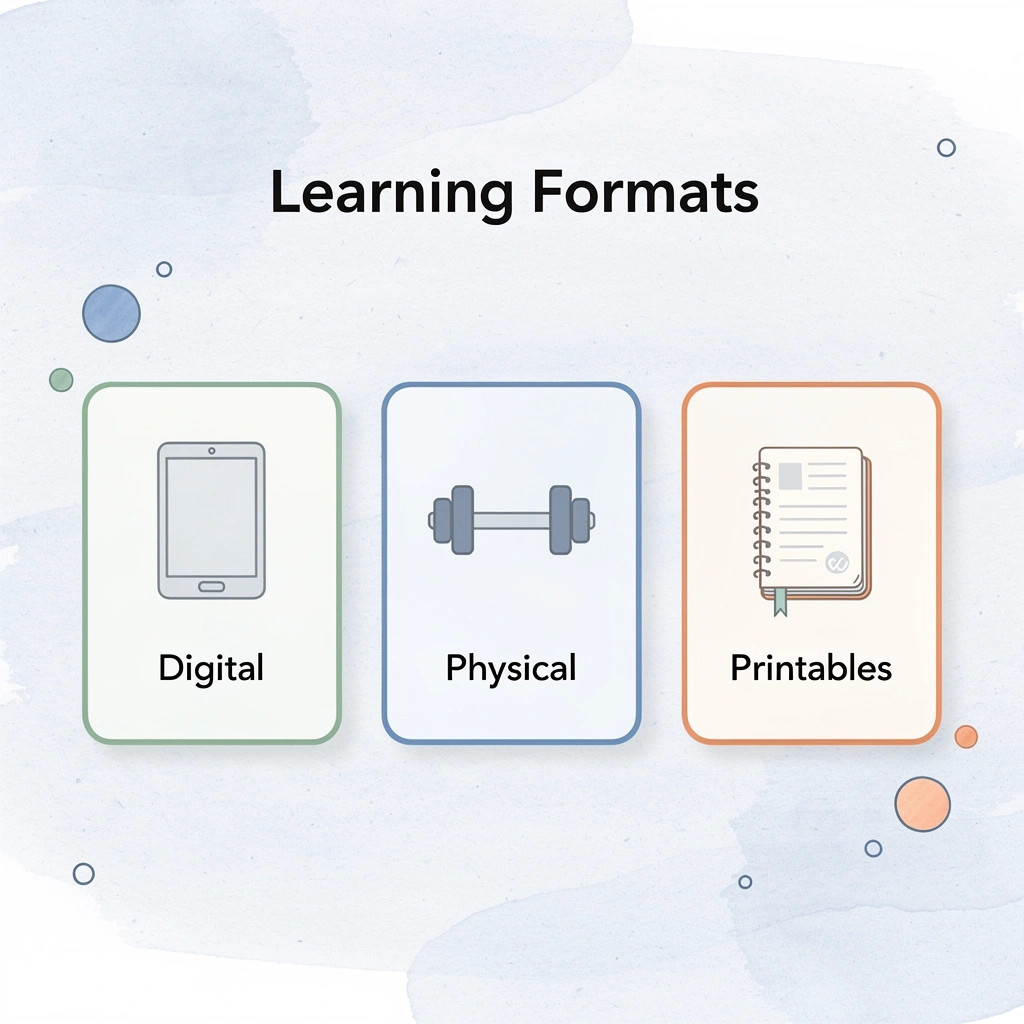
💡 Tip: Rotate your approach weekly to prevent boredom. If your child spent this week on ABCmouse, next week, use physical manipulatives from Mother Goose Time. The following week, try live classes on Outschool for social interaction. This variety maintains engagement through novelty.
⚠️ Warning: Watch what excites your child and focus more on those formats. Some preschoolers light up during songs and animations, making Starfall or Khan Academy Kids ideal for them. Others need to move their bodies and touch objects, thriving with subscription boxes that include physical materials. The curriculum that works is the one your child actually completes without constant prodding.
Related Reading
- How To Homeschool In California
- Illinois Homeschool Laws
- 5th Grade Homeschool Curriculum
- Georgia Homeschool Requirements
- 2nd Grade Homeschool Curriculum
- Alabama Homeschool Laws
- Homeschool Reading Curriculum
- California Homeschool Laws
- Accredited Homeschool Curriculum
- 3rd Grade Homeschool Curriculum
- North Carolina Homeschool Laws
- 4th Grade Homeschool Curriculum
- Science Homeschool Curriculum
- Homeschool Art Curriculum
- Michigan Homeschool Laws