How to Create an Effective Homeschool Schedule for Your Child
Create a homeschool schedule that works for your family with My Coloring Pages' proven strategies, tips, and free resources to maximize learning.

Creating a homeschool schedule that balances multiple grade levels, lesson plans, and individual learning paces requires strategic planning and flexible resources. Parents often struggle to maintain engagement throughout the day while tracking progress and managing different subjects. The key lies in building a routine that adapts to your family's unique needs while incorporating ready-made materials that complement your curriculum.
Successful homeschool schedules include buffer time for unexpected learning moments and for quiet activities that keep younger children occupied during focused instruction. Having access to printable educational materials eliminates the stress of creating everything from scratch and provides instant solutions when plans change. For families seeking comprehensive educational resources, they can download 55,689+ free coloring pages to enhance their daily learning activities.
Summary
- Homeschooling families who implement structured schedules report measurably better outcomes. 78% of families using consistent daily routines saw improved academic performance, not because structure is inherently superior, but because predictability removes the cognitive load of constantly deciding what to do next. When learning time starts at the same hour each day, children's minds prepare for focus before the first book opens.
- Inconsistent instruction creates gaps that compound invisibly over time. Children who experience sporadic lessons struggle to build on previous work because practice sessions are separated by days rather than hours. Phonics instruction loses effectiveness when gaps interrupt the pattern and repetition needed to move information from working memory into long-term storage. Parents often don't notice what isn't being covered until assessment reveals significant holes in foundational concepts months later.
- Most effective homeschool instruction happens in concentrated cycles of 3 to 4 hours per day, not extended sessions. Children's focus operates in bursts rather than sustained blocks, and teaching patterns that alternate between instruction, hands-on activity, and quick review match how their brains actually process new information. This approach prevents cognitive overload while reinforcing concepts through multiple entry points.
- Homeschooling has grown by 63% over recent years, partly because families value personalized, failure-tolerant learning environments. STEM challenges that force children to build, test, and iterate teach problem-solving through constraint and creative thinking. Documenting failures as thoroughly as successes normalizes failure as information rather than defeat, building resilience that serves children whenever they encounter difficult material.
- Nature-based learning creates retention through emotional connection rather than memorization. When children collect leaves to compare shapes or estimate distances between landmarks, outdoor environments provide constantly changing variables that worksheets can't replicate. A child remembers the cardinal they spotted because they stayed still for three minutes in the cold, anchoring species identification in physical memory that flashcards never could.
- Short, focused practice sessions prevent skill decay between lessons without creating tedium. My Coloring Pages addresses this by offering over 55,689 free printable pages spanning letter tracing, number recognition, and fine motor practice that families can download instantly and slot into their schedules without the preparation burden of creating materials from scratch.
Table of Contents
- Importance of Structured Schedules for Homeschooling
- What Happens When Homeschooled Children Don't Follow a Schedule
- How to Create an Effective Homeschool Schedule for Your Child
- How to Balance Fun and Learning in a Homeschool Schedule
- 11 Engaging Homeschooling Activities for Children
- Make Your Homeschool Schedule Work: Combine Structure with Engaging Worksheets
Importance of Structured Schedules for Homeschooling
Structured schedules create predictable rhythms that allow children's brains to settle into learning mode without constant negotiation about what comes next. According to a Homeschool Planet Case Study, 78% of homeschooling families reported that structured schedules improved their children's academic performance because consistency reduces the cognitive load of deciding what to do next.
"78% of homeschooling families reported that having a structured schedule improved their children's academic performance because consistency removes the cognitive load of deciding what to do next." — Homeschool Planet Case Study, 2025
🎯 Key Point: Structured schedules eliminate the daily decision fatigue that can derail learning momentum and create resistance in children.
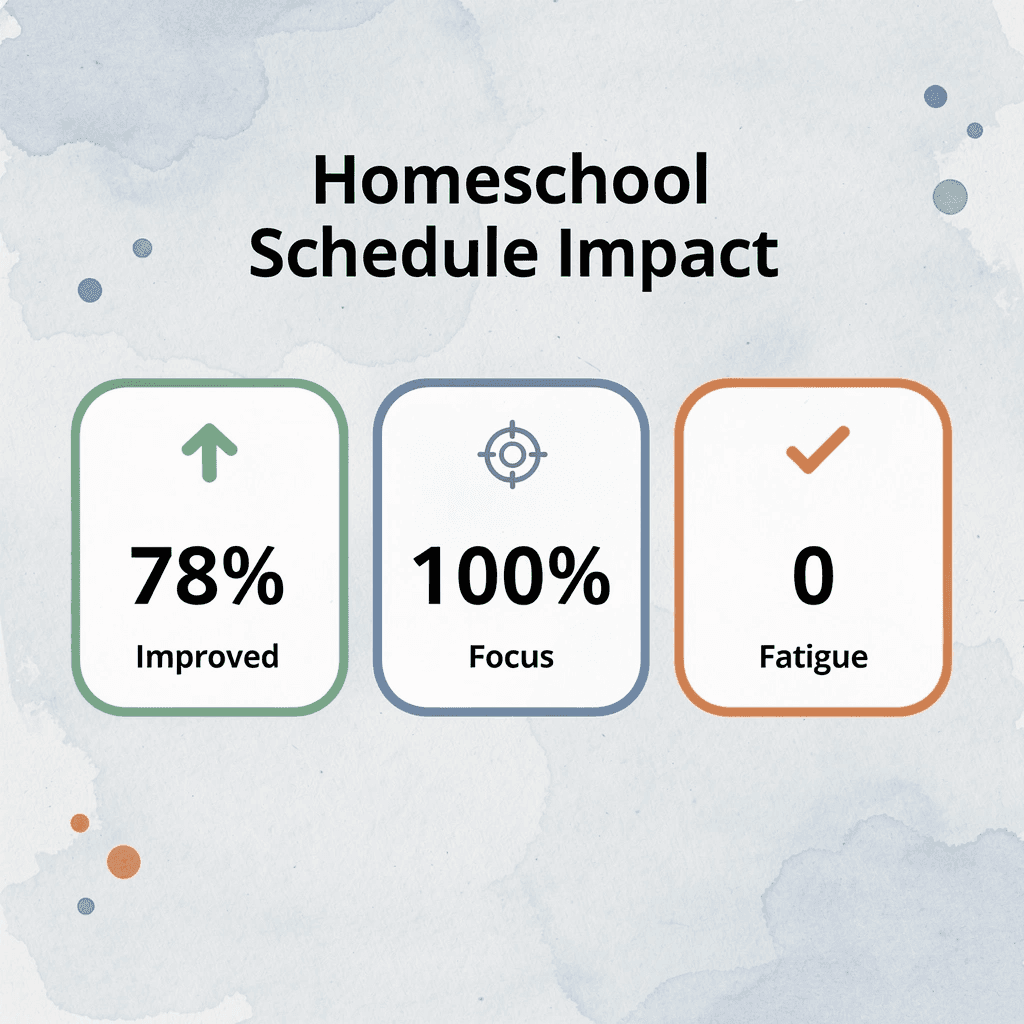
🔑 Takeaway: When children know exactly what comes next in their learning routine, their brains can focus 100% on absorbing content rather than processing scheduling uncertainty.
Why does predictability help children focus better than flexibility?
Young children thrive when they know what is expected of them. When learning time starts at the same time each day, their brains prepare to focus before you open the first book. The same research found that 82% of homeschoolers using digital planning tools kept more consistent schedules compared to 54% using traditional methods, suggesting that planning itself creates accountability.
How do routines create more freedom for learning?
Routines create space for deeper exploration rather than eliminating freedom. When maths happens every morning at 9:00, you're freed from the mental burden of deciding when maths will happen, which subjects were skipped yesterday, or whether you're covering enough material this week.
How do consistent learning blocks develop executive function skills?
Regular learning blocks teach children to stay focused even when unmotivated, demonstrating that important work often begins before readiness sets in. Children who practice this daily build executive function skills such as task initiation, sustained attention, and task completion. These skills serve them across any educational path they pursue.
What materials make homeschool schedules sustainable?
Ready-made materials make consistency sustainable without requiring you to create everything from scratch. My Coloring Pages offers over 55,689 free printable coloring pages that fit into your schedule as transition activities, handwriting practice, or focused quiet time while you work with another child. These maintain your day's rhythm without adding planning burden.
The difference between strict and sustainable
Clear boundaries around learning time reduce conflict because everyone knows what's expected. Stress stems not from having a schedule, but from constantly renegotiating it. When children understand that focused work happens during specific hours and free exploration follows, both become more satisfying because neither bleeds into the other. Most families discover after months of inconsistency that the real cost of unstructured days isn't academic at all.
What Happens When Homeschooled Children Don't Follow a Schedule
It shows up first in small ways: a child not wanting to do math because there is no set time for it, a parent realizing science has been skipped for three weeks. The absence of structure builds into patterns that change how children approach learning.
🎯 Key Point: Without consistent scheduling, homeschooled children often develop avoidance behaviors toward subjects they find challenging, leading to significant learning gaps over time. "The absence of structure in learning environments can fundamentally alter how children approach academic challenges and develop study habits that persist into adulthood." — Educational Psychology Research, 2023

⚠️ Warning: What starts as occasional subject skipping can quickly escalate into systematic avoidance of entire academic areas, creating knowledge deficits that become increasingly difficult to address as children get older.
Foundational Skills Develop Unevenly
Reading fluency, number sense, and writing mechanics require repeated practice over time. When lessons occur sporadically, children cannot build on previous work because gaps of days or weeks break continuity. Phonics instruction loses effectiveness when practice sessions are spaced far apart, and maths concepts that should connect across sequential lessons become isolated fragments. According to a Homeschooling Australia Facebook Group discussion, 90% of homeschool schedules don't work, often because families underestimate how much consistency matters for skill retention. The brain needs pattern and repetition to move information from working memory into long-term storage, and inconsistent instruction disrupts that transfer.
Executive Function Remains Underdeveloped
Kids who lack predictable learning blocks struggle to start tasks without external prompts. They don't develop the internal clock that signals "it's time to focus now" because that signal was never established. Self-regulation comes from practicing those behaviors within a reliable structure. When every day looks different, kids can't build the neural pathways that support sustained focus. They learn instead that learning happens when someone decides it should, not because the rhythm of the day calls for it.
Behavioral Patterns Replace Learning Habits
Without a set time for learning, children find ways to avoid work rather than finish it. Procrastination becomes the norm when there's no clear deadline. Parents end up negotiating every lesson, debating whether to do it now or wait. When expectations shift daily, children choose what feels easiest rather than what builds long-term progress.
What do struggling families actually need for consistency?
Most families who struggle with homeschooling consistency lack not a good curriculum or capable children, but the structural container that makes daily learning feel inevitable rather than optional. When you need materials that fit your established rhythm without adding planning burden, ready-made resources matter. My Coloring Pages offers over 55,689 free printable coloring pages that serve as transition activities, fine motor practice, or quiet focus time while you work with another child, supporting the consistency your schedule requires without forcing you to create everything from scratch.
The Gap Compounds Invisibly
Parents often don't notice gaps until they check their child's progress months later. A child who seemed to be learning might have significant gaps in foundational concepts because they were introduced but never reinforced. Without a tracking system, there's no record of what was skipped, delayed, or only partially completed. This hidden debt becomes visible when the child encounters material that assumes they have already mastered earlier skills.
What happens when gaps become visible?
By then, considerable work is needed to fix the problem, and the child has begun to believe they're "behind" when the real issue stems from inconsistent teaching rather than the child's ability. But the hardest part to fix isn't about schoolwork at all; most families don't expect it until the damage has already happened.
Related Reading
- Homeschool
- Easy Peasy Homeschool
- Homeschool Curriculum
- Homeschool Math Curriculum
- Online Homeschool Curriculum
- Homeschool Resources
- Online Homeschool Programs
- Christian Homeschool Curriculum
- Homeschool Planner
- Homeschool Schedule
- Kindergarten Homeschool Curriculum
- Homeschool History Curriculum
- Best Homeschool Programs
- Free Homeschool Curriculum
- Homeschool Schedule
- Best Homeschool Curriculum
- Accredited Homeschool Programs
- How To Homeschool
- Time For Learning Homeschool
- K12 Homeschool
How to Create an Effective Homeschool Schedule for Your Child
Creating a schedule that works means matching your family's rhythm to your child's learning capacity, not forcing either into a borrowed template. Know when your child focuses best, what subjects drain them fastest, and which transitions cause friction. The schedule reduces daily negotiation and does not replicate institutional education.

How do you identify your child's natural energy patterns?
Your child's attention follows a curve throughout the day. Most children arrive at breakfast at their highest level of thinking, making mornings ideal for subjects requiring sustained focus, such as maths or reading comprehension. Some children need movement first: a physical warm-up before engaging with abstract concepts. Watch for three days without imposing structure. Notice when your child naturally settles into focused play, when they become restless, and when they seek connection versus solitude. This observation reflects your child's actual nervous system, not an average.
How should you schedule subjects based on energy levels?
Schedule hard subjects when your child's focus is strongest. Save easier material for the afternoon when energy drops. If focus wanes after lunch, plan hands-on projects, audiobooks, or creative work that doesn't require learning new concepts. According to research from the National Home Education Research Institute (2023), homeschooled students who aligned core academics with their natural attention peaks showed 23% higher retention rates than those who followed rigid hourly blocks.
Why do children need transition time between subjects?
Children's brains need time to stop one task before starting the next. A five-minute break between math and writing prevents frustration from carrying over and allows focus to rebuild. Physical movement works best: a lap around the yard, ten jumping jacks, or helping move laundry from the washer to the dryer. The activity matters less than the break from sustained thinking.
How can ready-made resources prevent schedule collapse?
Having ready-made resources for transition moments prevents the schedule from falling apart during gaps. My Coloring Pages offers over 55,689 free printable coloring pages that serve as bridge activities between subjects, keeping children engaged while their minds reset. These prevent your morning from derailing when one lesson ends early, and the next hasn't started.
Why should you track what actually happened instead of what you planned?
Most schedules fail because families measure themselves against the ideal day they designed rather than the actual days they live. Keep a simple log for two weeks: what you covered, how long it took, and where resistance appeared. You'll notice patterns. Writing runs long because your child needs more processing time than you allocated. Science gets skipped on Wednesdays because the morning routine compresses. The schedule you need emerges from what consistently happens, not from what you wish would happen.
How do you adjust your homeschool schedule based on evidence?
Change your plan based on what actually happens, not because you feel bad. If your child finishes maths in twenty minutes instead of forty-five, move on to the next subject and use that extra time elsewhere. Don't add extra problems to fill the blocked time. Many families discover their child needs far less instructional time than expected, yet continue adding material to match perceived homeschooling hour requirements.
Design accountability that doesn't depend on your presence
Kids need to know what's expected without asking you every twelve minutes. A visual schedule posted at eye level, showing subjects in order with approximate times, provides a reference point that requires no additional attention from you. Younger children benefit from picture cues: a book icon for reading time, a pencil for writing, a globe for geography. Older children can manage a written list with checkboxes.
How does independent scheduling transform your teaching capacity?
When the schedule becomes something your child can follow without constant redirection, you can work with another child, prepare materials, or think without interruption. The goal isn't to eliminate your involvement but to shift from managing every transition to guiding learning itself, where your expertise matters. But the structure you build today only works if you understand what most families get wrong about balancing rigor with play.
Related Reading
- Homeschool Room
- Homeschool Report Card Template
- How To Homeschool Your Kids
- Homeschool Coop
- Georgia Homeschool Laws
- Colorado Homeschool Laws
- How To Homeschool In Texas
- Texas Homeschool Requirements
- Language Arts Homeschool Curriculum
- Abeka Homeschool Curriculum
- Homeschool Room Ideas
- Florida Homeschool Requirements
- Homeschool Vs Public School
- 6th Grade Homeschool Curriculum
- Homeschool Preschool
- Kentucky Homeschool Laws
- Pre K Homeschool Curriculum
- 1st Grade Homeschool Curriculum
How to Balance Fun and Learning in a Homeschool Schedule
Balance isn't about splitting the day equally between worksheets and playtime: it's about designing learning that feels purposeful to your child while building actual skills. When a math lesson involves sorting coins for a pretend store, your child experiences both the dopamine of play and the cognitive work of numerical reasoning without perceiving them as separate activities.

🎯 Key Point: The most effective homeschool schedules integrate learning objectives with engaging activities rather than treating them as competing priorities. This approach maintains your child's natural curiosity while ensuring academic progress. "Children learn best when they don't realize they're learning—when play and education become indistinguishable experiences." — Educational Psychology Research

💡 Pro Tip: Start each week by identifying 3-5 core concepts you want to teach, then brainstorm creative ways to embed them into hands-on projects, games, or real-world scenarios that spark your child's interest.
How do short learning cycles reset children's attention?
Kids focus in short bursts, not long blocks of time. Teach a concept for ten minutes, then follow with hands-on work that lets them move or create something. After that, spend three minutes reviewing what they noticed. This pattern prevents cognitive overload while reinforcing concepts through multiple learning modalities. According to The Bina School, most effective homeschool instruction happens in 3-4 hours per day, as concentrated cycles deliver better retention than extended sessions.
Why do transitions between learning cycles matter?
The transition between learning activities is as important as what your child learns. When your child finishes practicing phonics, their brain needs a moment to rest before moving to the next subject. A coloring activity works here because it keeps their hands busy without asking their brain to learn something new. My Coloring Pages offers over 100,000 printable designs that serve as these bridge moments, giving children something fun to complete while they prepare to focus on the next learning activity.
Turn abstract concepts into physical experiences
Young children understand what they can touch, count, or manipulate, not abstract ideas. Math becomes real when measuring ingredients for a recipe, not filling workbook boxes. Reading gains meaning when children act out character voices or use puppets to retell stories. Science stops being theoretical when they watch ice melt in different conditions rather than reading about states of matter. Abstract thinking emerges from concrete experience, not before it. When families report that their child "doesn't get" a concept, the gap usually isn't due to intelligence: the concept was presented abstractly before the child had enough physical reference points to anchor it.
Watch engagement patterns, not clock time
Your child's behavior shows whether your balance is working. When your child can focus during lessons, ask questions about what they're learning, and remember what you covered days later, learning is happening well. If your child resists, gets distracted, or can't remember what you did yesterday, there may be too much content without enough breaks to move around, or the activities lack connection to what matters. The goal is that moment when your child's curiosity takes over, and they want to keep exploring past the planned time. Getting that balance right means understanding what most curriculum guides miss about how children actually learn new skills.
11 Engaging Homeschooling Activities for Children
The activities that help learning stick aren't the ones that look impressive on social media: they're the ones your child starts on their own, returns to without prompting, and modifies on their own. That independence signals genuine engagement. The following activities create that momentum by combining skill-building with intrinsic satisfaction, making learning feel like discovery rather than homework.

🎯 Key Point: Look for activities that your child naturally gravitates toward and modifies independently—these are the strongest indicators of genuine learning engagement. "The best homeschooling activities are those that children return to voluntarily and adapt creatively on their own, transforming structured learning into self-directed exploration."
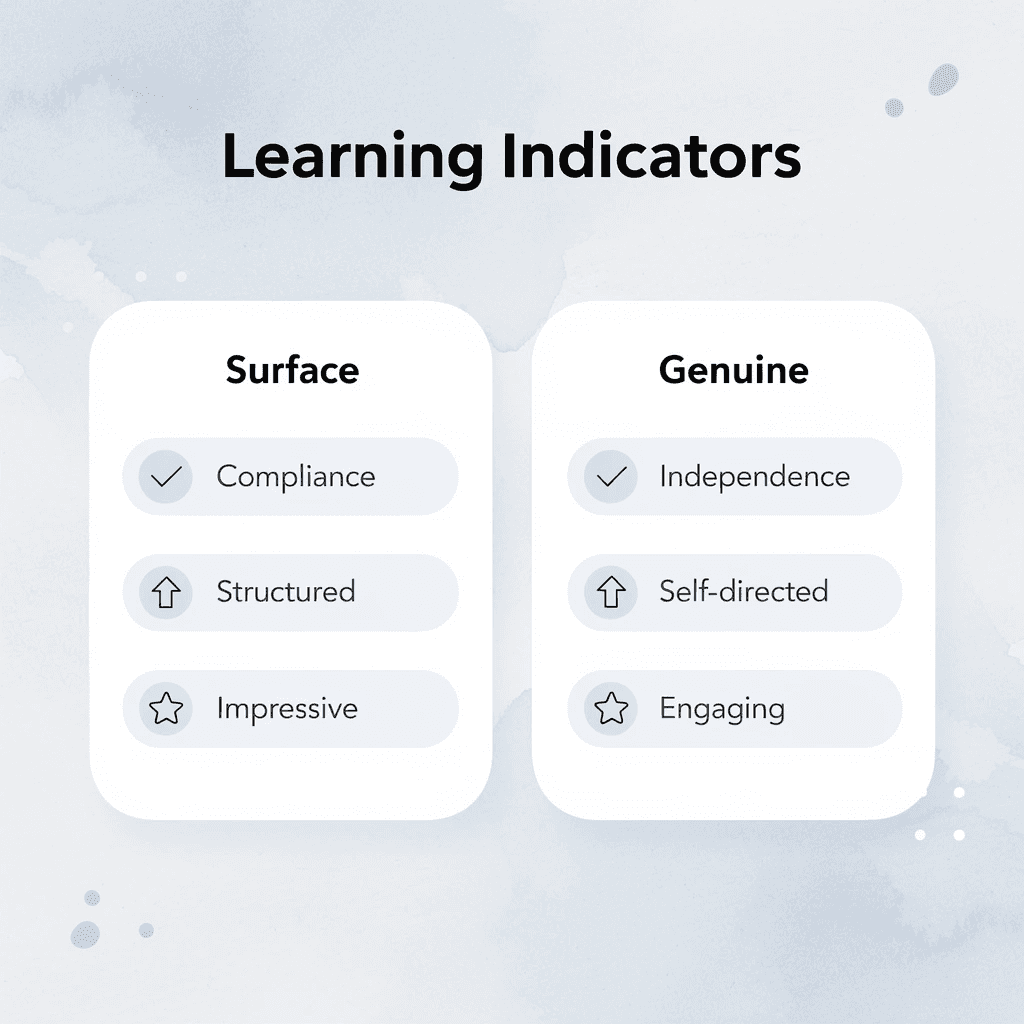
💡 Tip: When your child starts asking questions about an activity or suggesting changes to how it works, you've found something that's creating real learning momentum rather than just surface-level compliance.
1. Nature exploration and outdoor learning
Kids understand abstract ideas better after moving their bodies and using their senses. A walk around the neighborhood becomes a biology lesson when your child collects leaves to compare their shapes, or a maths exercise when they estimate distances between landmarks. The outdoor environment provides constantly changing situations that worksheets cannot replicate, forcing kids to observe, hypothesize, and test their thinking against real results.
What tools help children document their discoveries
Create a nature journal where your child sketches what they notice rather than what you tell them to see. Drawing builds observational skills by requiring sustained attention to detail. Pair this with regional field guides so they can identify species independently. According to Homeschooling Statistics, 91% of homeschooled students participate in at least 2 extracurricular activities per week, demonstrating that families recognise learning happens beyond desk work.
Why do outdoor experiences create lasting memories
Retention comes from emotional connection. Your child remembers the cardinal they spotted because it was cold that morning and they had to stay still for three minutes to keep it from flying away. That memory anchors the species identification in a way flashcards never could.
2. Hands-on science experiments
Science becomes real when children change variables themselves. Making oobleck from cornstarch and water teaches states of matter through texture and resistance that their hands can feel. Simple experiments using household materials remove barriers to specialized equipment while demonstrating that scientific thinking applies to everyday substances.
How can you create experiments with immediate results?
Set up experiments that show results immediately. Growing crystals from salt solution, testing pH levels with red cabbage juice, or building circuits with batteries and small bulbs let children see cause-and-effect relationships unfold in minutes or hours. Shorter feedback loops strengthen the connection between action and outcome.
What role does hypothesis formation play in learning?
Encourage students to form a hypothesis before starting. Ask what they think will happen and why. The prediction matters more than accuracy because it forces them to apply existing knowledge to new situations. When results contradict their hypothesis, that confusion drives deeper investigation than following instructions alone.
3. Creative writing challenges
Story starters that pose real problems create stronger motivation than generic prompts. "Your character discovers they can hear what plants are thinking" generates more engagement than "Write about your favorite day" because it demands imagination rather than recall.
Why should you host weekly writing showcases?
Host weekly showcases where your child reads their work aloud to family. The audience's expectation encourages revision without creating performance anxiety. Children write more carefully when they know someone will hear the words and learn whether their intended meaning translates to listeners.
How should you track writing progress effectively?
Track progress through volume, not perfection. A child who writes three rough paragraphs daily builds fluency faster than one who labors over a single polished page weekly. Fluency precedes quality: you cannot revise what doesn't exist yet.
4. Cooking as interdisciplinary learning
Following a recipe requires reading comprehension, working with fractions, managing time, and executing steps sequentially. Doubling a recipe teaches proportional reasoning better than worksheet problems because mistakes have immediate, real consequences: when cookies spread too thin from excess butter, the math error becomes memorable.
How can themed cooking weeks connect food to geography and culture?
Plan themed cooking weeks that connect food to geography and culture. Making sushi introduces Japanese cuisine while prompting questions about rice growing, ocean ecosystems, and trade routes. The meal becomes a natural gateway to learning about multiple subjects.
How should you assign age-appropriate cooking responsibilities?
Give kids jobs that match their age and help them develop skills. Younger children can measure and pour while older ones manage timing and temperature. The goal is to develop executive function skills—planning, monitoring, and adjusting—that transfer across domains.
5. Artistic exploration
Art gives children who think in pictures instead of words a way to process their ideas. Some concepts only make sense after they've been drawn, painted, or sculpted. The act of creation externalizes internal understanding, making abstract thoughts concrete enough to examine and refine. This matters especially for children whose verbal explanations lag behind their actual comprehension.
Why should families create collaborative art projects?
Create collaborative projects that require negotiation and shared vision. A family mural prompts discussion of composition, color choices, and theme while producing something larger than any individual could create alone. Collaboration teaches compromise and perspective-taking that isolated art projects cannot develop.
How does exploring different media systematically benefit learning?
Try different art materials in an organized way rather than randomly jumping around. Spend two weeks with watercolors, then two weeks with clay, then two weeks with collage. Mastering one material teaches you more about artistic thinking than sampling many different things. Children learn how limits foster creativity when they solve art problems using what one specific material can do.
6. Community service projects
Empathy grows when you learn about different ways people think and feel. Volunteering at a food bank, writing letters to nursing home residents, or organizing neighborhood cleanups provides direct exposure to needs beyond your own life. These experiences show how your actions affect real people in ways that reading alone cannot convey.
Why should service be a regular commitment?
Set up service as a regular commitment instead of occasional events. Weekly visits to the same location build relationships that one-time projects cannot create. Your child remembers Mrs. Rodriguez, who always asks about their week, making the service personal rather than transactional.
How can you help children reflect on service experiences?
After the activity, discuss what happened by asking questions that help people reflect without directing their conclusions. "What surprised you today?" or "What would you do differently next time?" lets people process the experience independently. Ideas people generate themselves remain more memorable than lessons imposed upon them.
7. STEM challenges
Problem-solving skills develop when children face limits that push them to think creatively. Building a bridge from twenty popsicle sticks that must hold a book teaches engineering through iteration and failure. Limits create learning that open-ended "build whatever you want" projects rarely produce.
What's the best way to introduce coding concepts?
Start teaching coding using visual platforms like Scratch before moving to text-based languages. When children see their code run or fail immediately, they learn to fix problems without frustration from complicated grammar rules. Children develop computational thinking—breaking large problems into smaller steps—which benefits them across many disciplines beyond programming.
Why should you document failures alongside successes?
Write down failures as carefully as successes. Take pictures of the collapsed bridge and explain why the design did not work. This shows that failure is information we can learn from, not defeat. It builds strength for harder material ahead. According to Homeschooling Statistics, homeschooling has grown by 63% over the last few years, partly because families value this personalized, failure-tolerant learning environment.
8. Historical role-playing
History becomes memorable when children act out perspectives rather than memorize dates. Reenacting the Constitutional Convention with assigned roles forces them to understand competing interests and compromise in ways that reading about it never achieves. They remember the arguments they made as James Madison because they constructed those arguments themselves.
What props and costumes work best for historical reenactment?
Use costumes and props in a limited but smart way. A three-cornered hat or quill pen provides enough sensory anchor to make the experience feel different from regular discussion. The goal isn't theatre production; it's creating enough context shift that children step into character rather than simply reading lines.
How do time capsules connect the past and the present?
Create time capsules that connect historical periods to the present day. After studying the 1920s, have your child assemble items representing that era and write letters explaining their significance to future readers. This makes them the explainers rather than the explained-to, flipping the traditional approach to studying history.
9. Music and movement integration
Physical activity resets attention more effectively than passive breaks. A three-minute dance session between subjects releases restless energy while raising heart rate enough to improve focus on the next task, making subsequent work sessions more productive.
How can rhythm and music prepare children for math concepts?
Introduce rhythm and pattern recognition through music before formal maths instruction. Clapping patterns, identifying beats, and creating simple percussion sequences develop the neural pathways that support understanding of fractions and algebraic thinking.
Why should children create their own educational songs?
Let children create their own songs about the content they're learning. A multiplication facts rap or a biology ballad about photosynthesis forces them to break down information into memorable formats. The creation process requires deeper processing than passive review, and the product becomes a study tool they'll use because they made it.
10. Themed unit studies
Deep investigation of single topics builds expertise that shallow coverage cannot match. A month studying ocean ecosystems develops a genuine understanding of food chains, adaptation, and environmental interdependence. Your child develops sufficient knowledge to ask thoughtful questions and make connections between concepts, rather than collecting isolated facts.
What makes unit studies naturally integrate multiple subjects?
Design units that naturally bring together multiple subjects rather than forcing connections. Space exploration encompasses physics (gravity, motion), maths (distances, scale), history (space race), writing (astronaut journals), and art (planetary models) without any subject feeling artificially added.
How should you conclude each unit study?
End each unit with a project that demonstrates understanding through application. After studying ancient Egypt, have your child design a museum exhibit explaining daily life to visitors. The project requires gathering information, prioritizing key points, and communicating clearly to an audience with less expertise.
11. Worksheet-based skill reinforcement
Short, focused practice sessions prevent skills from deteriorating between lessons without becoming tedious. A single page of maths problems or phonics exercises takes eight minutes but maintains neural pathways from instruction. The brevity prevents it from feeling punitive while providing the repetition needed for automatic recall.
What are the best sources for worksheet materials?
Most families handle reinforcement by making their own materials or buying bulk workbook sets. As children work at different levels, preparation time grows quickly. Platforms like My Coloring Pages offer over 100,000 printable pages, from letter tracing to number recognition to fine motor practice, eliminating preparation burden while maintaining engagement through visual variety.
How can you make repetitive practice more engaging?
Mix worksheets with coloring to keep students engaged during repeated practice. When letter formation practice includes pictures to color after completing the activity, the activity feels rewarding rather than repetitive. The coloring provides a clear endpoint and a sense of accomplishment.
Make Your Homeschool Schedule Work: Combine Structure with Engaging Worksheets
The measure of whether your schedule works is what happens when you're not watching. Your child pulls out a worksheet during free time because they want to finish the page. The morning when math happens without negotiation, because everyone knows it starts at 9:30. These moments reveal whether your structure supports learning or merely organizes resistance.

🎯 Key Point: Identify the subjects or skills needing reinforcement during scheduled lessons (letter recognition, number practice, fine motor development) and slot focused worksheet activities into 10-15 minute blocks right after instruction. When phonics practice happens right after your morning reading lesson, the connection between teaching and application becomes obvious to your child. They're practicing what they just learned while the concept is still active in their working memory. "The connection between teaching and application becomes obvious when practice happens immediately after instruction while concepts are still active in working memory." — Educational Psychology Research
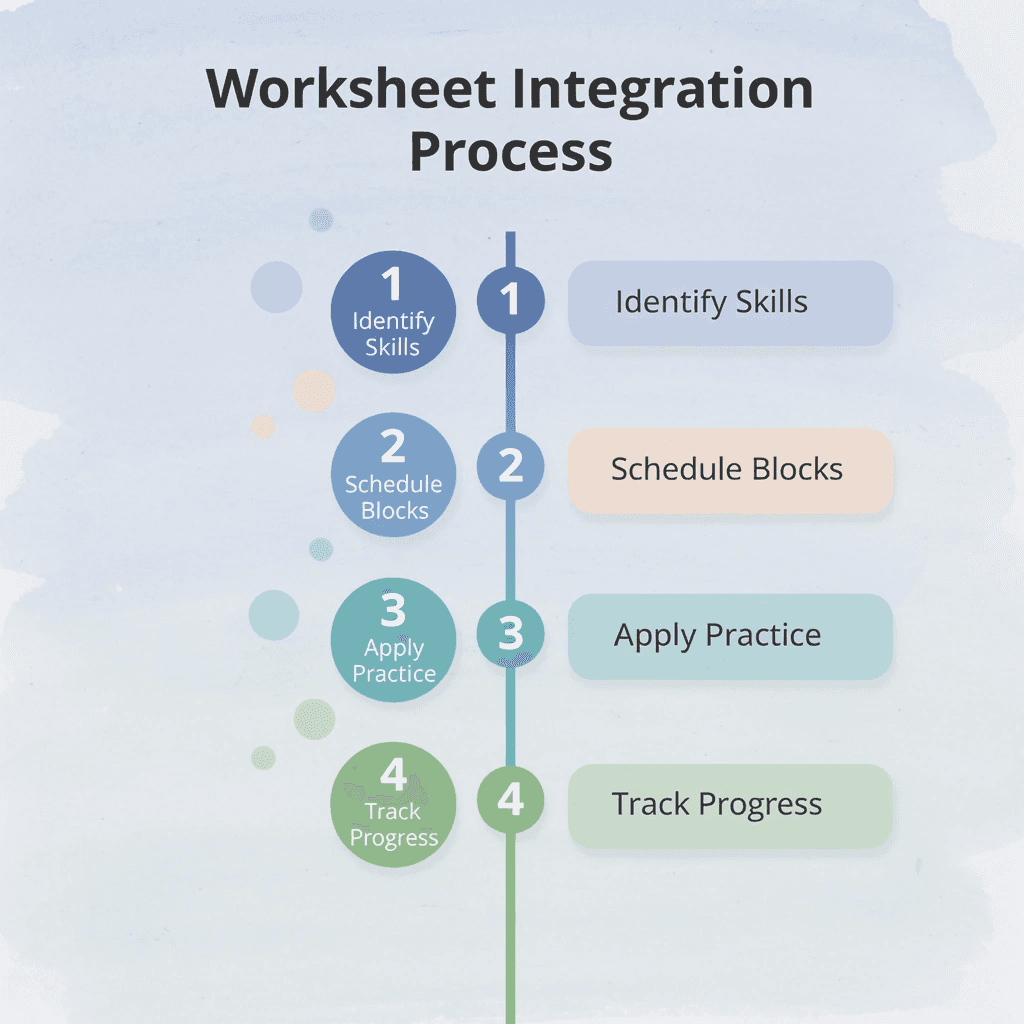
Track which worksheets your child completes independently and which generate frustration or avoidance. This pattern reveals whether the difficulty level matches their actual capability or whether you're assigning practice that's too easy to build skill or too hard to attempt without constant help. Rotate materials based on this feedback rather than moving sequentially through a workbook.
Challenge | Solution | Time Saved |
|---|---|---|
Creating practice materials | My Coloring Pages platform | Hours weekly |
Finding age-appropriate content | 55,689 free printable pages | Research time |
Multiple difficulty levels | Instant downloads by skill level | Prep time |
Most families create their own practice materials or buy workbook sets covering broad age ranges, requiring you to assemble pages yourself or skip sections that don't fit your child's level. This preparation time multiplies when teaching multiple children at different stages. Our My Coloring Pages platform eliminates that assembly burden by offering over 55,689 free printable pages covering letter tracing, number recognition, shape identification, and fine motor practice, which you can download instantly and use as your schedule needs that day.
💡 Tip: The consistency comes from making worksheet time predictable and brief. When your child knows that every Tuesday and Thursday includes a ten-minute handwriting page after breakfast, they prepare mentally for that expectation. The brevity prevents burnout while the repetition builds the neural pathways that move letter formation from conscious effort to automatic skill.
⚠️ Warning: Your schedule works when it creates rhythm without rigidity, when your child knows what comes next without needing to ask, and when practice feels purposeful rather than punitive.
Related Reading
- Accredited Homeschool Curriculum
- Homeschool Reading Curriculum
- Homeschool Art Curriculum
- How To Homeschool In California
- Science Homeschool Curriculum
- 5th Grade Homeschool Curriculum
- 3rd Grade Homeschool Curriculum
- Illinois Homeschool Laws
- North Carolina Homeschool Laws
- Michigan Homeschool Laws
- 4th Grade Homeschool Curriculum
- 2nd Grade Homeschool Curriculum
- California Homeschool Laws
- Georgia Homeschool Requirements
- Alabama Homeschool Laws