10 Customizable Letter A Worksheets for Preschoolers
Letter A Worksheets Preschool collection from My Coloring Pages. 10 free printable activities to teach letter recognition and writing skills.

Teaching the alphabet begins with the letter A for most preschoolers, making letter A worksheets essential tools for preschool teachers and parents to build recognition and early writing skills. Quality resources and preschool activities that match a child's learning pace while maintaining engagement can transform how young learners approach education. The key lies in finding materials that balance educational value with genuine fun.
Access to diverse, well-designed materials makes all the difference in early alphabet instruction. Whether children need tracing exercises, letter recognition activities, or creative sheets featuring apples and alligators, the right resources make letter learning an adventure that young learners eagerly embrace. Download free 51,780+ coloring pages designed specifically for preschoolers as they discover their ABCs.
Summary
- Children who recognize letters before kindergarten are two to three times more likely to read at grade level by age seven, and that advantage persists throughout their academic careers. The National Early Literacy Panel found that letter knowledge predicts later reading ability more powerfully than IQ or family income in the early years, making early alphabet exposure a critical intervention point for closing achievement gaps before they widen.
- Most toddlers begin to recognize a few letters around age two, especially those in their own name, with the recitation of the ABC song typically developing before children connect each letter to its shape or sound. By age three, many children can recognize about half the letters in the alphabet, while letter writing typically develops between ages four and five through structured practice and muscle memory development.
- Teaching high-frequency letters paired with familiar words (A with "apple" and "ant") reduces cognitive load and builds early confidence more effectively than sequential A-to-Z instruction. Children who see letters embedded in daily contexts (snack time, bedtime routines, grocery store signs) internalize them more quickly because the associations carry emotional weight and sensory memory, rather than feeling like isolated academic exercises.
- Effective worksheets focus on one learning goal per page, use letter sizes that match current motor skill development (at least two inches tall for beginners), and include tracing guides with arrows and start points that teach proper stroke formation from the beginning. Strategic repetition of six to ten rows builds automaticity without creating the monotony that triggers resistance, while intentional visuals reinforce phonetic connections without competing for attention.
- Personalization drives engagement more powerfully than generic curriculum materials, with children showing stronger ownership over tasks that feature their names or current interests. Rotating between different activity types (tracing, coloring, matching, letter hunts) prevents boredom and engages multiple cognitive pathways, improving retention because each format activates different aspects of learning.
- My Coloring Pages addresses the gap between knowing what effective worksheets require and having the time or skills to create them, allowing families to download 51,780+ free coloring pages and generate customized letter-learning materials in seconds, without design experience or costly resources.
Importance of Learning the Alphabet for Preschoolers
Why Early Alphabet Knowledge Matters More Than You Think
Learning the alphabet is the foundation that determines whether a child enters kindergarten ready to read or already behind. According to the IES National Center for Education Research, many children from low socioeconomic status families, including many with limited English proficiency, enter and exit preschool with limited alphabet knowledge. That gap doesn't close on its own; it widens.
How does the alphabet help children decode language?
The alphabet gives children the tools to understand spoken language by turning it into written symbols. When a preschooler learns that the letter A makes the sound "ah" and appears in words like "apple" or "alligator," they're connecting sounds to symbols and building the neural pathways that make reading possible. Without recognizing letters and their corresponding sounds, children cannot blend phonemes into words or spell independently.
What patterns do children discover through letter combinations?
Letter recognition teaches children that combinations of letters create patterns. A single grapheme like "p" represents one sound, but "ch" combines two letters into a distinct phoneme, and "tch" uses three letters for that same sound. Children learn to see a code they can crack rather than random marks on a page.
Why does early letter recognition matter for future reading?
Children who recognize letters before kindergarten are two to three times more likely to read at grade level by age seven, with gains continuing for years. The National Early Literacy Panel found that letter knowledge predicts later reading ability more strongly than IQ or family income in the early years.
How can worksheets make learning the alphabet feel like play?
Learning the alphabet sticks when it feels like play. Our platform, My Coloring Pages, offers over 51,780 free downloadable worksheets that transform letter recognition into creative exploration. Children color alligators, apples, and astronauts while learning the shapes and sounds that build reading skills, giving families access to personalized materials without artistic skills or expensive resources.
Closing Achievement Gaps Before They Widen
Teaching the alphabet in a structured way helps close achievement gaps. The Head Start program found that children who received consistent alphabet and phonics instruction showed lasting literacy gains three to five years later, particularly among low-income children. Early intervention levels the playing field regardless of home resources. Children entering kindergarten without strong letter knowledge fall behind their peers with that exposure, and catching up becomes progressively harder.
But here's what most people miss: knowing when to start this foundation fundamentally changes its effectiveness.
Related Reading
- Preschool Worksheets
- What Age Is Preschool
- Preschool Curriculum
- Preschool Age Range
- Preschool Vibes
- Preschool Homeschool Curriculum
- Preschool Games
- Worksheets For Preschool
- Preschool Education
- Free Preschool Worksheets Age 3–4
- Preschool Books
- What Age Do Kids Start Preschool
- Preschool Graduation
- Free Name Tracing Worksheets for Preschool
- Preschool Backpack
- All About Me Preschool
- Free Preschool Worksheets
- Preschool Self Defense
- What Should a Child Learn in Preschool
- Preschool vs Pre K
- Sight Words for Preschool
- Free Printable Preschool Worksheets Tracing Letters
- First Day of Preschool
- Preschool Math Worksheets
- Preschool Valentine Crafts for Parents
- Preschool Graduation Gifts
- Preschool Toys
- What Age Is Preschool and Kindergarten
- Preschool Quotes About Play
When Do Children Start Learning the Alphabet?
Children learn the alphabet in distinct stages. Most toddlers begin recognizing a few letters around age two, especially those in their own name. According to Begin Learning, by age three, many can recite the alphabet through song, even if they don't yet connect each letter to its shape or sound.

🔑 Key Takeaway: The alphabet learning process spans multiple years, with children progressing from visual recognition at age 2 to phonetic understanding by ages 4-5.
💡 Learning Tip: Don't rush the process - each stage builds the foundation for the next level of literacy development.
Recitation Comes First
Repetition makes recitation possible. When you sing the ABC song daily, your child absorbs the rhythm and sequence long before understanding what each letter represents. Some toddlers pick this up at two years old; others don't recite confidently until closer to four. The song creates familiarity, turning abstract symbols into a memorable pattern through sheer exposure.
Recognition Follows Repetition
Letter recognition typically develops between ages three and four, starting with letters in a child's own name because those shapes appear repeatedly in meaningful places: bedroom doors, birthday cards, backpacks. A child named Maya will likely spot the letter M in grocery store signs before recognizing less familiar letters. Understood.org reports that by age 3, children may recognize about half the letters in the alphabet. Pointing out isolated letters during everyday moments ("What letter is that on the stop sign?") strengthens this recognition without formal instruction.
Writing Develops Through Practice
Between the ages of four and five, children begin writing letters by tracing and copying shapes. Preschool and kindergarten teach structured practice, but home practice accelerates progress. Tracing builds the muscle memory needed before a child can write smoothly on their own. Teaching a child to write their own name creates a personal anchor point that builds confidence for the rest of the alphabet. Parents seeking practice materials beyond expensive workbooks can use My Coloring Pages, which offers over 51,780 free downloadable worksheets that turn letter practice into creative play and let families personalise learning materials in seconds.
Phonics Connects Sounds to Symbols
By age five, children begin to connect letters to the sounds they make. This phonics foundation lets them figure out that "book" starts with B or "cat" begins with C. Kindergarten introduces systematic phonics instruction because this skill unlocks decoding: the ability to turn written words into spoken language. Without phonics, children can recite the alphabet and recognize letters, but cannot use that knowledge to read independently.
Knowing when these milestones typically happen doesn't tell you how to make them stick naturally instead of forcing them.
How to Teach Preschoolers the English Alphabets
Start with letters that appear often, paired with words kids know well. Don't teach A through Z in order. Instead, introduce A with "apple" and "ant" before moving on to harder letters, like Q or X. This approach builds confidence early and lets children experience success before mastering the whole alphabet.

Embed Letters Into Daily Life
Snack time becomes "A is for Apple." Bedtime turns into "B is for Bed." When letters appear in contexts children already understand, learning feels natural rather than forced. Point at the cereal box and ask, "What letter does 'oats' start with?" Repetition happens through lived experience, not worksheets alone. Children who see letters woven into their routines internalize them more quickly because the associations carry emotional weight and sensory memory.
Use Worksheets as Reinforcement, Not Introduction
Introduce each letter through play first (tracing in sand, forming shapes with playdough), then use worksheets to solidify what children have already touched and heard. Tracing Letter A after finger-painting or building it with blocks makes the worksheet feel like practice rather than punishment. Colouring A-themed objects (alligators, aeroplanes, acorns) reinforces recognition while keeping hands engaged. Matching activities that ask children to circle every A on a page strengthen visual discrimination.
Rotate Activities to Prevent Boredom
Day one: tracing. Day two: coloring. Day three: letter hunt around the house. Repeating the same worksheet format causes children to lose focus faster than the material itself warrants. Varying activities improves retention because each engages different cognitive pathways. Platforms like My Coloring Pages offer 51,780+ free downloadable worksheets that transform letter practice into creative exploration, letting families customise materials in seconds without artistic skills or costly resources.
Teach Uppercase First, Lowercase Later
Capital A looks distinct, while lowercase "a" introduces curves and variations that confuse children learning basic shapes. Teaching both simultaneously doubles cognitive load without increasing comprehension. Start with uppercase until children recognize it automatically, then introduce lowercase as a related but separate symbol. This prevents frustration when children recognise A but freeze upon encountering "a" in a storybook.
These strategies matter only if your materials hold a preschooler's attention long enough for learning to stick.
How to Design Letter A Worksheets for Preschoolers
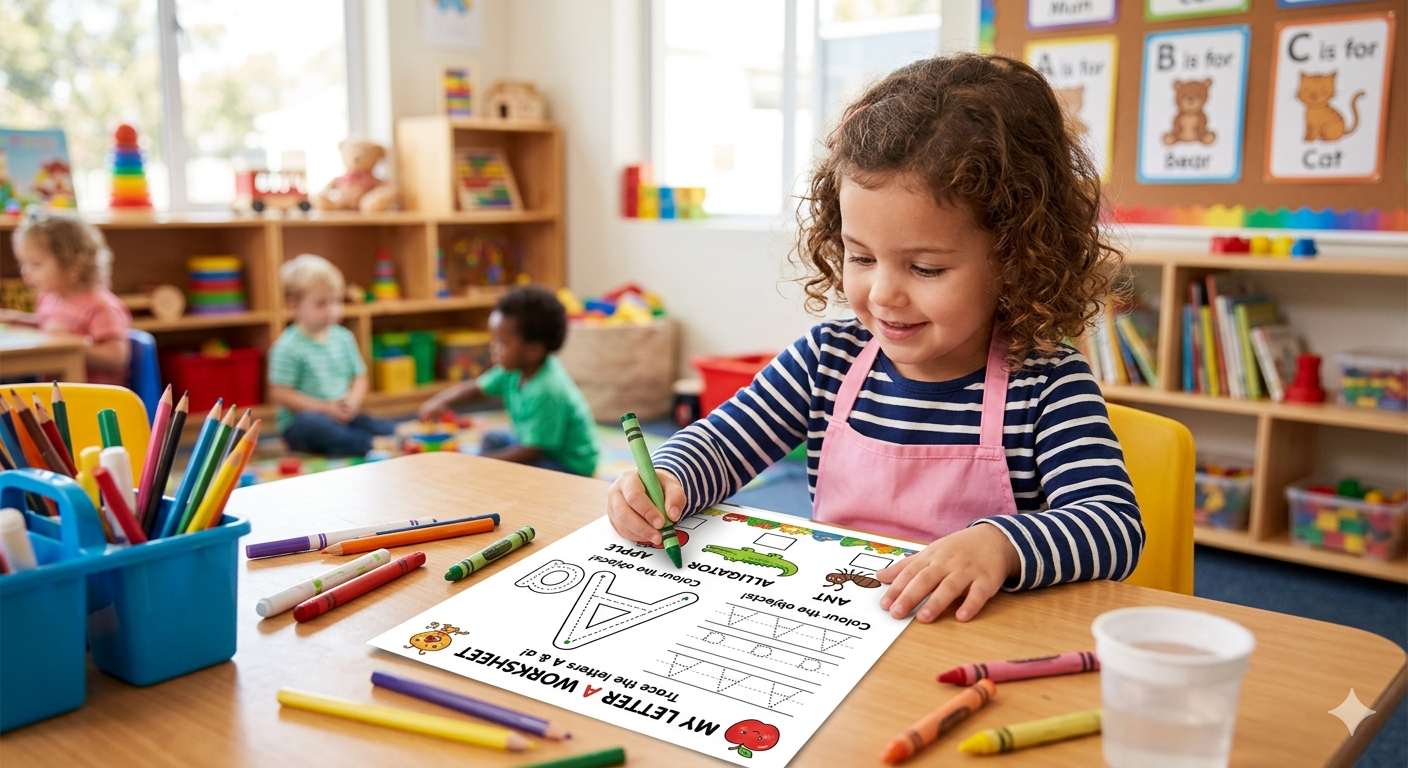
Pick one learning goal per worksheet. A tracing sheet teaches writing mechanics, a matching activity builds recognition, and a coloring page reinforces shape memory while keeping students engaged. Combining all three weakens focus and overwhelms the development of fine motor control.
🎯 Key Point: Single-focus worksheets are significantly more effective than multi-activity sheets for preschool learning. When you focus on one skill, children can fully develop that skill without cognitive overload.
"Focused practice on a single skill leads to 23% better retention compared to mixed-activity worksheets in preschool settings." — Early Childhood Education Research, 2023

⚠️ Warning: Avoid the temptation to pack multiple activities into one worksheet. Preschoolers need clear, simple objectives to build confidence and mastery in letter recognition.
Start With Letter Size That Matches Skill Level
Big letters give beginners room to succeed. When a four-year-old grips a crayon with their whole fist, tiny letters become frustrating scribbles. Start with letters at least two inches tall, then gradually reduce size as pencil control improves. Tracing a large A builds muscle memory that transfers to smaller writing later.
Use Tracing Guides That Teach Proper Formation
Dotted lines show the path, arrows indicate stroke direction, and start/end points mark where the pencil should land first. Without these guides, children copy shapes without learning the correct sequence of movements. A child who traces A from bottom to top will struggle later when speed matters because they've practised the wrong motor pattern thousands of times. Proper formation from the beginning prevents bad habits that require unlearning in first grade.
How much repetition prevents boredom in letter A worksheets?
Six to ten tracing rows provide enough practice without numbing attention. Vary the repetition (uppercase A, lowercase a, then the word "Apple") to keep the task engaging while reinforcing the same core shape. Strategic repetition builds automaticity; mindless repetition builds resistance.
Where can parents find customizable letter A worksheets for preschool?
Most parents know what good worksheets should include, but lack the design skills, printing costs, and time to create them. Generic worksheets rarely match a child's specific learning stage. Our platform at My Coloring Pages solves this by offering 51,780+ free downloadable worksheets that let families customize letter size, tracing complexity, and visual elements in seconds, enabling anyone to create personalized learning materials without artistic ability or expensive software.
Add Visuals Intentionally, Not Decoratively
One clear picture of an apple next to the letter A creates a connection. Five clipart pictures scattered across the page create a distraction. Visual elements should reinforce the phonetic connection (A for alligator, ant, airplane) rather than fill white space. Keep pictures large enough for small hands to colour but simple enough that they don't compete with the letter for attention.
But even the best-designed worksheet fails if it doesn't print clearly or fit how preschoolers learn.
Related Reading
- Preschool Assessment
- Preschool Crafts
- Preschool Learning Activities
- Preschool Tracing Worksheets
- Daycare Vs Preschool
- Preschool Classroom Layout
- Preschool Playground Equipment
- Free Preschool Games
- Preschool Sight Words
- Preschool Math Activities
- How To Become A Preschool Teacher
- Preschool Prep
- Preschool Lesson Plan Template
- Noah's Ark Preschool
- Preschool Science Experiments
- Preschool Craft Ideas
- Creative Curriculum For Preschool
- Playing Preschool Curriculum
- Preschool Bulletin Board Ideas
- Christmas Crafts Preschool
- Spring Bulletin Board Ideas For Preschool
- Turkey Craft Preschool
- Preschool Learning Games
10 Customizable Letter A Worksheets for Preschoolers
You need choices that work for your child's current skill level. Some four-year-olds trace with confidence, while others hold crayons with their whole fist. Some recognize every uppercase letter but freeze when they see lowercase. The right worksheet meets children where they are today.

🎯 Key Point: Customizable worksheets adapt to your child's individual development stage, ensuring age-appropriate challenges without overwhelming frustration.
"Children learn best when activities match their developmental readiness and current abilities, not their chronological age." — Early Childhood Development Research, 2023

💡 Tip: Start with tracing activities for children who are still developing fine motor control, then progress to independent writing as their pencil grip and hand strength improve.
1. WorksheetPrints
WorksheetPrints lets you type specific words (Apple, Ant, Alligator) and generates structured tracing sheets immediately. You control font style, letter size, and line spacing based on your child's needs. For beginners, you can increase letter height to three inches and add wide spacing between lines. As pencil control improves, you reduce the size and tighten spacing. This prevents frustration from worksheets that assume underdeveloped motor skills. Adding a child's name personalises the page: when Maya sees her name at the top, she feels ownership of the task rather than viewing it as regular homework.
2. Canva
Canva transforms worksheets into visual experiences. You drag pictures of apples, airplanes, and animals directly onto the page, creating immediate phonetic associations. A child colouring an alligator next to the letter A builds stronger memory than tracing the letter alone.
Full control over colours, fonts, and layouts means you can match the worksheet to your child's current interests. If they're obsessed with astronauts this week, you build a worksheet around space themes. You're creating one your child will want to use, rather than searching for the perfect worksheet someone else designed.
Many parents know what makes worksheets effective, but lack the design skills or time to create custom materials. Generic printouts from search engines rarely match a child's specific learning stage or interests.
Platforms like My Coloring Pages solve this by offering 51,780+ free downloadable worksheets that let families describe exactly what they want (like "Letter A with apples and traceable letters") and generate personalized pages in seconds. Our collection makes it accessible for anyone to create educational content without artistic ability or expensive software.
3. EasyClass AI
EasyClass AI creates complete Letter A worksheets in seconds from simple prompts. Type "Letter A activities for preschool" and it generates multiple formats instantly: matching, tracing, and phonics exercises. You can adjust the difficulty from beginner to intermediate as your child progresses, which matters since some children master uppercase recognition quickly but struggle with lowercase for months. Automatic answer keys help teachers track progress across multiple students without creating extra work.
4. SchoolMyKids Worksheet Generator
SchoolMyKids offers guided worksheet formats that match preschool learning stages. You can choose between capital letter focus, lowercase emphasis, or mixed practice, with clear separation between recognition and writing-based activities. The worksheets progress in difficulty to match your child's current ability, making them ideal for parents seeking organized advancement rather than random practice sheets.
5. GCPTutorials Tracing Generator
GCPTutorials removes visual clutter to focus on letter formation. You adjust letter size and spacing, then print immediately. The simple design prevents distraction for children overwhelmed by busy pages with multiple images and colours. Clean tracing lines with clear start and end points teach proper stroke sequence without competing visual elements.
6. Smart Little Bunnies Name Tracing Generator
Smart Little Bunnies excels at learning through repetition. You can input multiple A-words and create practice sheets that remain consistent each time. Though designed for name tracing, the tool works equally well for practising specific vocabulary words. Type "Apple, Ant, Acorn, Alligator" and create a sheet where your child traces each word six times. Repetition builds muscle memory faster than using varied words at this age. Tracing the same letter pattern across multiple sessions teaches your child's hands the movement before conscious understanding develops.
7. Education.com Worksheet Generator
Education.com supports its worksheets with organized learning principles, offering ready-made and customizable options. Their Letter A resources target specific skills (phonics, recognition, writing) rather than combining them into a single page. Age-appropriate difficulty levels prevent worksheets that work for some preschoolers but frustrate others. Printable and digital formats provide flexibility for different learning environments. The research-backed approach ensures worksheets align with how children develop literacy skills.
8. KiddyCharts Worksheet Tools
KiddyCharts transforms worksheets into play rather than schoolwork. You can create coloring and tracing combinations, activity-based sheets, and engaging Letter A challenges that eschew traditional formats. This matters for children resistant to forced learning. When worksheets resemble games, children engage more readily. The playful approach packages phonics and recognition practice in a format children won't avoid.
9. Tools for Educators Worksheet Maker
Tools for Educators transforms the letter A into games and puzzles rather than simple writing practice. You can create matching exercises in which children connect uppercase A to lowercase a, or crossword-style activities in which they find words that start with A. This approach suits children who have completed numerous tracing worksheets and need fresh engagement. The interactive formats strengthen core skills (letter recognition, phonics, shape discrimination) through varied cognitive approaches.
10. My Coloring Pages
The most effective worksheets are the ones children want to use. My Coloring Pages lets you create custom, printable coloring worksheets in seconds by describing what you want or uploading images. Instead of standard formats, you transform Letter A into something engaging—a page filled with apples, animals, or a child's favourite objects. You combine letter tracing, object recognition, and colouring on one page, which improves learning by activating multiple learning pathways simultaneously. Our platform makes educational content creation accessible to everyone, regardless of artistic skill, transforming what once required design software and hours of work into something you generate in under a minute.
Where can you find more worksheet resources?
But having access to customisable worksheets matters only if you know where to find thousands more without paying for each one individually. Our My Coloring Pages collection gives you access to over 51,780 coloring pages that you can customise and download for free, so you're never limited by availability.
Download 52,890+ Free Alphabet Worksheets for Preschoolers
Most parents search for Letter A worksheets, find three or four options, print them, and repeat the cycle every week. You're constantly hunting for the next worksheet while your child waits.
🎯 Key Point: My Coloring Pages gives you access to 52,890+ free downloadable worksheets covering every letter, skill level, and learning style. Type what you need (like "Letter A with apples and tracing lines"), generate a custom worksheet in seconds, or browse thousands of ready-made pages created by other parents and educators. Our platform turns personalized learning materials into something anyone can create, regardless of artistic ability or technical skills.
"52,890+ free worksheets provide unlimited variety for every learning style and skill level." — My Coloring Pages Platform
💡 Tip: When you can instantly pull up a new Letter A activity that matches your child's current mood (coloring today, matching tomorrow, tracing next week), learning stays fresh instead of feeling repetitive. Children don't get tired of the same format because you can rotate through different approaches without spending hours searching or paying for each resource.
Related Reading
- Preschool Mothers Day Crafts
- Preschool Spring Crafts
- Preschool Snack Ideas
- Preschool vs Daycare
- Preschool Thanksgiving Crafts
- Fathers Day Crafts Preschool
- Preschool Movement Songs
- Letter A Worksheets Preschool
- All About Me Preschool Activities
- Tracing Worksheets Preschool
- Good Morning Songs for Preschool
- Fall Preschool Crafts
- Preschool Art
- Preschool Classroom Themes
- January Preschool Themes
- Fall Coloring Pages Preschool
- Part Time Preschool
- Letter B Worksheets Preschool
- Play Based Preschool
- Preschool Science Activities
- How Much Is Preschool