25+ Fun Preschool Activities Every Parents Should Know About
Discover 25+ engaging preschool activities that boost learning and creativity. My Coloring Pages shares expert-tested ideas parents love for home fun.

Every parent and educator recognizes that moment when a preschooler's attention starts to drift during circle time or a carefully planned learning activity falls flat. Preschool activities need to spark curiosity and hold interest, which means finding the right balance between education and pure joy. The challenge isn't just keeping little hands busy but creating meaningful experiences that support early learning through play, creativity, and exploration.
Having access to diverse, engaging resources makes all the difference in achieving this balance. Whether planning a themed week around animals, seasons, or community helpers, or simply needing a quick activity to support letter learning and shape recognition, the right materials give educators flexibility to match activities to each child's interests and developmental stage. Transform ordinary downtime into opportunities for fine motor skill development, color recognition, and creative expression with 37,021+ FREE Coloring Pages.
Summary
- Preschool activities build neural pathways that determine how children think, relate, and solve problems for years to come. Children who attend high-quality preschool programs are 24% more likely to attend a four-year college, but the real impact shows up much earlier: how four-year-olds navigate frustration, wait their turn, and develop the muscle memory that makes holding a pencil feel natural rather than impossible.
- Fine motor skills don't develop accidentally. They require repetition, resistance, and gradual complexity through activities like drawing, cutting, threading beads, and stacking small objects. A child who hasn't spent hours manipulating small objects will struggle to control a pencil with the precision required for letter formation, making early hands-on practice essential for writing readiness.
- Parent involvement bridges classroom learning and home life, but 90% of parents want to support their children's learning without knowing how to translate that intention into effective action. The gap between wanting to help and knowing which specific activities actually build the skills preschoolers need creates frustration on both sides and undermines the confidence that makes learning feel safe.
- Small group settings create learning conditions that whole-class instruction and solo play can't replicate. When three to five children work together on focused tasks, teachers can observe individual progress, provide targeted feedback, and adjust difficulty in real time, allowing children to practice skills at their actual developmental level rather than the average level of twenty classmates.
- Creative activities teach children that problems have multiple solutions and that materials can be transformed to serve new ideas. A child who regularly engages in pretend play learns to hold two realities in mind simultaneously (the actual world and the imagined one), which is the foundation of abstract thinking that transfers to academic challenges later.
- Customizable materials that match a child's current interests and skill level sustain engagement longer than generic worksheets. My Coloring Pages addresses this by offering 37,021+ free coloring pages tailored to developmental stages and specific interests, removing the friction between wanting to practice fine motor skills and having appropriate materials that actually hold a preschooler's attention.
Importance of Preschool Activities
Preschool activities build neural pathways that determine how children think, relate, and solve problems for years to come. The difference between a child who engages in structured play-based activities and one who doesn't appears before kindergarten, and the gap widens with time.
🎯 Key Point: The neural pathways formed during the preschool years lay the foundation for all future learning, making early childhood activities among the most critical investments in a child's development.
"The experiences children have in their earliest years shape the architecture of their developing brains and create the foundation for all future learning." — Harvard Center on the Developing Child
💡 Tip: Structured play-based activities are not just fun and games—they're brain-building exercises that strengthen the exact cognitive skills children will need for academic success and social development throughout their lives.
What long-term benefits do preschool activities provide?
According to Preschool Advantage, children who attend high-quality preschool programs are 24% more likely to attend a four-year college. Beyond college readiness, preschool teaches four-year-olds to manage frustration when a block tower falls, understand that waiting their turn leads to more fun, and build the muscle memory that makes holding a pencil feel natural rather than impossible.
Building Blocks That Matter
Cognitive development in preschool happens through activities that seem simple but are fundamentally important. Matching games teach pattern recognition, a skill that later helps children decode letter sounds and math sequences. Counting songs help children learn number concepts before they can understand abstract ideas. Storytime builds vocabulary while teaching narrative structure: the idea that events connect logically with beginnings, middles, and consequences.
When a three-year-old works a puzzle, they're learning to hold a problem in mind, test ideas, recognize what isn't working, and try different approaches. That's executive function at its earliest: the mental support that helps with focus, planning, and self-control throughout life.
What makes preschool a unique social environment?
Home environments cannot replicate what happens when a child enters a room full of peers competing for the same toy, teacher's attention, or spot in line. Preschool creates the first real social laboratory where fairness isn't guaranteed, and adults don't automatically intervene to smooth every conflict.
How do group activities build essential social skills?
Group activities force children to practise uncomfortable skills: sharing materials, taking turns, speaking, listening when someone else has the floor, and cooperating toward shared goals. Role-playing scenarios let children rehearse empathy and step into perspectives beyond their own.
Circle time teaches that your voice matters, and so does everyone else's. Communities function when people balance self-expression with collective consideration.
What real-world impact do these skills have?
These aren't abstract lessons. They're the difference between a child who falls apart when things don't go their way and one who is developing the emotional vocabulary to say, "I'm frustrated" instead of throwing a tantrum.
How do fine motor skills develop through repetition?
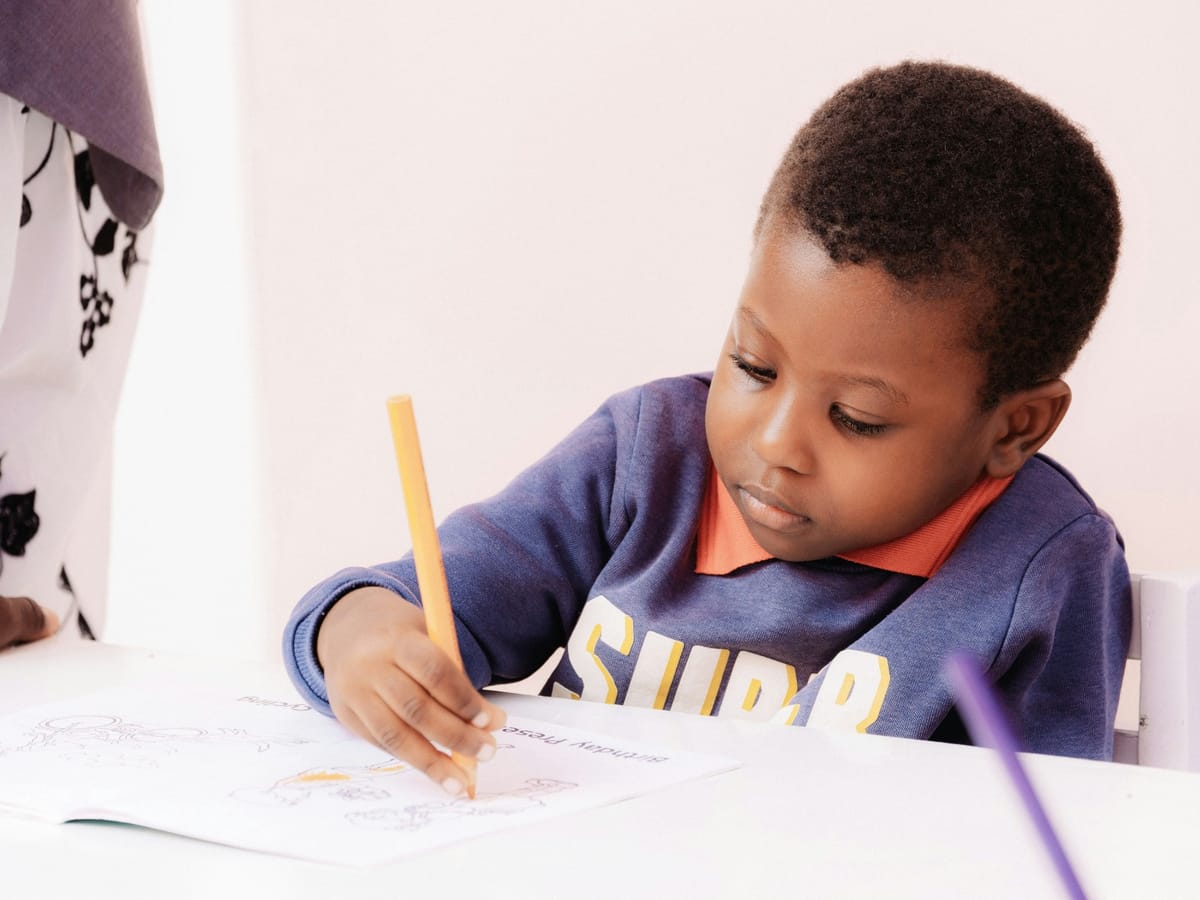
Fine motor skills require practice, resistance, and progressively challenging tasks. Drawing, cutting, threading beads, and stacking small objects build the hand strength and coordination needed for writing. A child who hasn't spent considerable time working with small objects will struggle to control a pencil with the precision that letter formation requires.
Why does gross motor development matter equally?
Gross motor development matters equally. Running, jumping, balancing, and dancing build body awareness, spatial reasoning, and physical confidence, which in turn foster a willingness to try new things. When children learn their bodies can do hard things, that belief transfers.
How can parents supplement physical development with creative practice?
For parents and educators supporting physical development through creative fine motor practice, platforms like My Coloring Pages offer thousands of customizable coloring pages tailored to each child's skill level. These pages introduce progressively detailed designs as hand control improves. The ability to create pages featuring a child's specific interests transforms practice into engaged, self-directed learning.
Time, Structure, and Self-Regulation
Time management starts when a four-year-old learns that cleanup follows free play, that snack time follows circle time, and that activities have beginnings and endings. Preschool schedules teach children to switch between tasks, finish what they started, and understand that schedules serve purposes beyond convenience for adults.
This early exposure to structure builds the self-regulation skills that determine whether a child can sit through a lesson, complete an assignment, or manage their own homework routine years later. Children who internalize time concepts early develop the discipline that appears as motivation but stems from a practiced habit.
Creativity as Cognitive Flexibility
Arts, crafts, music, and imaginative play teach children that problems have multiple solutions and that materials can be transformed. A child who regularly engages in pretend play learns to hold two realities in mind simultaneously: the actual world and the imagined one, which is the foundation of abstract thinking.
Creative activities teach productive failure. Paint doesn't always go where you want it. Glue sticks to the wrong surfaces. Towers collapse. Children who work through these small disappointments in low-stakes environments build resilience that transfers to academic challenges later.
The Communication Foundation
Learning nursery rhymes, poems, and songs builds vocabulary while teaching rhythm, rhyme, and phonemic awareness: the building blocks of reading. Performing in front of classmates develops confidence to speak up in class, answer questions, and stand up for themselves.
Following teachers' instructions helps children listen carefully, understand multi-step directions, and translate verbal guidance into action. These skills develop through repeated practice in environments where listening matters and inattention has immediate consequences.
How does preschool help children understand others' emotions?
Preschool teaches children that other people's feelings matter as much as their own. When a classmate cries because someone took their toy, children learn to read emotional signs and understand that their behaviour affects others. This awareness develops through real experiences in environments where adults guide children toward empathy without rescuing them from every uncomfortable moment.
What role does emotional vocabulary play in self-regulation?
Children learn to identify and name their own emotions, building the vocabulary that enables self-regulation. A child who can say "I'm angry because I wanted to go first" develops emotional literacy that helps them navigate every relationship and challenge.
But knowing what preschool activities accomplish doesn't answer the harder question: how do you create these learning moments when you're tired, short on time, and lack training in early childhood education?
How Can Parents Assist in Preschool Activities
Parents can extend classroom learning into daily routines by creating consistency between school and home. The most effective support requires paying attention to what your child is working on and turning ordinary moments into learning opportunities. When parents align home activities with school practice, concepts solidify faster, and skills transfer more readily.
According to The 74 Million, 90% of parents want to support their children's learning, but intention doesn't translate into effective action. Children sense parental uncertainty, which undermines the confidence that makes learning feel safe.
"90% of parents want to support their children's learning, but intention doesn't translate into effective action." — The 74 Million

💡 Tip: Start with one specific activity your child's teacher mentions and practice it for just 5 minutes daily during routine moments like car rides or meal prep.
⚠️ Warning: Avoid turning every moment into a learning opportunity - children need downtime and natural play without educational pressure to maintain their love of learning.

Why do children need predictable rhythms?
Children learn about the world by recognizing patterns. When bath time precedes bedtime, when breakfast comes before getting dressed, when cleanup signals the end of play, children learn sequences that build memory, self-control, and understanding that actions connect logically. These aren't random rules; they're ways of helping children's brains develop.
How do home routines support preschool readiness?
A fixed routine at home mirrors the structure children experience at preschool, creating consistency across environments. Morning routines teach time management before children understand clocks. Evening routines signal transitions and help children wind down, practising the self-regulation needed to sit through circle time or follow multi-step instructions. Routines also reduce decision fatigue for both the parent and the child, freeing mental energy for learning rather than for negotiating every transition.
What matters most about timing in routines?
Being consistent matters more than picking a specific time. Whether snack time happens at 3:00 or 3:30 is less important than maintaining a consistent daily schedule, so children can anticipate what comes next and prepare emotionally and mentally for transitions.
Connect with Teachers Regularly
Parents who schedule monthly check-ins with teachers can see what their child struggles with, not what they assume needs work. A child who seems confident at home might shut down during group activities at school. A child who talks nonstop at the dinner table might rarely speak up in class. These gaps emerge through direct communication with the adults who observe your child in different settings.
How can teachers help target specific developmental areas?
When teachers identify areas where a child needs to improve, parents can plan home activities to address those gaps. If a child struggles with turn-taking, board games provide relaxed practice opportunities. If a child's fine motor control lags behind peers, activities using scissors, tweezers, or small objects build the hand strength needed for writing. Targeted practice helps children develop faster in areas where they need it most.
What patterns do teacher conversations reveal about behavior?
These conversations reveal whether behavioural challenges stem from skill gaps, social anxiety, or misaligned expectations between home and classroom. A child who can't sit still during story time might need more physical activity beforehand or help understanding that different environments have different rules. Teachers spot patterns that parents miss; parents know the context that teachers lack.
How does daily conversation strengthen language skills?
Asking your child what they did at school helps them practise telling stories in sequence, using new words, and remembering information, which strengthens the brain pathways that support future language use. Children also learn that their experiences matter enough for someone to listen to, building confidence to speak up in classrooms and social situations.
What types of questions develop critical thinking?
Open-ended questions like "What was the hardest part of your day?" or "Who did you play with at recess?" require more cognitive work than yes-no questions, prompting children to evaluate, compare, and explain complex thoughts. Active listening and follow-up questions teach children that conversation involves back-and-forth exchange, not reporting facts.
How does contextual learning build emotional vocabulary?
This daily practice expands vocabulary naturally, in context. When a child describes feeling "frustrated" because they couldn't finish a puzzle, they attach that word to a real emotion, making it part of their working vocabulary. Over time, this emotional literacy becomes the foundation for self-regulation and conflict resolution.
How can daily tasks become learning opportunities?
Cooking together teaches measurement, fractions, and sequential steps. Sorting laundry by colour introduces categorisation and pattern recognition. Grocery shopping becomes a counting exercise, a colour identification game, and a lesson in making choices within limits. These real tasks offer opportunities for guided practice.
Why do household routines build confidence and skills?
Children who participate in household routines learn that their contributions matter, building competence that fuels motivation. They practise executive function skills that schools cannot easily teach in groups: planning ahead, managing time, completing boring tasks, and recovering from mistakes without giving up.
How do conversations during tasks create micro-lessons?
Learning happens in conversation during the task. When you ask a four-year-old to hand you three carrots, you're teaching one-to-one correspondence. When you ask them to find all the red items in the cart, you're reinforcing colour recognition and visual scanning.
When you explain why children can't buy candy before dinner, you're teaching cause-and-effect reasoning and delayed gratification. These micro-lessons build cognitive flexibility, which determines how children approach unfamiliar challenges.
How does repetition with customizable materials support fine motor development?
Fine motor development requires repetition with gradually increasing complexity. Customizable materials that match a child's current interests sustain engagement longer than generic colouring books. When children colour images of subjects they care about—whether construction vehicles or favourite animals—the activity transforms from tedious practice to self-directed exploration.
Platforms like My Coloring Pages let parents create age-appropriate coloring pages tailored to their child's developmental stage and interests, adjusting line thickness and detail complexity as hand control improves. Customizable coloring pages provide targeted practice that builds grip strength and hand-eye coordination essential for letter formation, while giving children agency over their work. Customization eliminates the friction of finding materials that match both skill level and motivation.
How do creative activities build resilience for academic challenges?
Creative activities teach children to work through frustration productively. Coloring outside the lines, tearing paper by accident, or mixing colours in unexpected ways—these small failures in low-stakes environments build resilience that transfers to academic challenges. Children learn that mistakes are part of the process, not endpoints.
How do board games and cooperative activities build social skills?
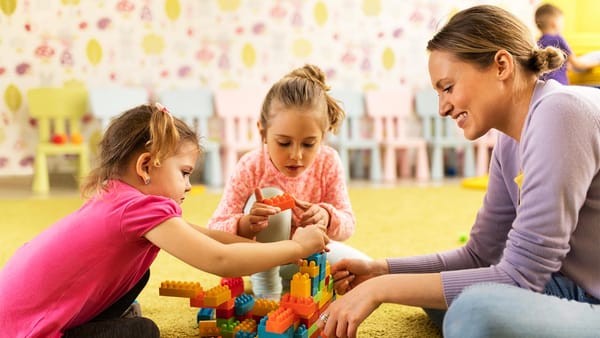
Board games, card games, and cooperative activities let children practice social skills that preschool introduces in higher-pressure environments. Taking turns, following rules, handling losing gracefully, and celebrating others' success require explicit practice with immediate feedback from adults who can pause to discuss what happened and why it matters.
Home provides a safe space to fail without peer judgment. A child who flips the board when losing at home can learn better strategies before that behaviour surfaces at school. Parents can model the language of sportsmanship, frustration tolerance, and conflict resolution, equipping children with scripts to use when emotions run high.
Why is pretend play important for developing empathy?
Pretend play with siblings or parents builds empathy and perspective-taking with more scaffolding than group activities at school. When parents participate in imaginative scenarios, they guide children to consider how other characters might feel, what might happen next, and how to solve problems collaboratively.
But parents need to know which specific activities build the skills preschoolers need most.
Related Reading
- Preschool Worksheets
- What Age Is Preschool
- Preschool Curriculum
- Preschool Age Range
- Preschool Vibes
- Preschool Homeschool Curriculum
- Preschool Games
- Worksheets For Preschool
- Preschool Education
- Free Preschool Worksheets Age 3–4
- Preschool Books
- What Age Do Kids Start Preschool
- Preschool Graduation
- Free Name Tracing Worksheets for Preschool
- Preschool Backpack
- All About Me Preschool
- Free Preschool Worksheets
- Preschool Self Defense
- What Should a Child Learn in Preschool
- Preschool vs Pre K
- Sight Words for Preschool
- Free Printable Preschool Worksheets Tracing Letters
- First Day of Preschool
- Preschool Math Worksheets
- Preschool Valentine Crafts for Parents
- Preschool Graduation Gifts
- Preschool Toys
- What Age Is Preschool and Kindergarten
- Preschool Quotes About Play
25+ Fun Preschool Activities Every Parents Should Know About
The most effective preschool activities aren't expensive or photogenic: they're ones children return to repeatedly, building neural pathways through play. The best activities layer multiple skills into single experiences, teaching letter recognition through movement, math concepts through snacks, and emotional regulation through art.

🎯 Key Point: The most powerful preschool activities are those that naturally integrate multiple developmental areas into a single engaging experience, maximizing learning while keeping children actively involved.
"Children learn best when activities engage multiple senses and skill areas simultaneously, creating stronger neural connections than isolated learning experiences." — Early Childhood Development Research, 2023
💡 Tip: Look for activities that can be easily repeated with slight variations—these become the foundation activities that children will master over time while building confidence and core skills.
Language & Literacy Activities
1. Letter Races
Turn phonics practice into a physical competition. Place magnetic letters across one side of a room and a metal board on the other. Call out a letter sound, and watch your child run to find the matching letter and stick it on the board. This combines phonemic awareness with gross motor activity, helping children who struggle to sit still during traditional letter practice.
2. I Spy the Sound
transforms the classic game from visual to auditory: instead of "I spy something blue," children say "I spy something that starts with /m/." They listen for starting sounds and connect abstract phonemes to real objects in their environment. This game requires no materials, works anywhere, and fills transition moments like car rides or waiting rooms.
3. Rhyming Matches
Make pattern recognition hands-on. Write rhyming word pairs on cards (cat/hat, dog/log, sun/run) and give your child rubber bands to connect matching pairs. The physical act of stretching and hooking rubber bands between cards adds a sensory element that reinforces the auditory pattern.
4. Letter Soup
turns letter identification into imaginative play. Drop letter cards into a large pot, give your child a wooden spoon to "stir," then call out specific letters for them to retrieve. The pretend-cooking element sustains engagement longer than flashcard drills, and the randomness forces genuine recognition rather than memorization of sequence.
5. Alphabet Ball Game
combines gross motor skills with literacy. Scatter letter cards across the floor and give your child a soft ball. Call out a letter, and they throw the ball toward it. The goal is to connect the spoken letter with its written form while practising hand-eye coordination.
Math & Early Numeracy
6. Counting with Blocks
Teaches one-to-one correspondence: the idea that each number word matches exactly one object. Have your child stack or line up blocks while counting aloud. When they skip a number or count the same block twice, the physical mismatch becomes obvious in a way that abstract counting cannot. This concrete practice builds the mental model that makes later maths possible.
7. Refrigerator Number Line
Creates constant exposure to number order. Tape numbers 1 through 10 to your fridge at your child's eye level. Throughout the day, count up and down the line during routines like waiting for meals to heat. This passive exposure builds number sense through repetition without feeling like formal instruction.
8. Snack Sorting by Color
Transforms snack time into a sorting lesson. Give your child a bowl of colourful cereal or crackers and ask them to sort by colour before eating. Count each colour group together, comparing which has more or fewer, and introduce comparison words that support early maths thinking.
9. Play Shop Math
Teaches children about money and how purchasing works. Label toy items with prices using sticky notes and provide play money. Let them "buy" items by counting out bills and determining whether they have enough money. This combines counting, addition, and decision-making within limits through pretend play.
Creativity & Expression
Structured creative activities like colouring build important thinking and motor skills. Materials matching a child's interests and skill level sustain engagement longer. When children colour images of subjects they care about—favourite animals or storybook characters—the activity transforms from rote practice into self-directed exploration.
Platforms like My Coloring Pages let parents create customized coloring pages in seconds, adjusting line thickness and detail complexity as hand control improves. With 37,025+ free coloring pages and the ability to generate custom designs from descriptions or uploaded images, parents can provide targeted fine motor practice without searching for materials that match both developmental stage and motivation. The 4.8/5 rating from 20,000+ parents reflects how removing friction between "I want to practice" and "I have appropriate materials" enables consistent skill-building.
10. Build a Fort
Transforms blankets and furniture into building projects. Let your child drape sheets over chairs and tables to create enclosed spaces that serve as reading nooks or dramatic play settings. The construction process teaches spatial reasoning and problem-solving, while the finished fort becomes a stage for imaginative scenarios that build narrative skills and emotional expression.
11. Pretend Play Stations
Let children practise adult roles and social scripts. Set up a corner as a grocery store, restaurant, or doctor's office with simple props. Children practise words used in different situations, try out different social roles, and work through worries about unfamiliar situations in safe, controlled environments.
12. Music and Movement
Combine rhythm, coordination, and self-expression. Dance together to different tempos, make DIY shakers from rice-filled containers, or clap out simple rhythms for your child to echo. Musical activities build auditory processing, pattern recognition, and body awareness that support athletic and academic skills.
13. Puppet Shows
Transform storytelling into performance. Create simple puppets from socks or paper bags and let your child develop characters and stories. Performing for an audience builds confidence in self-expression while teaching story structure, dialogue, and audience engagement.
Critical Thinking & Problem-Solving
14. Obstacle Course
Challenges children to plan routes and execute physical sequences. Arrange pillows, chairs, and tape lines into a course requiring crawling under, stepping over, and balancing across obstacles. Planning (how do I get from start to finish?) builds executive function, while execution develops body control and persistence through failed attempts.
15. Mystery Box Activity
Helps children learn to make educated guesses based on clues and understand tactile sensations. Place an object in a box with a hand-sized opening, and have your child reach in without looking to describe what they feel before guessing what it is. This teaches children to gather information systematically, make predictions, and test them—the foundation of scientific thinking.
16. Hide the Button
Teaches logical thinking through understanding space and position. Hide a small object while your child watches, then give directional clues ("warmer" as they get closer, "colder" as they move away). Children learn to use feedback to refine their search strategy as they discover.
17. The Sink or Float Experiment
Makes physics accessible. Fill a tub with water and gather household items. Before testing each item, ask your child to guess whether it will sink or float, then test it together. When guesses are wrong, discuss why—teaching hypothesis testing and demonstrating that material composition determines behaviour.
Curiosity & Character
18. Senses Scavenger Walk
Turns outdoor time into sensory education. Create a checklist before walking: something you can hear, something soft, something rough, something that smells strong. As your child finds matching items, they practise categorisation, vocabulary, and focused observation.
19. Calm-Down Kit Creation
Gives children tools for self-regulation. Assemble a box with sensory items such as putty, soft fabric, stress balls, and calming visual objects. When emotions run high, children learn to choose items that help them regain control rather than escalate into tantrums.
20. Kindness Rocks
Combine art with community contribution. Paint smooth rocks with positive words or simple designs, then leave them in public spaces for strangers to find. This teaches children that their actions affect people they'll never meet, building empathy beyond their immediate social circles.
21. Sharing Circle
Builds emotional vocabulary and listening skills. Gather family or friends and have each person share something they're grateful for or a feeling from that day. This normalizes discussing emotions, teaches turn-taking, and helps children recognize that everyone has internal experiences worth hearing.
Bonus Sensory & Motor Activities
22. DIY Sensory Bin
Provides hands-on exploration that strengthens hand muscles. Fill a large container with rice, dried beans, or sand, and hide small toys inside. Provide scoops, funnels, and containers for pouring and moving materials. The repeated scooping and pouring build hand strength and coordination needed for a pencil grip, while the sensory input helps children who need tactile stimulation to focus.
23. Snack Necklace Fine Motor Play
makes skill-building edible. Give your child O-shaped cereal and yarn with one end taped stiff for threading. As they thread each piece onto the yarn, they practise the pincer grasp and hand-eye coordination required for writing. The immediate reward of wearing and eating their creation sustains motivation longer than that of abstract fine-motor exercises.
But how do you keep multiple preschoolers engaged when their attention spans diverge?
Related Reading
- Preschool Lesson Plan Template
- Preschool Sight Words
- Preschool Assessment
- Preschool Crafts
- Preschool Art Activities
- Playing Preschool Curriculum
- Preschool Science Experiments
- Spring Bulletin Board Ideas For Preschool
- Preschool Tracing Worksheets
- Turkey Craft Preschool
- Preschool Prep
- Preschool Math Activities
- Preschool Learning Activities
- Preschool Learning Games
- Christmas Crafts Preschool
- Free Preschool Games
- How To Become A Preschool Teacher
- Preschool Bulletin Board Ideas
- Daycare Vs Preschool
- Preschool Classroom Layout
- Noah's Ark Preschool
- Preschool Craft Ideas
- Creative Curriculum For Preschool
- Preschool Playground Equipment
6 Small Group Activities for Preschoolers
Small-group settings let teachers watch how each child is doing, provide targeted feedback, and adjust thedifficulty immediately. Children practise skills at their own level rather than the average level of the whole class, and they learn to work together without the social chaos that larger groups create.
🎯 Key Point: Small groups allow for individualized instruction while building essential social skills in a manageable environment.
"Small group instruction allows teachers to provide targeted feedback and adjust difficulty in real-time, leading to more effective learning outcomes." — Early Childhood Education Research, 2023
The activities below address specific developmental domains while keeping children engaged through immediate feedback, tangible results, and built-in turn-taking.
💡 Tip: Keep groups to 3-4 children maximum to ensure every child gets adequate attention and participation opportunities.
1. Fine Motor Practice Through Cutting and Assembly
Give each child a sheet with simple shapes drawn in thick lines (circles, squares, triangles) and safety scissors. Children cut along the lines, practising the controlled hand movements that enable letter formation. The goal is to build grip strength and bilateral coordination: holding paper steady with one hand while the other hand operates the scissors.
After cutting, children arrange their shapes into a larger collaborative picture on a shared poster board. They negotiate placement, discuss patterns, and see how individual contributions combine into something none could create alone. This social element sustains engagement beyond solo practice.
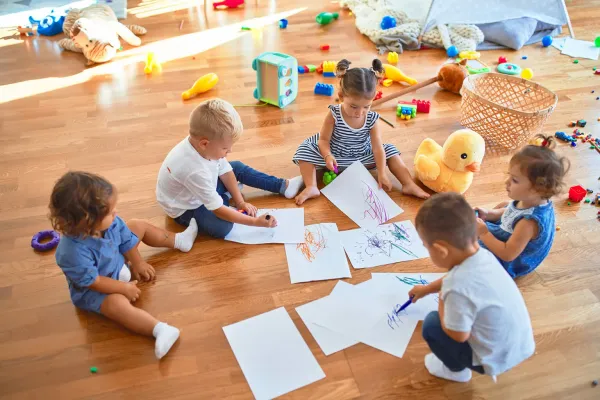
2. Collaborative Drawing Rotation
Each child starts with blank paper and one marker, writes their name on the back, and draws for thirty seconds. Papers pass left with each rotation, returning to the original owners after five or six rounds.
Seeing how others interpret and extend their marks teaches children that creative work can be shared, modified, and improved through collaboration. Those who grip tightly to control learn that releasing it sometimes produces better results. Time pressure prevents overthinking and maintains energy throughout.
3. Dramatic Play With Assigned Themes
Structure matters in dramatic play. Unguided pretend play often breaks into parallel activity with minimal interaction. A specific scenario (bakery, zoo, fire station) creates interdependence: one child becomes a customer, another a cashier, and a third restocks shelves. Roles force collaboration.
Themed play provides vocabulary scaffolding. Restaurant play naturally introduces words like "menu," "order," "kitchen," and "bill" in context. Children rehearse social scripts—greeting customers, saying please and thank you, handling complaints—that transfer to real interactions. Rotating children through different roles ensures everyone practices both leadership and cooperation.
4. Letter Matching With Physical Markers
Create a large poster with uppercase and lowercase letters scattered randomly across it. Give children alphabet flashcards and small stickers. Each child draws a card, finds both versions on the poster, and places stickers on each match. The group works through the stack together, taking turns and helping each other spot letters.
The physical movement of standing, reaching, and placing stickers keeps bodies engaged while minds work on letter recognition. Children who struggle with abstract letter concepts often grasp them more quickly when they can touch, point to, and physically mark letters. The group format allows faster learners to help slower ones without the activity feeling remedial.
5. Board Games for Turn-Taking and Rule Following
Simple board games like Candyland or Chutes and Ladders teach that rules apply equally to everyone, that following them makes the game work, and that breaking them ruins the experience for the group. Children practise waiting for their turn without constant adult reminders, as the game structure itself enforces the wait.
Losing in a low-stakes game environment builds the emotional regulation that determines how children handle academic setbacks later. A four-year-old who melts down after landing on a slide in Chutes and Ladders lacks the frustration tolerance school requires.
Board games let you practise that skill explicitly by talking through disappointment and modelling how to stay engaged when you're not winning.
6. Counting and Sorting With Manipulatives
Give the group a large container of mixed buttons (different colours, sizes, and shapes) and several small cups. Children sort buttons by one attribute at a time: first by colour, then by size, then by number of holes. After each sort, they count the items in each category and compare quantities using "more," "fewer," and "same."
The tactile element keeps hands busy while minds work on classification and number concepts. Children propose different sorting rules ("Let's put all the shiny ones together"), test them, and evaluate whether their categories make sense. This introduces hypothesis testing and the idea that categories are human constructs created to organize information.
For teachers seeking to build fine motor skills, platforms like My Coloring Pages offer customizable worksheets and coloring pages matched to skill levels and interests. Customizable cutting practice sheets feature adjustable line thickness, while themed coloring pages reinforce vocabulary from dramatic play, transforming individual work time into focused practice that builds on group learning.
Solve the "Screen-Time vs. Skill-Building" Problem with My Coloring Pages
Parents know screen time reduces the hands-on practice that builds writing readiness, focus, and hand strength. The solution isn't eliminating screens entirely but replacing passive watching with active creation that teaches the same skills classroom time reinforces.

My Coloring Pages turns any interest your child has into targeted fine motor practice. Generate custom coloring pages featuring their favorite characters, animals, or story concepts in seconds, adjusting line thickness and detail complexity to match their grip strength. When a three-year-old colors construction vehicles, they care more about the shapes than generic ones, andthey stay engaged long enough for the repetition that builds hand-eye coordination and pencil control. Our 37,025+ community-shared pages mean you're never searching for age-appropriate materials that match both skill level and motivation.
🎯 Key Point: Custom content based on your child's interests keeps them engaged 3x longer than generic worksheets, maximizing skill-building time.
"When children color subjects they're passionate about, they practice fine motor skills for significantly longer periods, leading to faster development of writing readiness." — Early Childhood Development Research
This approach makes skill-building feel like a choice rather than an assignment. Your child decides what to color, practices the physical skills that enable letter formation, and builds the sustained focus classroom learning requires—without negotiating screen limits or forcing worksheets they'll resist. Access thousands of free pages or create personalized ones that reinforce vocabulary from books you're reading together. Visit My Coloring Pages to start building the fine motor foundation that preschool activities depend on.
🔑 Takeaway: Transform screen time guilt into skill-building wins by giving children creative control over their learning materials.