
How To Read a Parenting Styles Chart and Apply It at Home
A parenting styles chart can shed light on these daily struggles by showing how different approaches shape your child's responses, emotional development, and your connection with your child.


Every parent has stood in that moment when their child's behavior leaves them wondering if they're doing this right. Maybe it's the third meltdown before breakfast, or the bedtime battle that stretches into its second hour, and you find yourself questioning whether your approach is helping or making things harder. A parenting styles chart can shed light on these daily struggles by showing how different approaches shape your child's responses, emotional development, and your connection with your child.
When you pair this understanding with activities that naturally build calm and focus, you create space for real change. My Coloring Pages offers 21,838+ FREE coloring pages that give your family those precious moments of quiet togetherness, where kids can settle their emotions, and you can practice the patience and presence that your chosen parenting approach requires. These simple activities become opportunities to model consistency, respond to your child's needs with intention, and strengthen the positive patterns you're working to establish at home.
Summary
- Your parenting style influences outcomes across multiple life domains, with children of authoritative parents having a 4 times higher likelihood of happiness and success, according to research. The way you balance warmth and structure doesn't just affect today's behavior; it also shapes tomorrow's.
- It builds the emotional architecture your child carries into adulthood, shaping their confidence, relationship patterns, academic resilience, and stress management decades later.
- The correlation between parenting approach and child outcomes appears consistently across research, though it's not absolute causation. Studies show authoritative parenting was practiced by only 28% of parents in 2018, making it a minority approach despite its strong association with positive development.
- Children's temperament, cultural context, and other variables all play roles, which explains why some children thrive despite less-than-ideal parenting while others struggle even with skilled parents.
- Parenting styles operate through five underlying components that determine how warmth and demandingness manifest in daily life. These dials (warmth, acceptance, behavioral control, autonomy control, and expectations) create exponentially more variations than the basic four-category model suggests.
- Modern parenting labels like lighthouse, tiger, or snowplow parenting all map back to different positions on these five controls, making the framework more useful than adopting any single branded approach.
- The hidden cost of not understanding your approach shows up when parents can't see how their patterns create the very problems they're trying to solve. Permissive parents wonder why children lack self-discipline, unaware that warmth without structure doesn't teach regulation.
- Authoritarian parents feel hurt when teenagers won't communicate, missing how years of emotional distance taught children their feelings weren't welcome. Uninvolved parenting produces the worst outcomes across every domain, with affected children showing the lowest rankings in self-control, academic performance, and emotional health.
- Shifting your parenting style requires replacing projection with pause, trading hidden expectations for empathic engagement, and choosing connection over control.
- The work starts with an honest self-assessment of where you currently land on the warmth and demandingness axes, then with intentional adjustments based on the gap between your current approach and the outcomes you want for your child.
- Sustainable change happens through small, repeatable moments where you practice new responses without performance pressure.
- My Coloring Pages' collection of 21,838+ FREE designs creates low-stakes opportunities where families practice the balance of structure and warmth that authoritative parenting requires, offering predictable moments of connection that build trust without evaluation or control.
Why Parenting Styles Matter When Raising Children

The way you parent shapes more than just today's behavior. It builds the emotional architecture your child will carry into adolescence, adulthood, and eventually their own parenting. Your approach influences their confidence, their ability to form healthy relationships, their academic resilience, and even how they'll handle stress decades from now.
Researchers have spent years trying to isolate direct cause-and-effect links between specific parenting behaviors and later outcomes. The work proves difficult because children are complex. Two kids raised in identical homes can develop wildly different personalities. A child raised in chaos might become remarkably stable, while another raised with every advantage might struggle deeply.
Yet patterns emerge. According to Cedarway Therapy, children of authoritative parents are 4 times more likely to be happy and successful. That's not a coincidence. It's evidence that certain approaches create conditions where children thrive.
The Four Domains Where Your Style Shows Up
Your parenting style doesn't just affect one area. It ripples through academics, mental health, self-esteem, and social relationships. Each domain reveals something different about how your approach either supports or undermines your child's development.
1. Academic achievement and motivation
Often mirror the structure and expectations you set at home. Kids raised with clear boundaries and warm support tend to perform better in school. They develop internal motivation because they've learned that effort matters and that adults believe in their capacity to improve. Conversely, children raised without structure or emotional support often struggle to persist when schoolwork gets hard. They haven't internalized the belief that they can handle difficulty.
2. Mental health outcomes
Show stark differences across parenting styles. Children raised by authoritarian, permissive, or uninvolved parents experience higher rates of anxiety, depression, and other psychological struggles. The emotional climate you create at home becomes the baseline your child uses to interpret the world. When that climate is harsh, inconsistent, or absent, children learn that the world is unpredictable and that their feelings don't matter. That's a setup for long-term distress.
3. Self-esteem
develops when children feel both valued and capable. Kids raised with authoritative parenting tend to have stronger self-worth because they've experienced consistent warmth alongside reasonable expectations. They know they're loved and can handle challenges. Children raised with other styles often struggle with one or both of these beliefs. Either they feel incapable because expectations were too harsh or nonexistent, or they feel unworthy because emotional warmth was absent.
4. Social relationships and peer interactions
Reflect on what children learned about connection at home. Kids raised by permissive parents are more likely to be bullied because they haven't learned to set boundaries or assert themselves. Kids raised by authoritarian parents are more likely to bully others because they've learned that power and control are how you get what you want. The relational patterns you model become the patterns they replicate.
When Research Meets Reality
Correlational studies reveal these patterns, but they can't prove absolute causation. Other variables matter. A child's temperament plays a role. A naturally easygoing child might thrive under almost any approach, while a more reactive child might struggle even with skilled parenting. Context matters too. Cultural norms shape what effective parenting looks like. Authoritarian parenting, for instance, is associated with poorer academic outcomes in many studies, but that effect is less pronounced in Hispanic families where different cultural values frame authority differently.
There's also evidence that children shape their parents' styles. When a child misbehaves persistently, parents often become more variable in their responses. They might start with structure, then shift to permissiveness out of exhaustion, then swing back to harshness out of frustration. One interpretation is that parents of difficult or aggressive children sometimes give up on trying to control behavior altogether. The child's temperament drives the parent's inconsistency, not the other way around.
The correlations between parenting styles and outcomes are sometimes weak enough that expected results don't materialize. Authoritative parents can have defiant children. Permissive parents can raise self-confident, academically successful kids. These exceptions don't invalidate the patterns. They remind us that parenting is one force among many.
The Hidden Cost of Not Understanding Your Approach
When you don't recognize your own parenting style, you can't see how it's affecting your child. You might wonder why your child struggles with anxiety without realizing that your constant criticism has taught them they're never good enough. You might be confused about why your child doesn't listen, without seeing that your inconsistency has taught them that rules don't really matter. You might feel hurt that your teenager won't talk to you, without realizing that years of emotional distance have taught them their feelings aren't welcome.
Parents who want to be friends rather than authority figures often struggle to set boundaries. Their children may feel loved, but they lack the structure that builds self-discipline and respect for limits. When these children encounter the real world, where not everyone will indulge them, they're unprepared. They haven't learned that discomfort is sometimes necessary, that other people's needs matter, or that authority isn't inherently hostile.
Parents who adopt harsh, controlling approaches often believe they're preparing their children for a tough world. What they're actually doing is teaching their children that relationships are transactional, that love is conditional, and that vulnerability is dangerous. These children may comply in the short term, but they often carry resentment, fear, and difficulty trusting others into adulthood. Some research even suggests they're more likely to experience emotional abuse in adult romantic relationships because they've learned to accept control as normal.
The most painful pattern is when parents give up entirely. When a child is difficult, when nothing seems to work, when exhaustion sets in, some parents stop trying. They become inconsistent, disengaged, or absent. The child interprets this as evidence that they're unlovable or unfixable. That belief becomes the foundation for how they see themselves.
Creating Space for Intentional Parenting
Understanding your parenting style isn't about blame. It's about awareness. Most parents replicate what they experienced as children, even when they hated it. You can't change patterns you don't see. Once you recognize your default approach, you can decide if it aligns with the outcomes you want for your child.
The work of parenting isn't just about managing behavior. It's about creating an emotional environment where your child can develop confidence, emotional regulation, and healthy relationships. That requires presence. It requires patience. It requires the ability to stay calm when your child is dysregulated, to set boundaries without shame, and to offer warmth even when behavior is challenging.
These skills don't come naturally to most people. They require practice and often healing from your own childhood wounds. When you naturally build calm and focus, you create space for real change. My Coloring Pages offers 21,838+ FREE coloring pages that give your family those precious moments of quiet togetherness, where kids can settle their emotions, and you can practice the patience and presence that your chosen parenting approach requires. These simple activities become opportunities to model consistency, respond to your child's needs with intention, and strengthen the positive patterns you're working to establish at home.
The truth is, your parenting style matters more than almost any other factor in your child's development. It shapes their inner world in ways that persist long after childhood ends. The question isn't whether your approach has impact. It's whether you're creating the impact you intend.
But knowing your style matters is only the beginning. What you actually do with that knowledge depends entirely on understanding what each approach looks like in practice.
Related Reading
- Parenting Tips
- Bad Parenting
- Parenting Styles
- Parenting
- Gentle Parenting
- Co-Parenting
- Permissive Parenting
- Parallel Parenting
- Attachment Parenting
- Best Parenting Books
- Parenting Quotes
- Parenting Plan
- Parenting App
- Parenting Advice
Parenting Styles Explained: From Authoritative to Uninvolved

Four distinct approaches shape how parents interact with their children, each defined by two dimensions: responsiveness (how much warmth and support you provide) and demandingness (how many rules and expectations you set). Diana Baumrind identified three of these styles in the 1960s after studying over 100 preschool children through observation and interviews. Later researchers added a fourth. These aren't personality types. They're patterns of behavior that show up in how you discipline, communicate, and respond to your child's needs.
Authoritarian Parenting: High Demands, Low Warmth
Authoritarian parents establish strict rules and expect obedience without question. When a child asks why they can't do something, the response is often "Because I said so." There's no negotiation, no explanation, no room for the child's perspective. Punishment for rule-breaking is swift and often harsh, yet children are rarely told what they should have done differently. They're left to figure out expectations through trial and error, with mistakes met by consequences rather than guidance.
These parents prioritize control and status. They see their role as shaping compliant children who respect authority. The underlying belief is that strict discipline prepares children for a harsh world. What actually happens is different.
Children raised this way often become obedient and proficient at following rules, but they also develop higher anxiety, lower self-reliance, and reduced intrinsic motivation. They learn to comply out of fear rather than understanding. Some become skilled at lying to avoid punishment, which erodes trust and teaches them that honesty is less valuable than avoiding consequences.
The emotional climate in authoritarian homes feels tense. Children don't feel safe expressing opinions or making mistakes. They internalize the message that their thoughts don't matter and that love is conditional on perfect behavior. This pattern often repeats when they become parents themselves, perpetuating cycles of control and emotional distance.
Authoritative Parenting: High Demands, High Warmth
Authoritative parents also set clear rules and high expectations, but the similarity to authoritarian parenting ends there. These parents explain the reasoning behind the rules. They listen to their children's questions and perspectives. They adjust expectations based on the child's developmental stage and individual temperament. When children fail to meet standards, authoritative parents respond with support and guidance rather than punishment.
According to a 2018 study in the Journal of Child and Family Studies, 28% of parents were classified as authoritative. That's a minority. Most parents lean toward one of the other three styles, often without realizing it. Authoritative parenting requires intentional effort because it demands both firmness and flexibility, as well as structure and warmth. You have to hold boundaries while staying emotionally available. You have to enforce consequences while remaining nurturing.
The payoff is substantial. Children raised by authoritative parents tend to be happier, more capable, and more successful across multiple life domains. They develop strong self-regulation because they've internalized the reasons behind rules rather than just memorizing them.
They're socially responsible because they've learned that their actions affect others. They're independent because they've been given age-appropriate autonomy within a supportive framework. These children also report higher life satisfaction in adulthood, suggesting the benefits persist long after childhood ends.
The distinction between authoritative and authoritarian parenting can be confusing because both involve rules and expectations. The distinction lies in responsiveness. Authoritarian parents demand compliance without offering emotional support or explanation. Authoritative parents combine high standards with high warmth. One approach controls through fear. The other guides through connection.
Permissive Parenting: Low Demands, High Warmth
Permissive parents are warm, attentive, and communicative, but they set few rules and rarely enforce the ones they do establish. They see themselves as their child's friend rather than an authority figure. They avoid conflict, allow children to make most of their own decisions, and have low expectations for mature behavior or self-control. The underlying belief is that children need freedom to develop their own identity without parental interference.
This approach sounds loving, and in many ways it is. Permissive parents genuinely care about their children's happiness. The problem is that warmth without structure doesn't teach self-regulation. Children raised this way often rank low in happiness and self-regulation despite all the affection they receive.
They struggle to respect limits because they haven't learned that boundaries serve a purpose. They're more likely to engage in high-risk behaviors and tend to perform poorly in school. When they encounter situations where adults won't indulge them, they lack the skills to handle disappointment or delay gratification.
Permissive parenting often emerges from good intentions. Parents who experienced harsh, controlling childhoods sometimes swing to the opposite extreme, determined not to replicate the rigidity they endured. Others simply feel overwhelmed and default to permissiveness because enforcing rules consistently is easier. The child's short-term happiness becomes the priority, even when it undermines long-term development.
What these children miss isn't love. It's the experience of navigating structure, learning that discomfort is sometimes necessary, and discovering that they can handle challenges. Without that, they enter adulthood unprepared for environments that won't accommodate all their preferences.
Uninvolved Parenting: Low Demands, Low Warmth
Uninvolved parents provide basic necessities like food and shelter but remain emotionally detached from their child's life. They set a few rules, offer little guidance, and show minimal interest in their child's experiences, struggles, or achievements. In extreme cases, this detachment crosses into neglect or abuse. Even in less severe forms, the message to the child is clear: you're on your own.
This style produces the worst outcomes across every domain. Children raised by uninvolved parents struggle academically, experience higher rates of depression and anxiety, have difficulty forming healthy relationships, and struggle with emotional regulation. They rank lowest in self-control and self-reliance because they've never had the support needed to develop those capacities. Some become delinquent, acting out in ways that finally get adult attention, even if it's negative.
Uninvolved parenting sometimes stems from mental health struggles, substance abuse, or overwhelming life circumstances. Other times it reflects a parent who never wanted children or who gave up after years of feeling ineffective. The child interprets this absence as evidence of their own worthlessness. That belief becomes the lens through which they view every relationship.
The tragedy is that these children needed more support, not less. Their difficulties often stemmed from temperament, learning challenges, or trauma, but instead of receiving help, they were left to fend for themselves. The cycle perpetuates when they become parents without ever learning what healthy emotional engagement looks like.
Most families need quiet moments where everyone can settle and reconnect without pressure. These pauses create space for the warmth and presence that authoritative parenting requires. Simple activities that don't demand performance or perfection help parents and children practice being together without conflict. That consistency builds trust and makes the harder conversations possible when they're needed.
But understanding these four styles is just the framework. What matters next is recognizing how each one actually functions in daily life, where the distinctions become less abstract and far more personal.
Decoding Baumrind Parenting Styles Chart & Characteristics

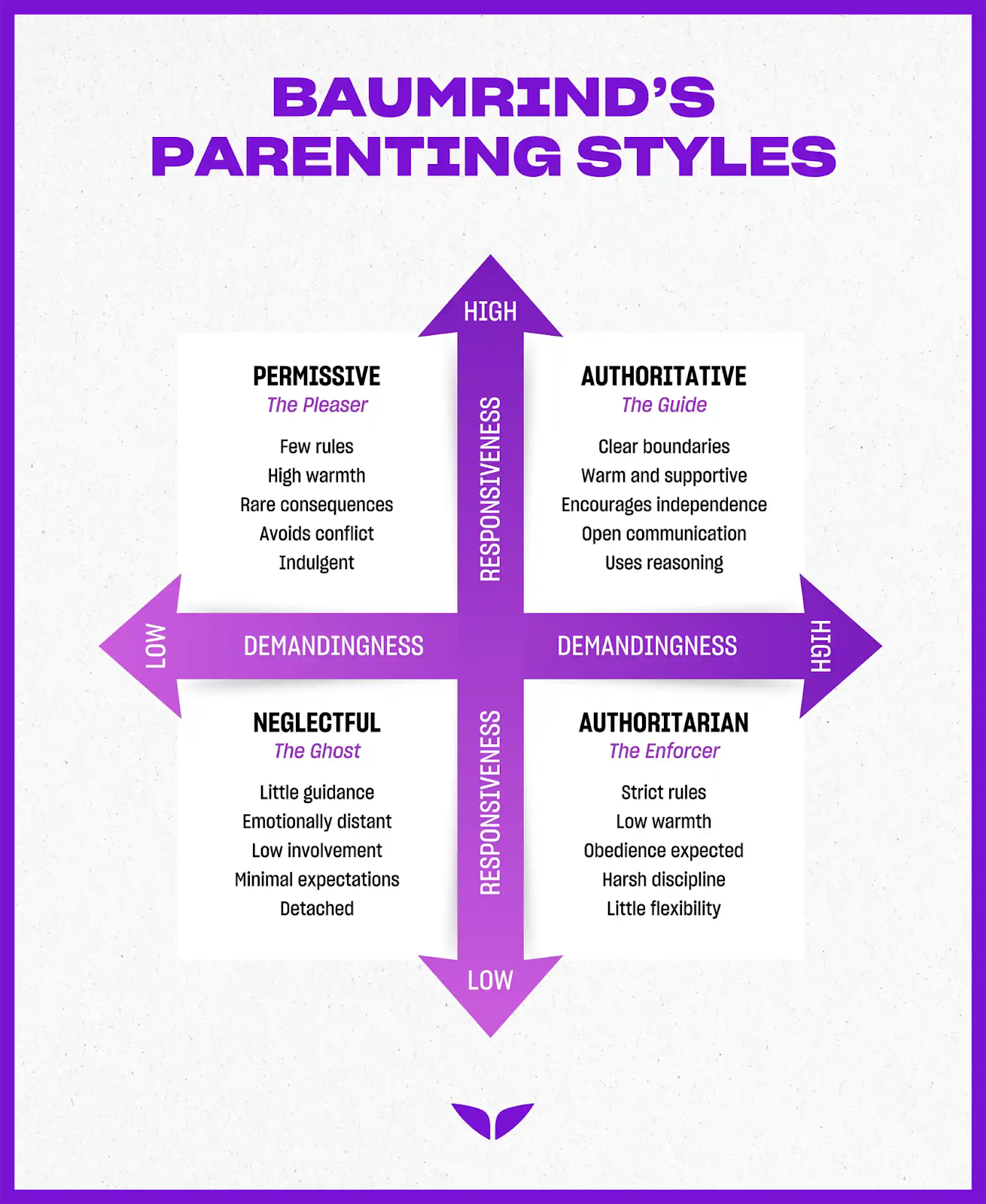
The parenting styles chart gives you a visual snapshot of where you land on two axes: warmth and demandingness. It's not a personality test. It's a diagnostic tool that shows how your daily choices cluster into patterns. You might see yourself clearly in one quadrant, or you might notice you shift between two depending on stress, your child's age, or the situation at hand.
The chart works because it simplifies complexity without erasing nuance. Instead of trying to remember dozens of parenting behaviors, you can locate yourself on two continuums and immediately understand the implications. High warmth paired with high demandingness puts you in the authoritative zone.
Low warmth with high demands signals authoritarian tendencies. High warmth with low demands points to permissiveness. Low on both axes means uninvolved parenting. Once you see where you fall, you can reflect on whether that position aligns with the outcomes you want for your child.
Using the Chart to Reflect on Your Tendencies
Parents rarely fit neatly into one category. You might be authoritative most of the time, but slip into authoritarian patterns when exhausted or permissive when you feel guilty about working long hours. The chart helps you notice those shifts. When you can name the pattern, you can decide whether it serves your child or just relieves your discomfort in the moment.
Start by asking yourself a few diagnostic questions. When your child breaks a rule, do you explain why the rule exists or simply enforce the consequence? That reveals your position on demandingness. When your child is upset, do you make time to listen and validate their feelings, or do you dismiss them as overreacting? That shows where you land on warmth. When your child wants something you've already said no to, do you hold the boundary or cave to avoid conflict? That's another signal of warmth versus demandingness.
The answers matter because they create the emotional climate your child navigates daily. A child who receives warmth but no structure learns that feelings matter, but actions don't have consequences. A child who gets structure but no warmth learns that performance matters but emotions are irrelevant. The authoritative sweet spot combines both, teaching children that their feelings are valid and that their behavior matters.
The Five Dials That Power the Chart
Baumrind's two-axis model is elegant, but it compresses five underlying components that shape how warmth and demandingness actually show up. These five dials, based on the work of Earl Schaefer and Diana Baumrind, give you more precise control points for adjustment.
1. Warmth
Measures how you express love. It includes verbal affirmation, physical affection, quality time, and the occasional indulgence that shows your child they matter. Some parents are naturally expressive. Others show love through acts of service or provision. The dial isn't about the quantity of affection but whether your child feels genuinely valued.
2. Acceptance
Reflects how responsive you are to your child's ideas, needs, and emotions. At one extreme, you welcome their input and validate their feelings even when you disagree. At the other, you reject or dismiss their perspective as inconvenient or irrelevant. Children who experience high acceptance develop confidence in their own thoughts. Those who face constant rejection learn to hide their inner world.
3. Control of behaviors
Determines how much you regulate what your child does. Young children need significant behavioral control to stay safe. As they grow, that control should decrease, giving them room to make choices and learn from mistakes. Parents who maintain high control as children age often produce compliant teenagers who lack decision-making skills. Those who release control too early create chaos and anxiety.
4. Control of autonomy
Governs how much space you give your child to develop their own identity. The terrible twos happen because toddlers realize they're separate people with their own preferences. Healthy development requires increasing autonomy over time. Parents who micromanage every choice stifle independence. Those who offer too much autonomy too soon leave children feeling unmoored.
5. Expectations
Shape what you believe your child should achieve. Reasonable expectations motivate effort and build competence. Unrealistic ones create chronic stress and fear of failure. The dial isn't about setting the bar high or low. It's about calibrating expectations to your child's developmental stage, temperament, and circumstances.
When you consider these five dials instead of two broad categories, the number of possible parenting styles expands exponentially. Tiger parenting, lighthouse parenting, free-range parenting, and dozens of other labeled approaches all reflect different positions on these five controls. That's why the chart feels both clarifying and incomplete. It shows the big picture, but can't capture every variation.
Most parents need simple ways to practice the skills their chosen approach requires. When you're working on increasing warmth without losing structure, you need low-stakes moments to build that muscle. My Coloring Pages offers 21,838+ FREE coloring pages that create those exact opportunities. Sitting together while your child colors gives you space to be present without needing to perform, teach, or correct. It's warmth in action, the kind that builds trust and makes the harder conversations about boundaries feel less adversarial. These small, consistent moments of connection reinforce the authoritative balance you're trying to establish.
Where Modern Labels Fit on the Five Dials
The internet has generated countless parenting labels, each claiming to be distinct. Most are just variations on the five-dial model. Lighthouse parenting, for instance, describes high warmth and moderate demandingness with strong acceptance and gradually decreasing behavioral control. The lighthouse metaphor suggests a steady, visible presence that guides without controlling. It's authoritative parenting with a poetic name.
Commando parenting, popularized by Dr. Phil, sits firmly in the authoritarian zone: high behavioral control, low acceptance, low warmth. It prioritizes discipline and structure above connection. Tiger parenting occupies similar territory but adds extremely high expectations, particularly around academic achievement. Both approaches lead to short-term compliance and, over time, resentment.
Snowplow parenting represents high warmth paired with excessive behavioral and autonomy control, but in a protective rather than punitive direction. These parents remove obstacles before their child encounters them, which sounds loving but actually undermines competence. The child never learns to handle difficulty because difficulty never arrives. They end up dependent and anxious, unsure whether they can manage life without parental intervention.
Koala parenting emphasizes physical closeness and emotional attunement, often linked to attachment theory. It's high warmth, high acceptance, but variable on the other dials depending on how it's practiced. Done well, it supports secure attachment. Taken to extremes, it can become enmeshed, where the parent struggles to let the child develop independence.
Free-range parenting offers high warmth and acceptance with deliberately low behavioral control once children reach appropriate developmental stages. The goal is to build self-reliance by allowing age-appropriate risk. When parents set this up thoughtfully, with clear safety plans and gradual skill-building, it works. When they simply stop supervising out of convenience or ideology, it crosses into neglect.
Each label tries to capture something specific, but they all map back to the same underlying dimensions. Understanding the five dials gives you more flexibility than adopting someone else's branded approach. You can adjust individual components based on what your child needs right now, rather than committing to a fixed philosophy that may or may not fit.
The chart doesn't tell you what to do. It shows you where you are and helps you see the distance between your current approach and the outcomes you want. That gap is where the real work happens.
Related Reading
- Tiger Parenting
- ADHD Parenting
- Solo Parenting
- PACE Parenting
- Parenting Research News
- Parenting Hell
- Therapeutic Parenting
- Permissive Parenting Style
- Parenting Styles Psychology
- FAFO Parenting
- Uninvolved Parenting
- Indiana Parenting Time Guidelines
- Authoritarian Parenting Style
- Parenting Classes
- Good Parenting
- Authoritative Parenting Style
- Positive Parenting
- Montessori Parenting
- Snowplow Parenting
Tips for Choosing or Adjusting Your Parenting Style

Your parenting style isn't set in stone. Most parents shift between approaches without noticing. You might enforce homework rules with a clear structure, then let bedtime slide when you're exhausted, then snap into harshness when stress peaks. That inconsistency isn't failure. It's human. The work starts when you notice the pattern and decide whether it serves your child or just manages your own discomfort.
Your primary job isn't to follow a perfect system. It's to parent in a way that helps your child develop positive beliefs about themselves and the world. That outcome doesn't come from rigid adherence to one style. It comes from honest self-assessment, intentional adjustment, and the willingness to meet your child where they are right now.
Take the Self-Assessment
Before you can adjust anything, you need to see where you currently land. This isn't about judgment. It's about clarity. Answer these ten questions using a scale of 1 to 5, where 1 means never and 5 means always.
- How often do you set clear rules for your child and explain the reasons behind them?
- When your child disagrees, how often do you encourage them to share their opinions?
- How frequently do you comfort and support your child when they are upset?
- Do you expect your child to follow rules without questioning them?
- How much freedom do you give your child to make their own choices?
- How often do you stay actively involved in your child's daily life?
- Do you leave your child to manage things on their own?
- How often do you expect quick compliance without explaining your decisions?
- When setting high standards, how often do you also guide your child toward achieving them?
- How much attention do you give to your child's emotions?
Add up your total. A score between 10 and 17 suggests neglectful tendencies. Between 18 and 25 points for permissive patterns. A range of 26 to 35 indicates authoritarian leanings. Scores from 36 to 50 reflect authoritative approaches.
The number matters less than what you do with it. If you scored in the authoritarian range but want your child to feel emotionally safe enough to share their struggles, you've identified a gap. If you landed in the permissive zone but notice your child struggles with self-discipline, you've found your starting point. The quiz doesn't box you in. It shows you the distance between your current approach and the outcomes you want.
Pause Instead of Project
One of the biggest blocks to real connection is projection. You take your anxieties, expectations, or unresolved feelings and unknowingly drop them onto your child. You might interpret their silence as anger toward you when they're actually processing something unrelated. You might push them toward activities you wish you'd pursued, not ones that match their interests. The more you project, the less space there is for them to discover who they actually are.
The conscious pause interrupts this pattern. When your child does something that triggers you, stop for a beat before reacting. Ask yourself whether this moment reflects your child's reality or your own ego talking. That pause creates space between stimulus and response. It lets you choose connection over control, curiosity over assumption.
Parents who practice this regularly report feeling less reactive and more present. Their children sense the shift. When you stop scripting their life according to your unexamined beliefs, they relax. They stop performing for your approval and start showing you who they really are.
Practice Empathic Engagement
Hidden expectations quietly sabotage the parent-child bond. Children smell them immediately. They know when you want something from them that has nothing to do with their actual needs. That awareness makes them withdraw. They stop sharing because they've learned that your agenda matters more than their experience.
Trading expectation for empathy requires three steps. First, name the expectation. Pause and ask yourself what you're hoping for that reality isn't giving you. Maybe you expected your child to love soccer because you did. Maybe you assumed they'd be naturally outgoing because you value social confidence.
Second, reevaluate it. Ask whether the expectation is even relevant or just a cultural script you're unconsciously running. Third, make a choice. Either adjust the expectation to match your child's reality, or adjust the situation if the expectation truly serves their development. But don't stay stuck in the mismatch.
When you let go of the agenda in your head, you free up space in your heart. That's when you can truly see your child in their natural state. Child psychologist Reem Raouda, who has studied over 200 kids, emphasizes that emotionally safe parenting works better than rigid adherence to a style precisely because it prioritizes attunement over expectations.
Lead with Compassion
Parents constantly judge their children. You label their actions as good or bad, positive or negative, as if someone appointed you the final authority on their worth. That judgment creates distance. It positions you as superior and your child as perpetually falling short.
Compassion offers a different path. When you lead with it, you step out of superiority and into humility. You stop seeing yourself as the judge of right and wrong and instead meet your child with understanding. You recognize that their difficult behavior often signals an unmet need or an emotion they don't yet have words for. This softens reactivity, expands tolerance, and builds the kind of trust that helps children feel safe enough to grow into who they are meant to be.
Most families need simple, repeatable moments where compassion can take root without pressure. When you're working on responding with understanding instead of judgment, you need low-stakes opportunities to practice that shift. My Coloring Pages offers 21,838+ FREE coloring pages that create exactly those moments.
Sitting together while your child colors gives you space to be present without needing to correct, teach, or evaluate. It's compassion in action, the kind that builds trust and makes the harder conversations about behavior feel less adversarial. These small, consistent moments reinforce the emotional safety you're trying to establish.
Feel Your Feelings
Most of us weren't taught to sit with our emotions. We learned to push them down, hide them, or get over them quickly. So when big feelings rise up, we react instead of respond. We snap, yell, or shut down because we never developed the skill of simply feeling what's present without flinging it at someone else.
Feelings aren't meant to be reacted to or broadcast to everyone around you. They're meant to be felt. The next time your chest tightens or your jaw clenches, pause and name what's happening. Say to yourself, "This is anger. This is stress. Let me feel it, not act on it." That simple act of naming and allowing breaks the cycle of reactivity. It shows your child how to manage their own emotions by watching you do it. It creates a calmer, safer space for both of you.
Parents who learn this skill report fewer explosive moments and more genuine connections. Their children stop walking on eggshells because they trust that emotions won't turn into unpredictable outbursts. They learn that feelings are information, not emergencies.
Choose Connection Over Control
Control feels like progress. It creates the illusion that you're managing the chaos, that your authority keeps everything in order. But control is often the wall standing between the love you feel and the connection your child needs. When you prioritize control, you teach your child that compliance matters more than a relationship. They learn to hide parts of themselves to avoid conflict. They stop asking questions because your answers feel like verdicts.
Connection requires a different approach. It asks you to be curious rather than commanding. Ask more questions. Stay open-hearted even when their choices confuse or frustrate you. Invite your child to share how they see things. When you do this, the energy shifts. They sense that you're genuinely interested in their perspective, not just waiting for a chance to correct them.
Connection with your child can only grow from your connection to yourself. If you're fragmented, reactive, or closed off, your child senses the holes rather than the wholeness. That's why self-awareness and mindfulness sit at the center of conscious parenting. You can't offer emotional safety if you're not emotionally grounded. You can't teach self-regulation if you haven't learned it yourself.
But knowing how to adjust your approach is only part of the equation. The harder question is how to sustain those changes when stress mounts and old patterns resurface.
Related Reading
- Helicopter Parenting
- Toxic Parenting Phrases
- Best Parenting Advice
- Authoritative vs Authoritarian Parenting
- Parenting Therapy
- Lighthouse Parenting
- Parenting Memes
- Parenting With Love and Logic
- Parenting Techniques
- Soft Parenting
- Triple P Parenting
- Parenting Agreement
- Bible Verses About Parenting
- Nacho Parenting
- Styles of Parenting
- Elephant Parenting
- Parenting Hacks
- Horizontal Parenting
- Parenting Resources
Explore Creativity While Reinforcing Positive Habits
Understanding your parenting style is just the first step. The lessons stick when your kids explore, create, and learn through activities that match how you want to raise them. A coloring page isn't just a distraction. It's a quiet space where your child practices focus, makes choices, and finishes something they started. Those are the same skills that matter when they're learning to regulate emotions, respect boundaries, or persist through difficulty.
Parents working to shift from permissive to authoritative patterns often struggle with how to introduce structure without triggering conflict. Coloring offers a low-stakes entry point. You're not suddenly enforcing a rigid homework schedule or issuing new rules. You're sitting together for a shared activity with a clear beginning and end. Your child chooses the colors. You stay present without controlling the outcome. That balance mirrors the authoritative approach: guidance without dominance, warmth without chaos. Over time, these moments build the muscle memory for how structure and connection coexist.
For parents moving away from authoritarian tendencies, coloring offers opportunities to practice responding rather than directing. When your child asks which color to use, you can resist the urge to tell them the "right" answer. When they color outside the lines, you can let it go instead of correcting. These small adjustments retrain your instinct to control. Your child notices. They start to trust that their choices matter, that mistakes aren't failures, and that your presence doesn't always come with judgment.
Families working on emotional safety need activities that don't put pressure on performance. When you download a page based on your child's current interest, whether it's dinosaurs, space, or their favorite character, you're signaling that you see them. You're not pushing your agenda. You're meeting them where they are. That recognition builds trust faster than any lecture about feelings. Coloring side by side becomes a container for harder conversations because your child has learned that time with you feels safe, not evaluative.
My Coloring Pages gives you instant access to 21,838+ free designs that match whatever your child cares about right now. You can browse by theme, create custom pages that reflect their specific interests, or print something in seconds when you need a calm transition between activities. Parents use it to reinforce lessons about patience, celebrate small wins after a tough day, or simply create predictable moments of togetherness that don't require screens or structured curriculum. Rated 4.8 out of 5 by over 20,000 families, it's become the easiest way to turn abstract parenting goals into tangible daily practices that actually fit into real life.