AI Vs Human Creativity: Which One is Better for Innovation?
AI vs Human Creativity explored by My Coloring Pages—see which drives real innovation and how to foster creativity that actually works.

The question of AI vs human creativity is no longer theoretical. As AI tools become capable of generating art, writing, and lesson materials in seconds, educators, parents, and designers are rethinking what it means to be creative and where human imagination still holds the edge. Understanding how both work together can open up faster, more effective ways to develop ideas across any context.
For anyone looking to build creative activities without starting from scratch, having the right resources makes a real difference. Ready-made, customizable materials free up time and mental energy, so you can focus on the creative thinking that matters most. A practical place to start is Download 75000+ Free Customized Worksheets, where you can tailor coloring pages and activity sheets to fit almost any need.
Table of Contents
- Is AI More Creative Than Humans?
- Importance of Human Creativity
- What Happens When You Neglect Human Creativity
- AI Vs Human Creativity: Which One is Better
- 15 Tips to Boost Your Creativity
- How to Use AI for Assisting Human Creativity in 6 Ways
- How to Use AI for Assisting Human Creativity
- A Better Human-AI Creativity Workflow
- Let AI Build the Starting Point—Not Have the Idea for You
Summary
- AI raises the creative floor without reaching the creative ceiling. Research published in Scientific Reports found that AI responses scored higher than average human responses on creative tasks, but the top 5% of human thinkers still outperformed AI in divergent thinking. That gap at the upper extreme is where the most consequential creative work happens.
- Lived experience is a creative resource that training data cannot replicate. Research published by IDIBELL in 2026 confirmed that human creativity still surpasses generative AI in creative tasks, in part because each person brings a unique map of failures, relationships, and observations that shapes how they approach a problem. When millions of people start from the same AI-generated starting point, the resulting ideas begin to converge in ways that are hard to detect but easy to measure over time.
- The order in which AI enters the creative process changes what kind of thinker you become. Students using AI tools showed a 30% decline in creative problem-solving scores compared to those who did not, according to research cited by Killer Innovations with Phil McKinney. Consistently outsourcing the generative phase before engaging your own thinking trades the skill of origination for the skill of selection, and those are not interchangeable.
- Polished output and original thinking are not the same thing. A study of more than 370,000 college admissions essays found that post-ChatGPT essays showed more diverse vocabulary but fewer original ideas, and some AI-influenced writing was even rated as more creative because the language sounded varied. Frontiers in Psychology research found that AI systems show a convergent bias, producing a limited creative range despite high average originality scores, meaning impressive surface quality can mask a narrower set of ideas underneath.
- A 2026 large-scale comparison of 9,198 humans and more than 215,000 language model observations found humans slightly ahead on average and considerably stronger at the upper end of creativity. AI performs well in the early expansion phase of creative work, where generating volume quickly has real value. But humans still produce the outlier ideas that nobody expected, and the judgment required to decide which idea fits a specific person, moment, or problem remains a distinctly human function.
- The discomfort of not knowing yet is where creative thinking actually develops. Tolerating ambiguity, sitting with an unfinished idea, and resisting the pull toward the first available answer are not inefficiencies in the creative process. They are the process, and consistently bypassing that phase by outsourcing to AI early means losing practice with the skill that produces genuinely new thinking.
- My Coloring Pages' Download 75000+ Free Customized Worksheets addresses this by keeping the human idea at the center, letting anyone describe a specific vision or upload a meaningful image and generate a finished page from that personal starting point rather than from a generic template.
Is AI More Creative Than Humans?
AI outperforms average humans on some creative tasks — but this doesn't mean it replaces all the different ways humans can be creative. The distinction is critical: breadth of performance is not the same as depth of creative potential.
💡 Tip: Don't confuse AI's consistency with true creative superiority; they measure different things.
🎯 Key Point: AI raises the creative floor for average outputs, but cannot reliably reach the ceiling that top human thinkers achieve.
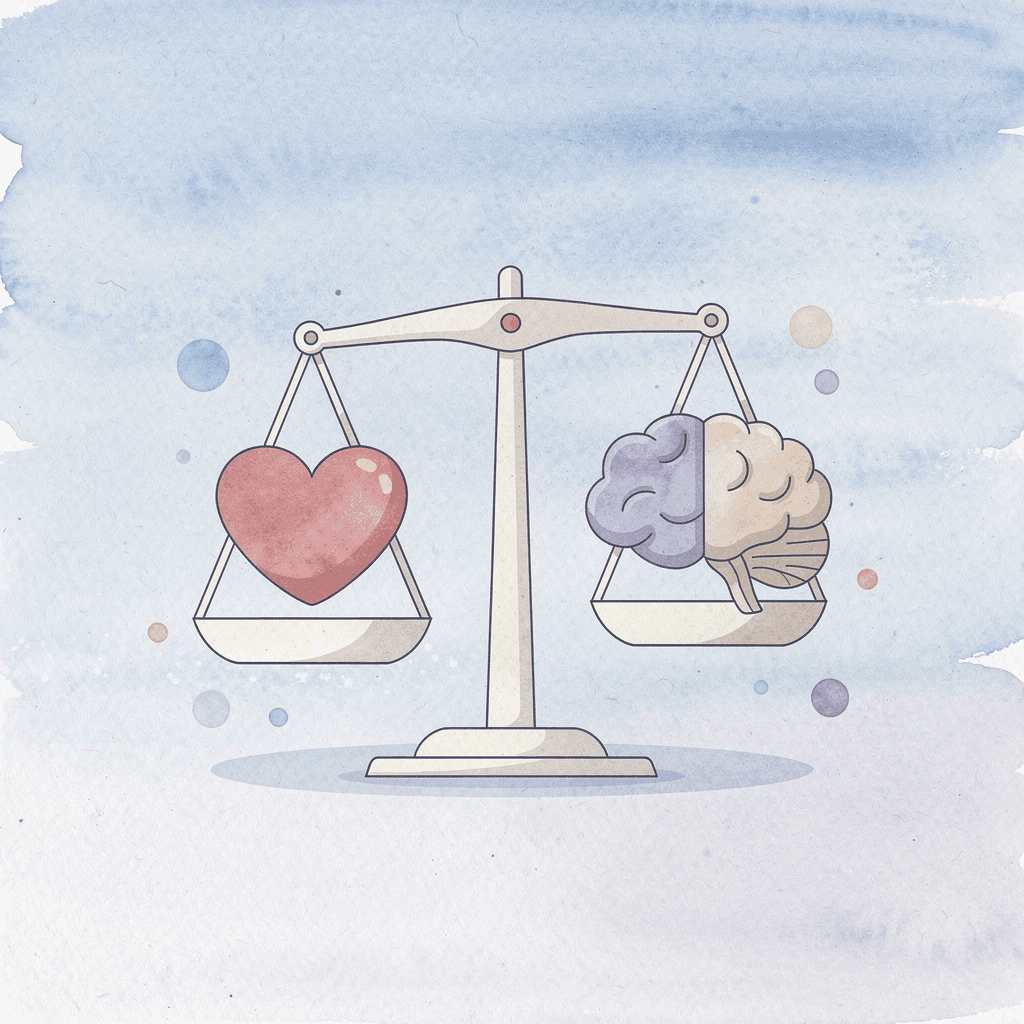
According to Scientific Reports, AI responses were rated as more creative than average human responses — but the top 5% of humans outperformed AI in divergent thinking tasks. This difference matters enormously.
"AI raises the floor of creative output, making mediocre results less common — while the highest human ideas still reach places AI cannot reliably follow." — Scientific Reports, 2023
Creative Performer | Divergent Thinking Result |
|---|---|
Average Human | Rated below AI responses |
AI | Rated above average human responses |
Top 5% of Humans | Outperformed AI |
🔑 Takeaway: AI is a powerful equalizer — it eliminates weak creative output — but the most original, boundary-pushing ideas still belong to exceptional human thinkers.
Why speed isn't the same as judgment
AI's advantage is that it can generate content quickly in volume. Ask it for thirty variations on a concept, and it delivers without fatigue, fixation, or self-doubt. This makes it useful in the early, expansive phase of creative work. But someone must still decide which idea solves the actual problem, which fits the specific audience, and which carries your intended meaning. Idea generation and creative judgment are different skills, and only one belongs entirely to you.
What goes wrong when AI enters the process too early?
The failure point most people miss is what happens when AI enters the process too early. When you see a promising AI-generated idea before forming your own, your thinking orbits that starting point. You're no longer exploring freely; you're refining someone else's suggestion. The fix requires discipline: think first, then use AI to expand outward from your own starting position, not theirs.
How does keeping your imagination as the starting point change the outcome?
Many people who create coloring pages, storybooks, or personalized worksheets for children encounter this problem. The traditional approach either requires technical skills most people lack or produces impersonal results. Platforms like Download 75000+ Free Customized Worksheets work differently: you bring the idea, memory, or specific child in mind, and the AI handles the technical work. Your imagination remains the starting point. AI doesn't make human creativity unnecessary. It makes the generative part faster and cheaper, which increases the value of everything that follows: the selection, the context, the meaning, the judgment. Those things come from a person who cares about the outcome.
Importance of Human Creativity
Your brain is not a search engine. It is a living record of every place you've been, every failure you've learned from, every conversation that changed how you see the world. No two people carry the same record, which means no two people generate ideas from the same starting point. That difference is the whole point of human creativity.
"No two people carry the same record, which means no two people generate ideas from the same starting point. That difference is the whole point of human creativity."
🎯 Key Point: Human creativity is inherently unique, built from a personal archive of experiences, failures, and conversations that no algorithm can replicate.
💡 Tip: Lean into what makes your perspective distinctly yours. Your lived experiences are not background noise; they are your greatest creative asset.
Why your life experience is your most underrated creative asset
When you approach a problem, your brain searches across networks built from your specific history. A nurse who grew up on a farm, a teacher who spent years coding, a parent who once worked in logistics: each brings a different map to the same territory. Research published by IDIBELL in 2026 confirms that human creativity surpasses generative AI in creative tasks because of the richness and specificity of lived experience that no training dataset can replicate. The danger is not that AI produces bad ideas, but that good ideas start looking alike when millions of people begin from the same generated starting point.
What happens when creativity starts from the same generated starting point?
This matters most for problems that existing answers have not solved. Scientific breakthroughs, social innovations, and new business models rarely come from refining the most statistically obvious next step. They come from someone willing to ask what has not been tried yet. If the creative sequence becomes "ask AI, receive likely answer, refine it," we get faster iteration within familiar patterns but lose the stranger, more uncomfortable questions that tend to produce real progress.
How does keeping human intention at the center change the creative outcome?
Most parents and teachers approach personalized creative projects by searching for pre-made templates and hoping they work. The hidden cost is that the finished page carries none of the child's specific world. Platforms like My Coloring Pages flip that sequence: a grandparent describes a memory, a therapist names a child's specific emotional experience, and our AI generates something built around that input rather than replacing it. The human intention stays at the center while our technology handles the technical barrier that once made personalization impossible for most people.
The process matters as much as the product
The creative struggle is not inefficiency: it is the work. When you spend thirty minutes wrestling with a problem, you are searching for connections, testing possibilities, rejecting weak ideas, and deciding what you think. That process builds something in you that the finished product alone cannot. If AI performs the entire generative sequence before you engage, you receive the output but skip the exercise. Over time, the skill weakens quietly, like a muscle when a machine does all the lifting.
What originality actually requires
Sounding creative and having an original idea are not the same thing. Research examining more than 370,000 college admissions essays written before and after ChatGPT's release found that post-release essays showed more varied vocabulary but fewer original ideas. Polished language can make something seem original without being original. A genuinely original thought isn't a familiar idea dressed in better words; it is a connection that didn't exist until someone with a specific life, specific failure, or specific obsession sought it out. The healthiest creative sequence keeps human thinking in the lead: generate your own ideas first, then bring AI in to expand, critique, or refine them.
Related Reading
- How To Encourage Creativity In Kids
- Creativity Quotes
- How To Foster Creativity
- Best Toys For Developing Creativity
- What Is Creativity
- Best Books To Inspire Creativity In Kids
- Best Toys For Promoting Creativity
What Happens When You Neglect Human Creativity
Reversing the creative order matters more than most people admit. When AI consistently goes first, the instinct to generate your own idea before seeking help weakens, the same way a muscle atrophies without use. The consequence unfolds gradually, which is exactly what makes it worth paying attention to.
"When AI consistently goes first, the instinct to generate your own idea before seeking help begins to weaken — the same way a muscle gets weaker when it stops being used."
⚠️ Warning: Damage to human creativity doesn't happen all at once. It's a slow erosion. Because the decline is gradual, most people don't notice until the creative instinct is already significantly weakened.
🔑 Takeaway: Protecting your creative process means being intentional about order. Generate your own ideas first before turning to AI—your ability to think independently depends on it.
The slow replacement of origination with selection
The shift usually starts small. Instead of asking "what do I think?" the first move is to open a prompt window. That single habit, repeated across enough projects, changes what kind of creative thinker you become. You get sharper at evaluating options and weaker at generating them from nothing—a real and measurable trade-off. Killer Innovations with Phil McKinney reports that students using AI tools showed a 30% decline in creative problem-solving scores compared to those who did not. Choosing between Option A, B, and C differs fundamentally from inventing the options yourself.
Why "polished" is not the same as "original"
The output looks good. The vocabulary is precise, the structure is clean, and the phrasing lands with confidence. But polished and original are not the same thing. Frontiers in Psychology found that AI systems show human-like convergent bias, producing a limited range of creative responses despite high average originality scores. When thousands of creators use similar systems as their starting point, the resulting work can be technically excellent yet culturally indistinguishable.
What happens when the template replaces the intention behind the work?
Most people who make coloring pages, storybooks, or personalized creative projects for children start with a familiar template because it feels safer than a blank page. The hidden cost is that the template gradually replaces the personal intention behind the project. Platforms like My Coloring Pages work differently: the human describes a specific vision first—whether a grandparent imagining a storybook around a grandchild's favorite memory or a therapist designing pages around a child's emotional world—and the AI executes that vision rather than replacing it. The idea stays human. The technical barrier disappears.
What happens to confidence when you always compare unfinished thoughts to finished outputs
The confidence problem is particularly damaging because it stays invisible until it becomes deeply rooted. You conceive something rough, then immediately see AI produce something smoother, and your rough idea gets discarded before it develops. Do that consistently and you stop trusting your own creative judgment, not because it failed, but because you never gave it the chance to succeed. Human ideas need time, iteration, and the discomfort of uncertainty to become genuinely good. Comparing an unfinished human thought to an instantly polished AI output is like judging a sketch against a finished painting and concluding you cannot draw.
The part of creativity that discomfort actually builds
Creative thinking thrives in the uncomfortable middle: the time when you've tried something, it hasn't worked, and you haven't yet found the connection that makes it click. That friction sharpens pattern recognition, forms unexpected combinations, and lets your specific perspective shape the work. When uncertainty gets immediately outsourced, you lose practice tolerating ambiguity—a core skill behind creative problem-solving.
The person who stops drawing because AI produces better images, or stops writing because AI produces cleaner prose, isn't saving time. They're trading the process that develops their thinking for the output that replaces it. The most consequential loss is your own perspective disappearing from the work itself.
AI Vs Human Creativity: Which One Is Better
Neither wins outright. The more useful question is: which type of creativity are we discussing?
🔑 Takeaway: This isn't a simple winner-takes-all debate. AI creativity and human creativity operate on fundamentally different terrain, and understanding that distinction is the real starting point.
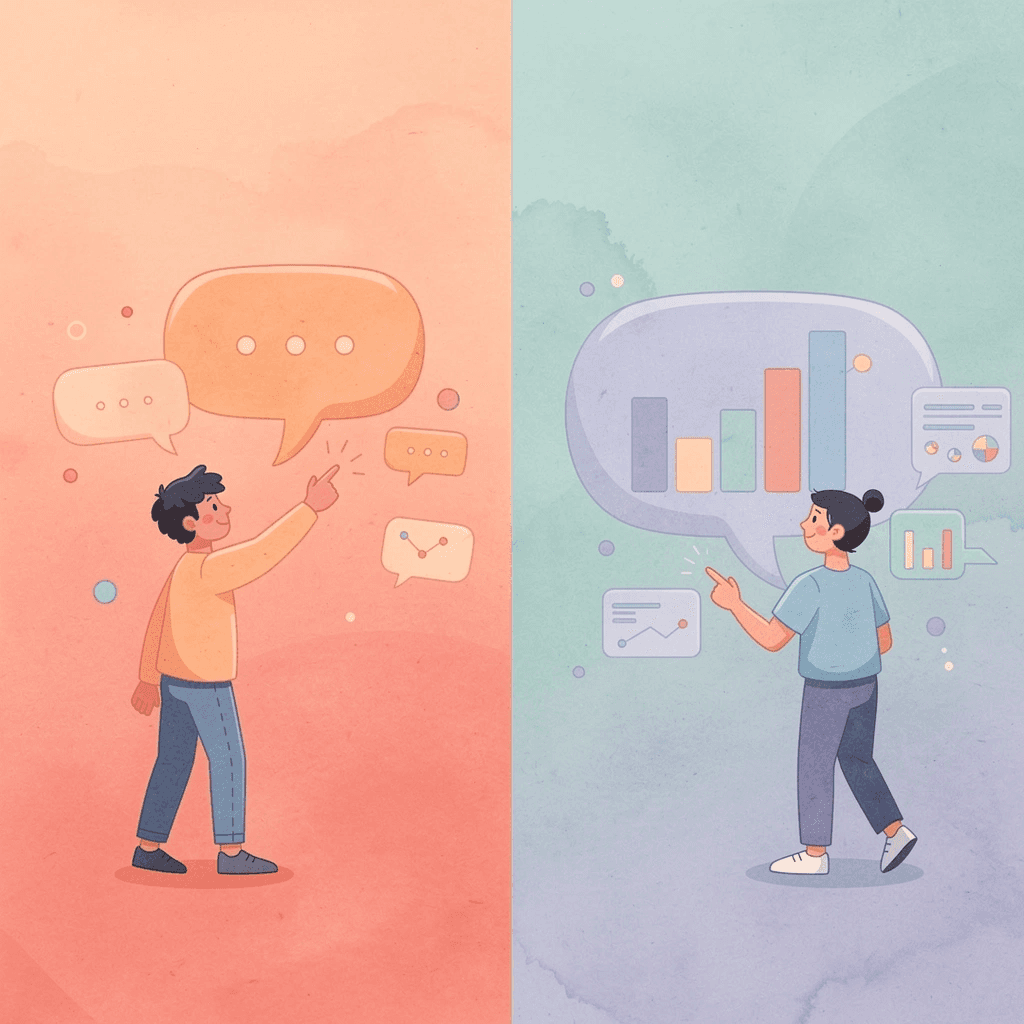
AI and humans don't compete on the same creative terrain. A 2026 large-scale comparison of 9,198 humans and more than 215,000 language model observations found humans slightly ahead on average — and considerably stronger at the upper creative extreme. AI raises the creative floor for everyone, but the ceiling still belongs to humans who bring genuine perspective, lived context, and the willingness to ask questions nobody has thought to ask yet.
"Humans were slightly ahead on average and considerably stronger at the upper creative extreme — AI raises the creative floor, but the ceiling still belongs to humans." — Large-Scale Creativity Comparison Study, 2026
Dimension | AI Creativity | Human Creativity |
|---|---|---|
Consistency | ✅ High — reliable output at scale | ❌ Variable — depends on mood, context |
Creative Floor | ✅ Raises baseline for everyone | ✅ Elevated further by AI tools |
Creative Ceiling | ❌ Limited by training data | ✅ Uncapped — driven by lived experience |
Lived Context | ❌ Absent — simulated, not felt | ✅ Core strength — real perspective |
Novel Questions | ❌ Rarely asks what's never been asked | ✅ The defining human advantage |
Speed & Volume | ✅ Exceptional | ❌ Slower, resource-intensive |
💡 Tip: Use AI as a creative floor-raiser — let it handle volume and consistency — while reserving your human perspective for the work that demands genuine insight and original questioning.
⚠️ Warning: Treating AI output as a creative ceiling is the biggest mistake creators make. It's a starting point, not a finish line.
Where AI Has a Real Advantage
For divergent thinking tasks—generating thirty campaign concepts, fifteen story endings, or a dozen visual directions—AI excels. It doesn't fatigue after the first five ideas as humans do, and it avoids getting stuck on obvious answers. According to HP Tech Takes, AI processes vast amounts of information at incredible speeds. This speed matters most in the early expansion phase of creative work, when quantity precedes quality. But quantity is not the same as originality. The same 2026 research found that humans produced the most unusual, outlier ideas at the top of the distribution. AI generates more options; humans produce the unexpected ones.
Where Human Creativity Holds Ground
The failure point is usually judgment. When AI generates fifty ideas, someone must decide which one matters, which fits the moment, which carries meaning for a specific person in a specific situation. Georgetown neuroscientist Adam Green's research shows that human creative ideas emerge from semantic networks shaped by individual life experience, which is why two people starting from the same prompt arrive at completely different, genuinely original places. A grandmother building a personalized coloring book for her granddaughter isn't selecting images—she is encoding memory, relationship, and love into every page choice, and no AI knows which detail makes that child laugh.
How do the right tools close the gap between imagination and execution?
Most people struggle with the gap between imagination and execution. Tools like My Coloring Pages close that distance, letting anyone describe an idea or upload a photo to generate something uniquely personal without design skills. The human brings the why; the platform handles the how.
What kind of creativity actually matters most?
The critical difference between AI and human creativity is not how much work gets done or how polished it looks: it's knowing which problem is worth solving. HP Tech Takes notes that AI excels at speed and pattern recognition, but lacks the emotional intelligence and contextual understanding humans possess. This distinction emerges most clearly in situations involving people and emotions, where the right answer depends on understanding who the person is, their history, and what matters to them. A therapist selecting coloring pages to help a child with anxiety isn't choosing random images; she's making decisions based on her knowledge of the child's condition and emotional needs—something no computer prompt can replicate.
How should humans and AI work together in the creative process?
The strongest creative model is human-led creativity with AI assistance: start with your own idea, use AI to expand unconsidered angles, then apply human judgment to decide what's worth keeping. That sequence protects what actually matters in creativity. But knowing where AI fits in that sequence is harder than it sounds, and getting it wrong costs more than most people expect.
15 Tips to Boost Your Creativity
1. Force Yourself to Generate Ideas Before Looking for Inspiration
Problem this tackles: Reaching for an answer before you've had an idea of your own. Before searching Google, Pinterest, social media, or any other source, write down your first ideas independently.
For example, if you need a birthday theme, article angle, design concept, or solution to a work problem, challenge yourself to produce 5–10 possibilities first. Those numbers are only practical starting points, not magic creativity thresholds.
Your first few ideas may be obvious. That's okay. The important part is forcing yourself beyond:
“I don't know.”
and into:
“What else could work?”
That gives your own associations a chance to appear before somebody else's ideas anchor your thinking.
2. Use the “10 More Ideas” Rule When You Think You're Finished
Problem this tackles: Settling for the first obvious solution. Your first idea is rarely your only possible idea. If you've already brainstormed five solutions, challenge yourself to invent another ten—even if some are ridiculous.
For example
“How could I make my bedroom feel more interesting?”
Your first answers might be
- Paint it.
- Add plants.
- Change the bedding.
Keep going.
Eventually you might reach
- Create a rotating mini-gallery.
- Project shadows onto a wall.
- Turn travel souvenirs into a display.
- Create a reading corner around one unusual object.
Creativity often improves when you push past the answers that came to mind automatically.
3. Give Yourself Constraints Instead of Complete Freedom
Problem this tackles: Freezing in front of unlimited possibilities.
Ironically
“Create anything you want.”
can be harder than:
“Create something using only these three things.”
Try restrictions such as
- Write a story in 100 words.
- Take ten interesting photos without leaving your house.
- Cook something using five ingredients you already have.
- Draw using only circles.
- Decorate a room without buying anything.
- Think of a solution that costs less than $10.
Constraints force your brain to search for unusual combinations within limited options. Instead of reducing creativity, the restriction can give it somewhere to start.
4. Do Something Creative You're Bad At
Problem this tackles: Perfectionism and the belief that creativity only counts when the result is impressive.
Try something where you have absolutely no reputation to protect.
- Paint badly.
- Write terrible poetry.
- Make clay figures.
- Dance.
- Take strange photographs.
- Learn three guitar chords.
- The goal isn't mastery.
It's rebuilding your tolerance for
“I don't know how to do this yet.” If every creative activity has to produce something impressive, you'll naturally avoid experimentation. Sometimes the most useful creativity exercise is making something you have no intention of showing anyone.
5. Change Your Environment When Your Ideas Feel Repetitive
Problem this tackles: Thinking through the same associations repeatedly. Your surroundings feed your attention. If you spend every day looking at the same desk, same screens, same apps, and same information, you're giving your brain many of the same inputs.
- Change something.
- Work in a library.
- Walk through a neighborhood you rarely visit.
- Go to a museum.
- Browse a bookstore section you normally ignore.
- Sit outside without headphones.
- Visit a market.
Even a walk can expose you to different conversations, architecture, colors, problems, behaviors, and objects. You're essentially giving your brain new material to connect later.
6. Consume Things Outside Your Usual Interests
Problem this tackles: Your ideas beginning to feel like variations of everything you've already seen. If you're a marketer, don't consume only marketing content. If you're a writer, don't read only books about writing.
Try
architecture, psychology, history, fashion, biology, documentaries, photography, mythology, engineering, cooking, music, or anthropology. Interesting ideas frequently come from connecting concepts that normally live in different categories.
For example
- Psychology + UX design
- Nature + architecture
- History + fashion
- Gaming + education
- Storytelling + marketing
The further apart the original ideas are, the more interesting the connection can become.
7. Keep an Idea Bank
Problem this tackles: Assuming creativity only happens when you urgently need an idea. Creative people don't necessarily have brilliant ideas on command. They often collect interesting fragments.
Keep one place for
- Strange questions
- Interesting phrases
- Photos
- Observations
- Problems you've noticed
- Story ideas
- Things people say
- Designs you liked
- “What if?” thoughts
- Ideas you're not ready to use
Then, when you need inspiration, you aren't always starting from zero. You have a collection of things your own attention found interesting.
8. Practice Connecting Two Unrelated Things
Problem this tackles: Losing the ability to make your own unusual associations.
Pick two random things
Coffee + libraries
Then ask
“What could connect these?”
Maybe
- A library café.
- Books matched to coffee personalities.
- A reading challenge where each genre corresponds to a drink.
Now try:
- Gardening + gaming
- Fashion + astronomy
- Cooking + psychology
- Photography + memory
- Don't worry about whether the ideas are useful.
You're training the mental action behind a lot of creativity
A + B → something that wasn't obvious before.
9. Ask “What If?” More Often
Problem this tackles: Becoming better at following existing patterns than questioning them.
Take something ordinary and change one assumption.
- What if restaurants had no menus?
- What if university classes lasted 20 minutes?
- What if a horror story were told by the monster's mother?
- What if this product were designed for someone completely different?
- Then follow the consequences.
“What if?” forces you out of
“How does this normally work?”
and into
“How else could it work?” That distinction matters when you're trying to strengthen original thinking.
10. Let Yourself Be Bored Occasionally
Problem this tackles: Feeling uncomfortable whenever your mind isn't being stimulated.
The second nothing is happening
- Phone out.
- Instagram.
- TikTok.
- YouTube.
- Music.
- Podcast.
- Messages.
Your brain rarely gets a moment of quiet. But unstructured time lets thoughts wander, and unrelated ideas collide.
Try taking
- a short walk without headphones,
- a shower without bringing entertainment into the room,
- or ten quiet minutes without immediately reaching for a screen.
You don't need hours. The goal is simply to stop filling every gap where an original thought might otherwise appear.
11. Turn Consumption Into Creation
Problem this tackles: Spending your free time experiencing other people's creativity rather than exercising your own. After reading, watching, or listening to something, don't immediately move to the next piece of content.
Respond to it.
- Watched a movie?
- How would you change the ending?
- Saw an outfit?
- How would you style it differently?
- Read an article?
- What do you disagree with?
- Saw a painting?
- What would your version look like?
- Heard a song?
- What story does it make you imagine?
Move from:
- consume → consume → consume
to:
- consume → think → transform → create.
12. Create Before You Edit
Problem this tackles: Killing ideas before they have time to develop.
A common creativity killer sounds like
- “That's stupid.”
- “Someone has probably done it.”
- “That wouldn't work.”
- “I'm bad at this.”
Before the idea has even finished forming.
Separate the process into two stages
Generate first. Judge later. During brainstorming, allow strange, impractical, and incomplete possibilities.
Only afterward ask
Which ones actually deserve further development? If your internal editor is allowed into the room too early, many potentially interesting ideas never survive long enough to become good ones.
13. Solve Small Problems Differently on Purpose
Problem this tackles: Automatically following familiar patterns. Creativity doesn't only need to happen in art. Choose ordinary situations and deliberately seek another approach.
For example
- “Can I organize this differently?”
- “Can I explain this more simply?”
- “Can I use what I already own instead of buying something?”
- “Can I cook this ingredient another way?”
- “Can I make this boring task more enjoyable?”
Everyday creativity gives you frequent, low-pressure opportunities to practice thinking beyond the default answer.
14. Protect a Hobby That Produces Nothing for Your Career
Problem this tackles: Turning creativity into another productivity metric.
- Draw without building a portfolio.
- Take photographs without starting an Instagram account.
- Write without planning to publish.
- Crochet without opening a shop.
- Paint without wondering whether you're talented.
Having an activity with no financial or professional outcome attached gives you somewhere to experiment without constantly evaluating performance. That freedom matters because creativity requires room for bad ideas. If every idea has consequences, you'll naturally become safer.
15. Keep a Human-First Creativity Routine
If you want one simple rule for protecting your creativity, make it:
Create before you consume.
When you face a creative task
- Sit with the problem yourself.
- Write your initial thoughts.
- Generate several possibilities.
- Question the obvious answer.
- Experiment with one or two options.
- Only then look at outside inspiration if you still need it.
This directly reverses the pattern that can weaken independent creativity
Need idea → immediately search → see existing answers → become anchored to them.
Instead, you create
Problem → independent thinking → original possibilities → outside inspiration → refinement.
Creativity Gets Stronger by Being Used
You don't need to become someone who constantly has brilliant ideas.
You need to stop treating every moment of uncertainty as a problem that must be solved immediately by someone—or something—else.
Spend more time
- wondering before searching,
- creating before comparing,
- experimenting before judging,
- and thinking before looking for the answer.
The goal isn't to avoid tools forever.
It's to make sure that when you're faced with nothing but a blank page and your own brain, you still know what to do with both.
How to Use AI for Assisting Human Creativity
The goal of using AI creatively shouldn't be:
"Think for me."
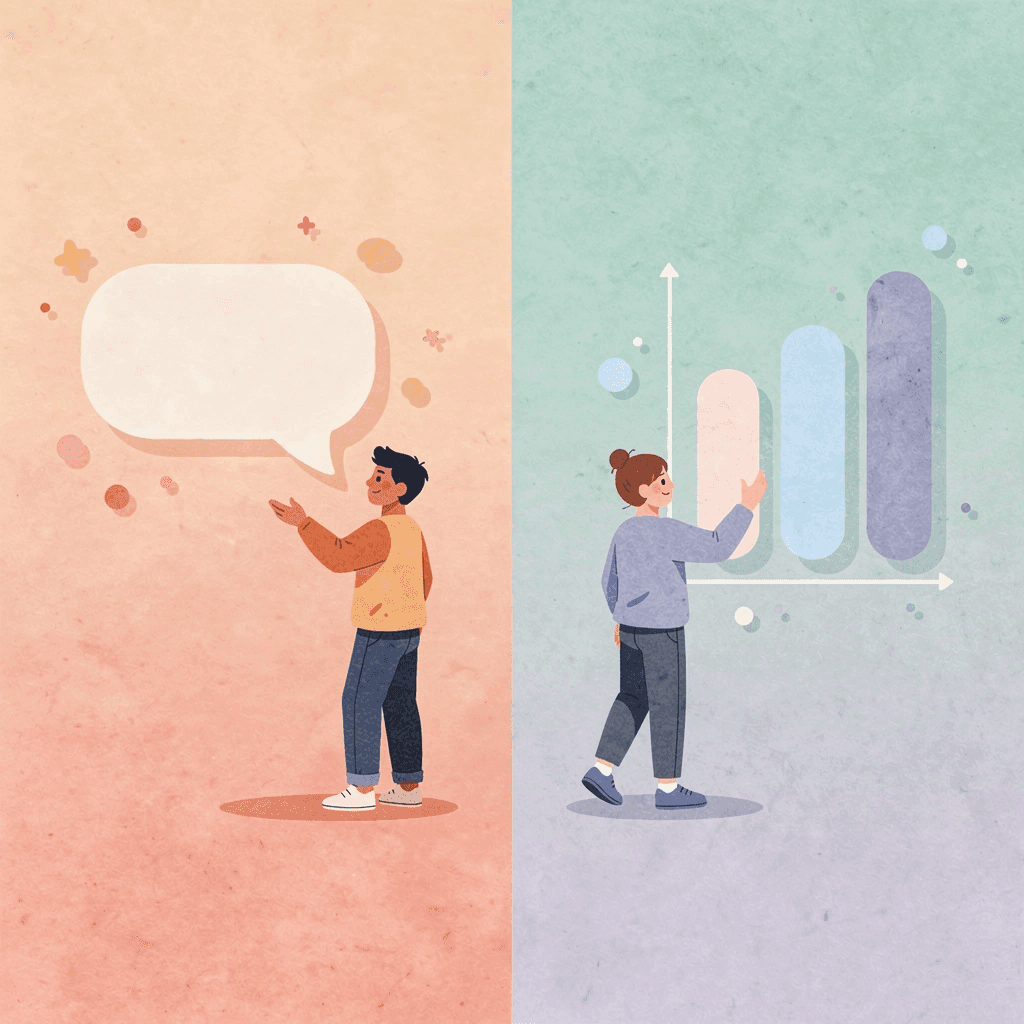
It should be:
"Help me explore what I already started."

💡 Tip: Think of AI as a creative collaborator, not a replacement. The most effective creators use AI to remove friction, generate variations, and challenge assumptions — while keeping their own perspective at the center of every decision.
When used well, AI removes friction, generates variations, challenges assumptions, and develops rough ideas — without replacing the human perspective that makes the work yours.
AI's Role | Human's Role |
|---|---|
Generate variations | Set the creative direction |
Remove friction | Make final judgment calls |
Challenge assumptions | Preserve personal voice |
Develop rough ideas | Own the finished creation |
"AI is most powerful when it amplifies human creativity rather than attempting to replace it — the best outputs emerge when human judgment stays in the loop." — Creative AI Research
⚠️ Warning: Over-relying on AI-generated output without applying your own critical thinking leads to work that feels generic and impersonal — always run AI suggestions through your own creative filter.
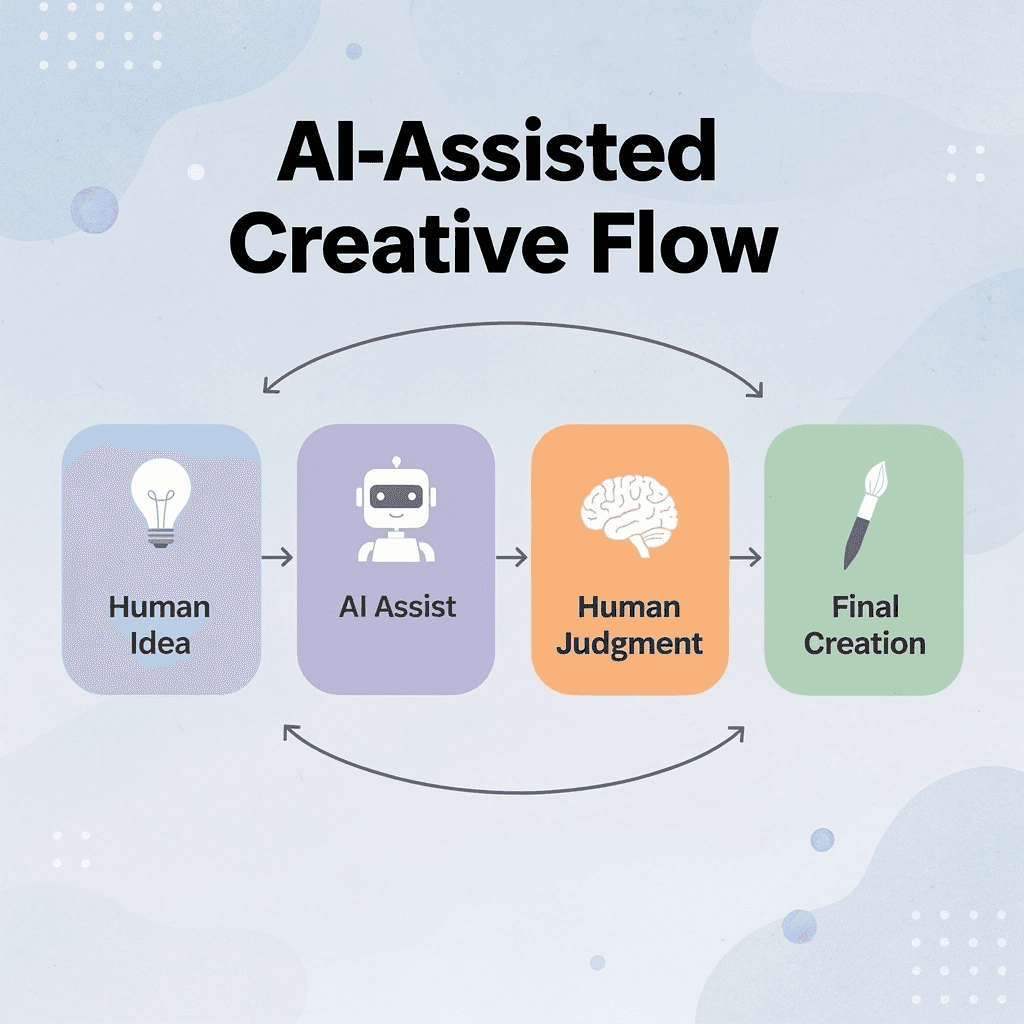
🎯 Key Point: The creative process works best as a loop, not a handoff — your ideas fuel the AI, and AI output fuels your next idea.
Human idea → AI assistance → human judgment → final creation.
Human idea → AI assistance → human judgment → final creation.
1. Start With Your Own Ideas Before Asking AI
Problem this prevents: Becoming dependent on AI for initial ideas.
Before opening an AI tool, spend a few minutes writing down what you think. Generate a handful of possibilities yourself first, whether you're creating a story, campaign, artwork, or solution.
Then ask AI:
"Here are my ideas. What completely different directions haven't I considered?"
Now AI expands your creativity instead of deciding where it begins.
2. Use AI to Generate Alternatives, Not the Final Answer
Problem this prevents: Accepting the first polished AI response as the best idea.
Instead of asking "Make this for me," ask: "Give me five alternative approaches with different moods, audiences, or assumptions."
AI excels at quickly expanding the pool of possibilities. Your job is to decide which idea feels strongest, which fits the actual situation, which feels too generic, and which could become something more original with revision.
3. Ask AI to Challenge Your Idea
Problem this prevents: Falling in love with your first idea and overlooking its weaknesses.
AI doesn't only need to brainstorm.
It can give feedback.
For example:
"What assumptions am I making here?"
"What could make this idea feel predictable?"
"Give me three reasons this concept might fail."
"What would someone with the opposite perspective say?"
That turns AI into a creative sparring partner, not an answer generator.
4. Use AI to Break Creative Blocks
Problem this helps solve: Knowing what you want to create but feeling stuck on the next step. You might have a character but no plot, a painting idea but no composition, a business idea but no name, or a campaign concept but no hook.
Instead of handing the whole project over, ask AI specifically about the part blocking you:
"Here is my character. Give me five conflicts that would force them to make a difficult choice."
You keep ownership of the project while AI helps remove the obstacle.
5. Use My Coloring Pages to Turn Your Own Ideas Into Something You Can Create
Problem this helps solve: Having an idea but lacking the drawing skill, time, or confidence to turn it into a visual project. With My Coloring Pages, describe the image you want or upload a picture, and the app converts it into a ready-to-print coloring page in seconds. You can also browse our 75,000+ free customized coloring pages for inspiration.
How do you turn your idea into a printable coloring page?
I notice you've provided only the beginning of a paragraph. To complete the proofreading task, please share the full paragraph you'd like me to edit.
"A cozy bookstore hidden inside a giant mushroom."
Then: You imagine the concept → My Coloring Pages creates the printable outline → you choose the colors, patterns, additions, and final look. After printing, you can add your own elements: draw characters in the background, change details, add patterns, or create a story around the scene. This removes the technical barrier of drawing from scratch without removing the creative decisions that make it personal.
How does this work for children's ideas and imagination?
For parents, ask children: "What would YOU like to color?" A child might invent a princess riding a dinosaur on the moon, and My Coloring Pages can turn that idea into a printable starting point. The AI handles the translation from idea to outline. The human provides the idea, choices, imagination, and final interpretation—the role AI should play in creativity.
6. Use AI for Tedious Parts So You Have More Energy for Creative Ones
Problem this prevents: Wasting limited creative energy on repetitive work. Not every part of a creative project is equally creative. AI can handle tedious work: organizing rough notes, creating variations, cleaning up formatting, summarizing research, sorting ideas into categories, turning brainstorms into outlines, and checking repetitive details. This frees you for what matters: concept development, experimentation, judgment, storytelling, design choices, and original thinking. The goal isn't to remove yourself from the process; it's to remove the parts that don't need your best creative attention.
7. Ask AI for Perspectives You Wouldn't Naturally Consider
Problem this prevents: Repeating the same ideas by approaching problems from a single angle.
When designing a product, ask AI:
"How would a child approach this?" "How would someone in a completely different industry solve it?" "What would the opposite of my current idea look like?" "What if money weren't a constraint?"
AI can quickly simulate alternative starting points, forcing you to think: "I hadn't considered that direction."
8. Combine AI Suggestions With Your Own Experiences
Problem this prevents: Producing generic work indistinguishable from anyone else's output.
AI might give you a technically strong idea. Before using it, ask: "What can I add that comes specifically from me?"
That might be a personal experience, inside joke, cultural reference, observation, customer problem, memory, sense of humor, or unusual preference. This is where generic AI output becomes your creative work.
9. Don't Let AI Make Every Creative Decision
Problem this prevents: Becoming an editor of AI output instead of a creator. If AI chooses the idea, structure, style, examples, wording, visuals, and final edits, what exactly did you create? You don't need to avoid getting help. Keep some decisions human: You choose the concept, and AI suggests variations. You choose the direction, and AI helps develop it. You decide what stays and AI helps polish it. This preserves creative control where it belongs.
A Better Human-AI Creativity Workflow
Instead of:
Blank page → ask AI → receive answer → use answer
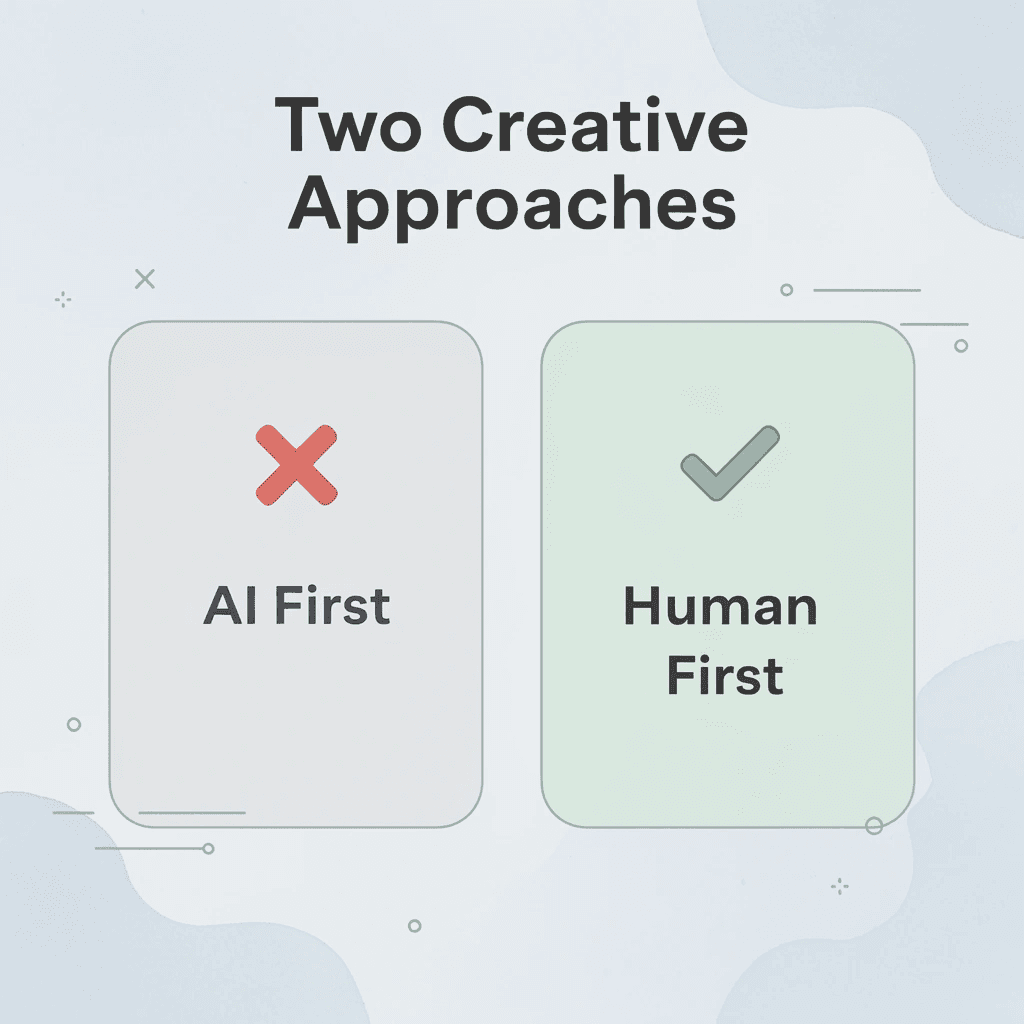
try:
💡 Tip: This 6-step workflow is designed to keep you in the driver's seat — using AI as a creative accelerator, not a creative replacement.
Step | Action | Who Leads |
|---|---|---|
1 | Think independently | You |
2 | Create a rough idea | You |
3 | Use AI to expand, challenge, or visualize it | AI + You |
4 | Compare the possibilities | You |
5 | Add your own context and perspective | You |
6 | Make the final creative decisions yourself | You |
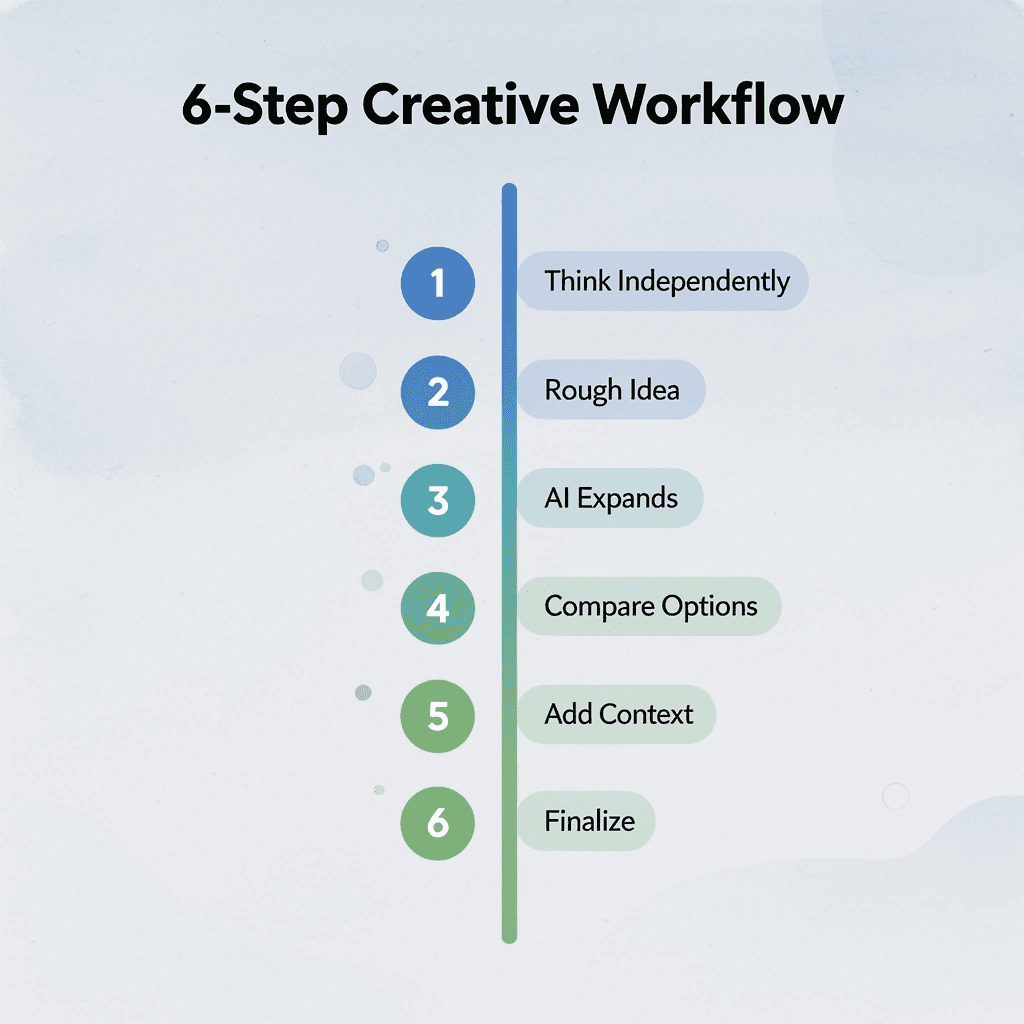
🎯 Key Point: Notice that five out of six steps are human-led. AI enters at step 3 — after you've already done the foundational thinking. This sequence is critical to preserving creative ownership.
"AI is most valuable when it increases the number of things you could create without deciding what you should create. Let AI reduce the friction. Don't let it remove human thinking." — JADM Research
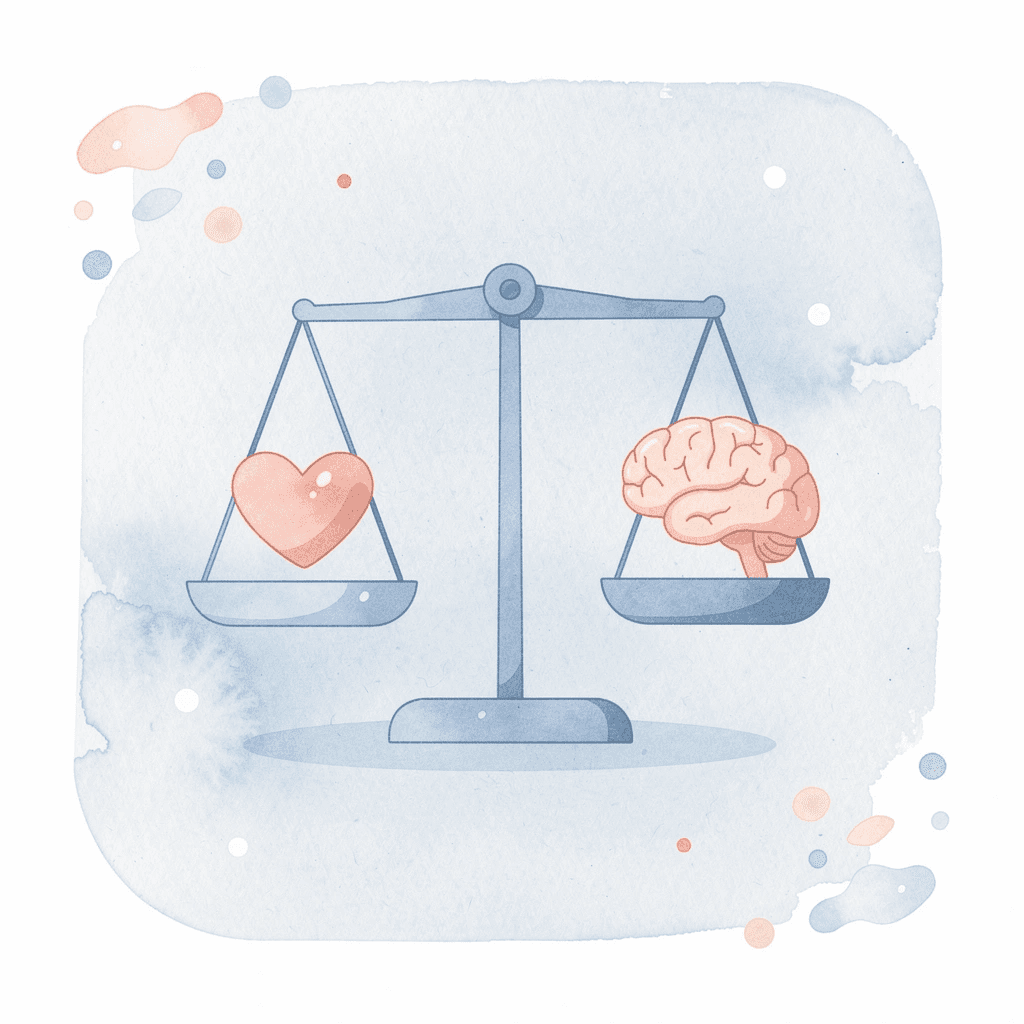
⚠️ Warning: Skipping steps 1 and 2 — jumping straight to AI — is the most common mistake creators make. When you start with a blank prompt, you outsource not just execution, but ideation itself. The result is output that feels efficient but lacks your voice, your insight, and your perspective.
Related Reading
- Ai And Creativity
- Do Schools Kill Creativity
- Examples Of Creativity
- How To Improve Your Creativity
- Creativity Training
- Ai Creativity
Let AI Build the Starting Point—Not Have the Idea for You
Getting that sequence right is the whole game. When AI generates the idea and you simply react to it, you are curating someone else's output, not creating. That distinction matters more than most people realize.
"When AI generates the idea and you simply react to it, you are curating someone else's output—not creating." — Core Principle
💡 Tip: Think of AI as a production tool, not an idea machine. The moment you let it lead the concept, you've handed over the most valuable part of the creative process.
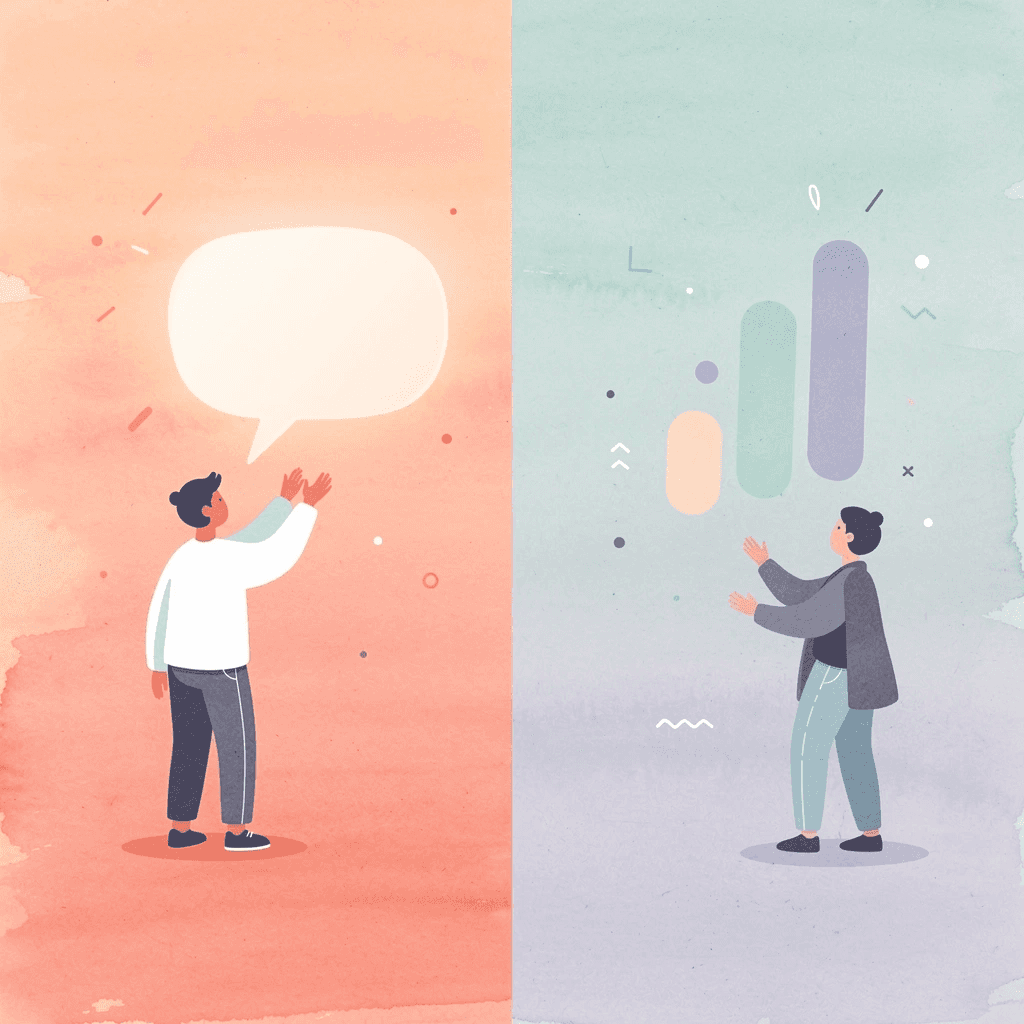
Try reversing it instead. My Coloring Pages is built around this exact sequence: your idea comes first—a memory, an imagined scene, or a meaningful photo. Describe it or upload the image, and the platform turns it into a printable coloring page in seconds. The creative work remains yours: the colors, the details, the decisions. With over 75,000 free pages available as starting points, the collection removes the technical barrier without removing the imagination.
Creative Element | Who Controls It |
|---|---|
The original idea | You |
The memory or scene | You |
Colors and details | You |
Technical rendering | AI (the tool) |
⚠️ Warning: Letting AI generate your creative concept—rather than execute it—is the fastest way to produce work that feels generic and disconnected from your voice.
✅ Best Practice: Always arrive with your concept fully formed before engaging any AI platform. Use it to accelerate production, never to replace imagination. Download 75000+ Free Customized Worksheets and let the platform make creativity easier to start—not easier to stop doing yourself.
Related Reading
- Human Creativity
- Ai Vs Human Creativity
- Is Creativity A Skill
- Creativity Toys For Toddlers
- Types Of Creativity