How to Help Kids With Learning Difficulties in 18 Ways


.Children who struggle with dyslexia, attention challenges, or processing differences often need more than standard classroom materials to build real confidence. Helping kids with learning difficulties comes down to finding the right tools, adjusting the pace, and making practice feel less like a chore and more like progress.
Customized worksheets and creative activities give children a low-pressure way to strengthen reading, writing, and focus at their own speed. Parents and teachers looking for ready-made resources can Download 75,000+ Free Customized Worksheets from My Coloring Pages and start supporting every child's unique learning style today.
Table of Contents
- Do Kids With Learning Disabilities Need Special Care?
- How Do Learning Disabilities Affect a Kid in 12 Ways
- Can Kids With Learning Disabilities Be Successful
- 15 Signs of Learning Disabilities in Kids
- How to Help Kids With Learning Difficulties in 18 Ways
- The Goal Is Not Just Better Grades
- Give Them a Starting Point Without Taking Over
Summary
- Children with learning disabilities are far more common than many adults realize, and standard instruction often fails to reach them. According to the National Center for Education Statistics, 7.5 million students (15% of all public school students) received special education services under IDEA in 2021 to 2022. Within that group, specific learning disabilities accounted for 33% of all students served, and the profiles within that category vary widely enough that treating any two children identically is more about convenience than effectiveness.
- The gap between what a child understands and what they can demonstrate on paper is one of the most misread signals in education. A child may give a clear verbal explanation of a concept and then produce written work that looks far below their actual comprehension. This disconnect leads adults to ask "why aren't you doing it if you know it," which can be genuinely devastating for a child who is asking themselves the same question.
- Avoidance behaviours, including refusing to read, resisting writing, or acting out in class, are often protective responses rather than discipline problems. When a child has experienced repeated failure in front of peers, pretending not to care can feel safer than trying and visibly struggling again. The Learning Disabilities Association of America reports that 1 in 5 children in the United States have learning and attention issues such as dyslexia and ADHD, meaning these patterns appear in nearly every classroom, often misread as attitude or effort issues.
- The graduation gap between students with learning disabilities and their peers reflects accumulated discouragement more than fixed potential. Students with learning disabilities graduate high school at a rate of 68%, compared to 80% of all students. Research from the Learning Disabilities Association of Ontario indicates that, with appropriate support, up to 75% of children with learning disabilities can achieve grade-level reading skills, showing that the gap between current performance and actual capability can close when the right support arrives early enough.
- Identifying the specific breakdown point in a child's learning is both the hardest and most important step for parents and teachers. A child who struggles with reading may have difficulty at the phonemic level, the word-recognition level, or the fluency level, and each requires a different response. Neuropedia reports that 80% of children with learning disabilities have dyslexia, which means attention difficulties in a struggling reader are rarely isolated and are often tied to the cognitive load of decoding itself.
- Persistent struggle that goes unaddressed long enough stops feeling like a task problem and starts feeling like an identity. NICHD data indicates that students with learning disabilities are 3 times more likely to drop out of high school than peers without disabilities, a number that reflects what happens when repeated frustration becomes a child's story about themselves rather than a signal that instruction needs to change.
- My Coloring Pages' Download 75000+ Free Customized Worksheets addresses this by giving children a low-stakes entry point built around their own interests, reducing the blank-page barrier that often stops struggling learners before they even begin.
Do Kids With Learning Disabilities Need Special Care?
Children with learning disabilities need effort directed at the right things, delivered in the right sequence, with the right level of support underneath them.
💡 Tip: The type of support matters as much as the amount: misdirected effort can widen the gap instead of closing it.
"Children with learning disabilities need effort directed at the right things, delivered in the right sequence, with the right level of support underneath them." — Core Principle of Special Education Practice

A common pattern emerges: a child struggles, the adult increases the workload, and the child falls further behind — not from unwillingness, but because instruction never matched the actual difficulty. According to the NCES Condition of Education report, 7.5 million students (15% of all public school students) received special education services under IDEA in 2021–22. That number signals a significant portion of children learn in ways standard instruction alone doesn't reach.
Special education services support millions of U.S. public school students under federal IDEA policy:
- Students receiving special education services → 7.5 million students.
- Share of all public school students → 15%.
- Governing federal policy → IDEA (2021–22).
🔑 Takeaway: When 15% of students require specialized services, this is not a fringe issue — it's a mainstream educational reality that demands intentional, matched instruction.
⚠️ Warning: Simply increasing workload without adjusting how material is delivered is one of the most common — and damaging — mistakes adults make with struggling learners.
What does special care actually mean in practice?
Special care isn't softer expectations. It's sharper ones. When a child struggles with decoding, the right response isn't reading more pages; it's identifying whether the breakdown occurs at the phonemic, word-recognition, or fluency level, then explicitly teaching that specific component. The "I do, we do, you do" model matters: demonstrate the skill, work through it together, then release the child to try independently. That structure builds genuine competence rather than practiced failure.
Why does repetition alone fail children who are struggling?
Most parents and teachers rely on repetition because it feels like progress. But if the student hasn't understood the main idea, those twenty math problems are twenty instances of the same confusion, not twenty steps toward mastery. Tools like our Download 75000+ Free Customized Worksheets can change that by giving children structured, low-pressure activities built around themes they care about, building interest before teaching rather than demanding focus as a prerequisite.
Why one approach rarely fits two children
The same problem, such as poor reading performance, can stem from completely different causes. The NCES Condition of Education data shows that specific learning disabilities made up 33% of all students served under IDEA in 2021-22, with many different profiles within that group. One child may read words correctly but lose meaning by the end of the sentence. Another may understand perfectly when listening but struggle when reading independently. Treating these two children the same way isn't fair—it's simply easier.
How does scaffolded instruction support a child's growing independence?
Scaffolded instruction works like a spotter in gymnastics: they don't do the skill for the athlete but reduce risk and step back as confidence builds. For children with learning difficulties, that scaffold might include visual supports, spoken instruction paired with written text, or activities that connect abstract concepts to physical experience. The goal is increasing independence.
Why does pinpointing the exact breakdown point matter most?
Finding the exact point where a child stops understanding something is the hardest and most important step.
How Do Learning Disabilities Affect a Kid in 12 Ways
What happens after diagnosis—inside a child's daily experience—is where the weight of a learning disability lives.
"The impact of a learning disability isn't just academic—it's emotional, social, and deeply personal, shaping every part of a child's day." — Learning Disabilities Association of America
💡 Tip: Understanding the day-to-day reality of a child with a learning disability is the first step toward offering meaningful support beyond academic accommodations.

According to the Learning Disabilities Association of America, 1 in 5 children in the United States have learning and attention issues such as dyslexia and ADHD. That means almost every classroom, sports team, and neighborhood includes a child quietly carrying this experience. Most adults underestimate what that experience actually looks like from the inside.
Learning and attention challenges affect children across everyday environments, but the child's personal experience is often overlooked:
- Prevalence → 1 in 5 U.S. children are affected.
- Common conditions → Dyslexia, ADHD, and related issues.
- Where it shows up → In every classroom, team, and community.
- Most overlooked factor → The child's internal daily experience.
⚠️ Warning: Because many children carry these challenges quietly, it's critical not to mistake silence for ease—the hidden weight of a learning disability is often the heaviest part.
🎯 Key Point: With 1 in 5 children affected, learning disabilities are far from rare—they are a widespread reality that demands greater awareness, empathy, and informed action from every adult in a child's life.
1. Schoolwork Can Take Them Much Longer Than Everyone Else
For another child, homework takes 30 minutes. For your child, the same assignment takes an hour, two hours, multiple explanations, tears, arguments, and eventually somebody saying, "We'll finish it tomorrow."
Learning disabilities can affect reading, writing, maths, memory, organization, attention, and the ability to follow directions. What looks like slowness may involve a child working much harder to accomplish what classmates do automatically. Greater effort may still produce less visible work.
2. They Can Know the Answer but Struggle to Show What They Know
A child gives a smart answer during conversation, then their written assignment falls below their understanding. Or they explain a math concept verbally but struggle to organize calculations on paper.
Learning disorders create significant gaps between what a child understands and what they can demonstrate through school skills. This gap leads adults to ask, "But you know this. Why aren't you doing it?" For the child, that question is difficult—they're wondering the same thing.
3. Repeated Struggle Can Start Attacking Their Confidence
One failed spelling test is disappointing. But repeated failure—Monday, Tuesday, Wednesday, every week, every school year—can change how a child sees themselves. They stop viewing the difficulty as something they have and start seeing it as something they are.
Children with learning disabilities are particularly vulnerable to this change. Without understanding why certain tasks are harder, they internalize damaging messages: "I'm stupid," "I'm the dumb kid," "Everyone else is better than me." Once a child believes they are incapable, asking them to try harder becomes ineffective.
4. They May Start Avoiding the Exact Activities They Need to Practice
A child with reading difficulties may suddenly "hate reading." A child who struggles with writing may "never want to write." Avoiding reading or writing is often a protective response, not laziness.
Why does avoidance make the underlying difficulty worse?
The cycle becomes: the skill is difficult, the task feels frustrating, the child avoids the task, gets less effective practice, the skill remains difficult, and avoidance strengthens. NICHD notes that children with dyslexia may give up on longer reading tasks, while dysgraphia can involve a strong dislike of writing and a rapid loss of energy shortly after writing begins. Getting them to open the book becomes a battle before learning has started.
What actually breaks the avoidance cycle for kids with learning difficulties?
Most parents respond to avoidance by putting on more pressure, which often accelerates the cycle rather than stopping it. What breaks avoidance is finding an entry point the child will willingly go through, even a small one.
Personalization matters here. When a child who avoids reading engages with content built around something they love—dinosaurs, space, or trains—the resistance drops. Tools like My Coloring Pages work on this principle: a child who refuses to sit still for a worksheet will often spend twenty focused minutes coloring a page built around their specific interest, creating the calm, low-stakes engagement that makes learning feel possible again.
5. Tests Can Become Something They Fear Rather Than Simply Complete
Imagine studying hard, knowing you studied, then sitting down for the test only to run out of time, forget information, misread questions, or struggle to organize your answer. Children with learning disorders often experience significant school-related anxiety around testing and timed assignments.
Eventually, anxiety starts before the test even begins: stomach aches on Sunday night, tears before school, "I don't want to go tomorrow." The child expects another experience of struggling in front of everyone else.
6. "Bad Behavior" Can Sometimes Be a Child Hiding Embarrassment
The child jokes during reading, distracts classmates, refuses to work, gets angry, says "I don't care." It can look like a discipline problem, but sometimes the behavior masks something more painful.
Child Mind Institute notes that some children with learning disorders act out or become the class clown to divert attention from academic struggles. From the child's perspective: "Would I rather everyone think I didn't try, or watch me try as hard as I can and still fail?" Pretending not to care feels safer than risking visible failure.
7. Simple Instructions Can Start Producing Constant Friction
"Get your homework, finish question five, put the worksheet in your bag, and bring me the permission slip." A parent hears one instruction. A child struggling with memory, attention, organization, or sequencing may have to hold four separate tasks in mind at once.
Learning disabilities can make it difficult to follow directions, remember information, stay organized, and manage sequences. When adults don't recognise this, the child repeatedly hears, "How many times do I have to tell you?" After enough repetition, what began as a learning difficulty affects the entire parent-child relationship around school.
8. They Can Become Exhausted From Trying to Keep Up
Imagine having to think carefully about something your classmates do almost without thinking: every paragraph, every spelling, every calculation, every written sentence. That tiredness doesn't show up on a report card.
Children with learning disabilities can become emotionally and mentally worn down by constantly trying to keep pace with academic expectations. Child Mind Institute identifies feeling worn out as a common emotional experience families should watch for. A child melting down over one worksheet may be reacting to six hours of keeping up, followed by one more demand, with no capacity left.
9. They Notice When Their Friends Finish First
Kids notice differences in school. They see who reads easily, finishes work first, gets the highest scores, needs extra help, or leaves the classroom for support, even when adults hope they won't.
When a child falls behind their classmates, it can cause embarrassment, sadness, worry, and lower self-esteem. Academic struggle becomes about comparing themselves to others: "Why can everyone else do this?" and eventually: "What's wrong with me?" Explain a learning disability in clear, honest words. A child needs to hear directly that having trouble with a particular way of learning does not mean they are not smart.
10. They May Stop Volunteering Answers, Even When They Know Them
A child gets something wrong in public once, then again. Someone laughs. The teacher corrects them. Eventually, raising their hand feels risky, so they stop—not because they lack knowledge, but because "if I don't answer, nobody can see me get it wrong."
This avoidance gradually makes a capable child seem quiet, unmotivated, or disengaged. While it protects them from short-term embarrassment, it eliminates opportunities to participate, practice, ask questions, and discover they can succeed.
11. Homework Can Start Affecting the Whole Family
A learning disability does not stay neatly inside the classroom. "Do your homework." "I don't understand it." "We already did this yesterday." "I can't!" "You're not even trying." Then comes the frustration: arguing, crying, a parent overstepping, and everyone dreading tomorrow's homework.
The original problem might be decoding, writing, maths, organization, or working memory. But at home it becomes: "Homework turns our house into a fight every night." Identifying the actual learning difficulty matters more than escalating pressure, which only amplifies friction without clarity.
12. "I Can't Do This" Can Eventually Become "I Don't Want to Try"
This progression is damaging: "This is hard" → "I'm bad at this" → "I'll probably fail anyway" → "Why bother?"
NICHD warns that students with learning disabilities are 3 times more likely to drop out of high school than their peers without disabilities, a direct result of unaddressed frustration becoming part of how they see themselves. The goal isn't finishing tonight's worksheet; it's helping a child learn the skill without letting struggle convince them they are the problem.
The Effect That Never Appears on the Report Card
Learning disabilities can affect reading, writing, maths, memory, organization, attention, and academic performance. But children also carry frustration, embarrassment, anxiety, avoidance, reduced motivation, and lower confidence: none of which show up in a grade.
How does a learning struggle become a story a child tells about themselves?
Different learning disabilities affect children in different ways, but one pattern deserves attention: "This task is hard for me" becomes "everyone else can do it" becomes "something must be wrong with me" becomes "I'm not even going to try." Supporting a child with a learning disability extends beyond improving grades. It means ensuring the struggle never becomes the story they tell about themselves.
Related Reading
Can Kids With Learning Disabilities Be Successful
Yes, a child with a learning disability can be successful. The disability shapes how they learn, not what they can achieve. The more pressing concern is what happens to their self-belief along the way.
💡 Tip: Never confuse a child's learning style with their potential ceiling: the two are entirely separate things.
🔑 Takeaway: A learning disability is a difference in processing, not a limit on achievement. The biggest barrier is often the system around the child, not the child themselves.
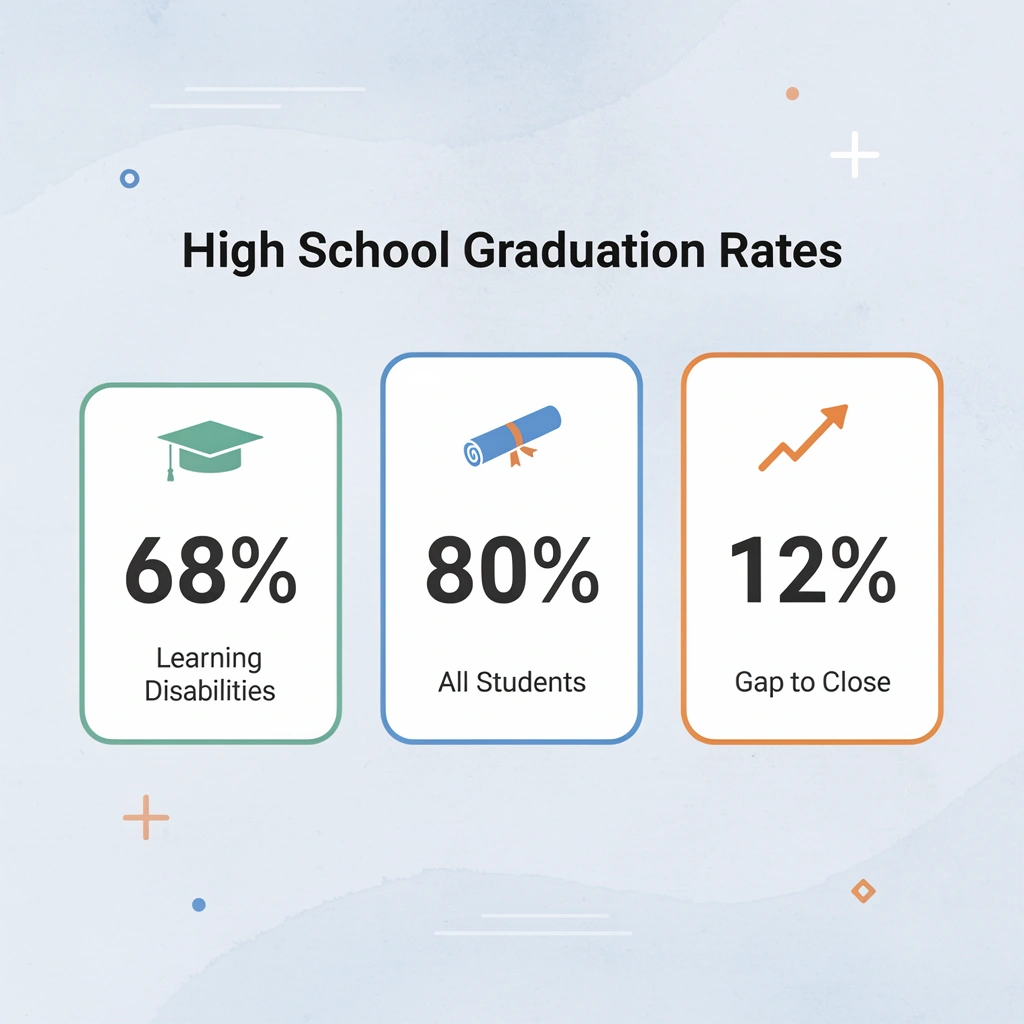
According to the Learning Disabilities Association of America, students with learning disabilities graduate high school at a rate of 68%, compared to 80% of all students.
"Students with learning disabilities graduate high school at a rate of 68%, compared to 80% of all students — a 12-point gap that reflects years of being measured by a narrow set of skills." — Learning Disabilities Association of America
Graduation rates can differ significantly for students with learning disabilities:
- All students → 80% high school graduation rate.
- Students with learning disabilities → 68% graduation rate.
- Graduation gap → 12 percentage points between the two groups.
That 12-point gap shows what happens when a child spends years in a system that measures ability through a narrow set of skills and quietly concludes they don't have enough.
⚠️ Warning: This graduation gap is not evidence of lower potential — it is evidence of a system misaligned with how these students actually learn.
What actually stands between a child and success
The real obstacle is not the disability itself, but the story the child builds around repeated struggle. A child who spends years finishing last, needing extra time, or watching classmates breeze through tasks they find exhausting does not think, "My processing speed is different." They think, "I must not be as capable." That belief, once rooted, makes decisions for them: which classes to attempt, which opportunities to pursue, which risks feel too dangerous to take.
Can the gap between current performance and actual potential be closed?
The good news is that belief is not fixed. The Learning Disabilities Association of Ontario reports that with the right support, up to 75% of children with learning disabilities can reach grade-level reading skills. This demonstrates that the gap between current performance and potential is closable.
What happens when support focuses only on the academic skill itself?
Most parents focus support on the academic skill itself. But children who receive help only with homework and test preparation can develop a hidden problem: they learn that success requires someone beside them at all times. When support is structured so the child gradually takes ownership of the strategy, not just the answer, something shifts. They stop waiting to be rescued and start trusting their own thinking.
How does interest-based creative activity build a child's confidence?
One place this low-pressure, self-directed engagement happens naturally is in creative activities built around a child's own interests. Tools like My Coloring Pages let parents and teachers generate custom printable coloring pages around whatever a child already loves, whether dinosaurs, space, or trains. When a child with a learning disability engages with content built around their world rather than a generic curriculum, the activity stops feeling like another test they might fail and starts to feel like something that belongs to them.
Is school performance really a forecast of what a child can achieve?
School performance measures a specific set of skills under specific conditions, not a prediction of the future. Many of the most capable adults in any field struggled in classrooms designed for a different kind of learner. The question worth asking is not whether your child can succeed despite their learning disability, but whether the support around them is building the confidence they will need to find out.
Knowing when to step in early enough to make a difference is crucial, and the signs are often unexpected.
15 Signs of Learning Disabilities in Kids
Early identification isn't about labeling—it's about understanding what makes learning harder so support arrives before frustration becomes identity.
💡 Tip: The sooner a child's learning differences are recognized and addressed, the better their chances of building lasting confidence and academic success.
"Early identification isn't about labeling—it's about understanding what makes learning harder so support arrives before frustration becomes identity."
🔑 Takeaway: Timely intervention is the single most critical factor in preventing a child's struggle from becoming a permanent self-image.
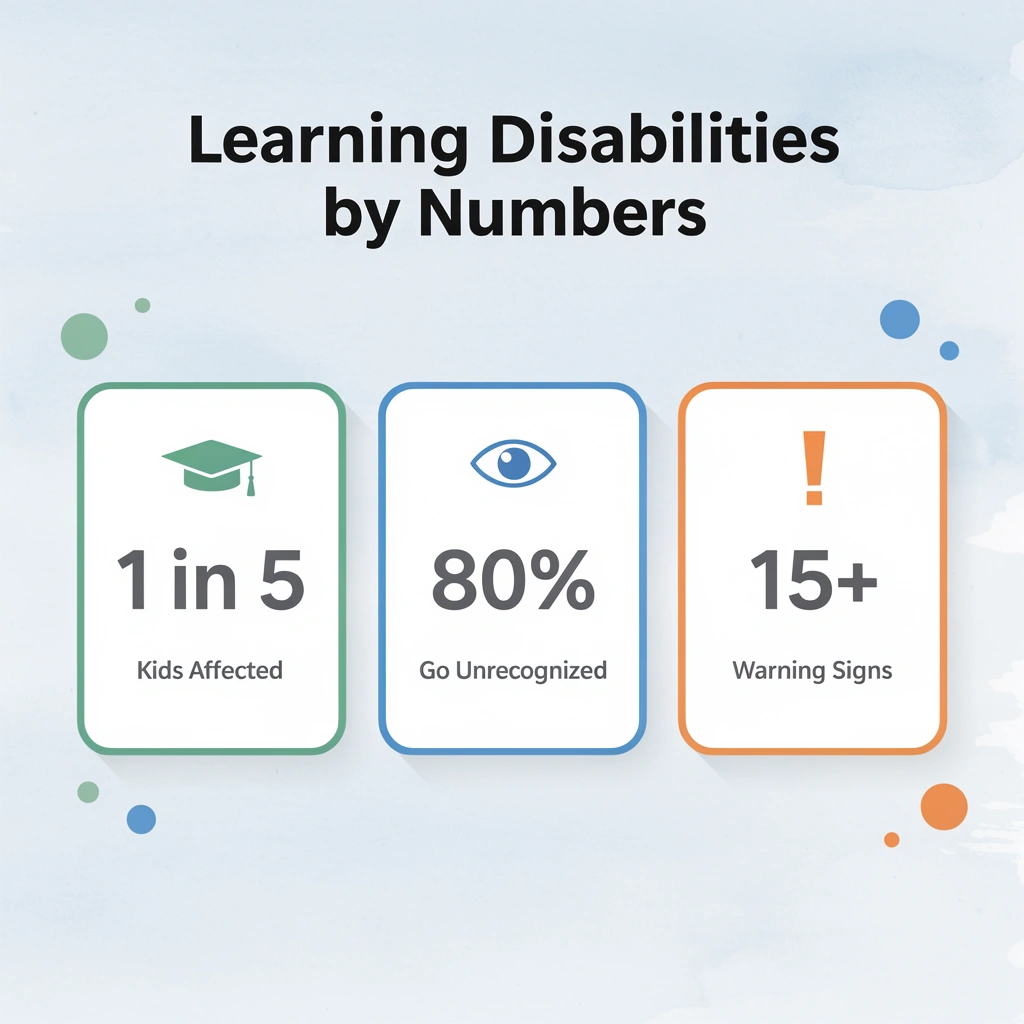
According to the Learning Disabilities Association of America, 1 in 5 children in the United States have learning and attention issues such as dyslexia and ADHD. Most classrooms contain children whose struggles go unrecognized and are misread as attitude problems or lack of effort.
⚠️ Warning: When learning disabilities are mistaken for laziness or defiance, children lose critical years of support—making early awareness essential for every parent and educator.
Learning and attention challenges affect a significant number of children in the U.S., with some conditions being especially common:
- Learning & attention issues (total) → Affect 1 in 5 children.
- Dyslexia → The most common learning disability.
- ADHD → The leading attention-related condition.
1. Reading Seems Much Harder Than It Should
A child who reads unusually slowly, struggles to connect letters with sounds, or avoids longer texts is not being lazy. That avoidance is information. When reading becomes exhausting enough to stop, the child has already spent more energy than most adults realize just getting through a single paragraph.
What are the common signs that reading is a genuine struggle?
With dyslexia, the National Institute of Child Health and Human Development (NICHD) identifies trouble connecting letters and sounds, poor spelling, and difficulty recognizing familiar words as common signs. Children may also struggle to learn songs or rhymes, have limited vocabulary growth despite regular exposure, or abandon longer reading tasks.
2. They Understand It Out Loud but Cannot Get It Onto Paper
Ask a child to explain something aloud, and they give you a clear, reasonable answer. Then you look at the written version, and almost nothing from that conversation appears on the page. That gap signals something specific is blocking the conversion of thought into written language.
NICHD lists difficulty organizing ideas into a logical order, grammar problems, unfinished sentences, and lost energy shortly after beginning to write as possible signs of dysgraphia. Poor handwriting that persists beyond the early grades can also be part of this picture. Telling a child who experiences this to "just write what you know" is like telling someone with a broken arm to "just lift the box."
3. Maths Turns Into a Battle Over Concepts Already Practiced
The same math problem appears three days in a row, and the child cannot solve it. NICHD identifies struggles with basic math, fractions, number lines, positive and negative numbers, and keeping calculation steps in the correct order as possible signs of dyscalculia.
What frustrates parents is that children may understand a concept when it's explained but lose track when working independently. The problem isn't the explanation; it's how the information is stored and retrieved under pressure.
4. They Forget Information You Thought They Knew
You explain the instructions. Your child nods. Two minutes later, they ask what they are supposed to do. When this pattern repeats, it warrants attention. NICHD lists poor memory as a common sign of possible learning disabilities, and with dyslexia specifically, difficulty remembering sequences of numbers like phone numbers and addresses is noted.
What looks like not listening is often a structural issue. The child heard the instruction but struggles to hold it long enough to act on it, particularly with multiple steps or unfamiliar information.
5. Multi-Step Instructions Keep Falling Apart
The failure point is usually the second or third step. A child told to get their notebook, finish question five, pack their bag, and bring a permission slip completes the first task and then drifts. NICHD includes trouble following directions and difficulty understanding questions as possible signs of a learning disability.
This creates a difficult cycle to break without understanding its cause. The adult sees repeated non-compliance. The child repeatedly fails to remember what they were just told. Both are frustrated, and neither is wrong about what they observed.
6. Staying Focused Seems Unusually Difficult
Attention problems alone don't confirm a learning disability, but when they appear consistently alongside difficulties in reading, writing, maths, memory, or organization, the pattern becomes significant. Telling a child to "just pay attention" without exploring why attention is difficult redirects their real challenge rather than addressing it.
Neuropedia reports that 80% of children with learning disabilities have dyslexia, meaning attention difficulties in struggling readers are rarely isolated. They're typically part of a larger cognitive load problem: the child expends so much processing power on decoding that focusing on meaning becomes nearly impossible.
7. School Performance Can Seem Inconsistent
One day they get it. The next day they look completely lost. One assignment is strong. The next is unfinished. NICHD lists school performance that varies significantly from week to week or day to day as a possible sign worth noting.
Adults often interpret this as "you can do it when you try," attributing inconsistency to effort rather than ability. But inconsistent performance doesn't automatically mean inconsistent effort—it can mean the conditions required for a child to access what they know are unstable, which is a different problem altogether.
8. Staying Organized Is Constantly Difficult
Their backpack is a mess. Homework disappears. Tasks are started and left unfinished. NICHD lists problems staying organized as a common sign of possible learning disabilities. Adults often respond by criticizing carelessness, which misses the point when disorganization is ongoing and accompanies other learning difficulties.
The mess is not the problem; it's a symptom. Treating it as a character flaw while the underlying pattern goes unexamined means the child gets punished for the signal while its source remains unaddressed.
9. They Struggle to Express What They Are Thinking
Some children know exactly what they want to say but cannot express it in the right order, speed, or words. NICHD notes that possible signs include difficulty expressing thoughts, trouble understanding certain words or concepts, and speech that sounds younger than expected, such as using short phrases or leaving words out of sentences.
This experience is deeply isolating. The breakdown occurs between thought and language, not in the child's thinking. Adults who interpret this as the child not knowing the answer solve the wrong problem.
10. Writing or Drawing Can Trigger Immediate Shutdown
A strong dislike of writing or drawing, or a child who loses energy immediately after picking up a pencil, can signal dysgraphia rather than simple reluctance. NICHD notes that holding a pencil awkwardly or tensely is also worth noticing. The physical act of writing can be painful and tiring for some children—not dramatically, but in a slow, grinding way that makes every writing session feel like a fight.
Most parents see this as a motivation problem. The more useful question is whether the task itself creates a disproportionate physical or cognitive burden the child cannot explain.
What happens when the written output pressure is removed?
When a child with this difficulty engages in a structured, low-pressure activity that lets them work with ideas visually rather than through written output, something shifts. Tools like My Coloring Pages offer printable pages built around a child's specific interests—dinosaurs, space, vehicles—giving them a way to engage with content and express themselves without the friction of a blank page and pen. It creates low-stakes engagement where a struggling child can experience focus and completion instead of avoidance and shame.
11. They Have Trouble With Time or Sequences
NICHD lists trouble telling time as a common possible sign of dyscalculia, which can involve difficulty understanding sequences or following steps in logical order. A child who is consistently late, cannot estimate task duration, or loses track of sequential steps needs attention.
This reflects a specific difficulty processing time and sequence as information, affecting everything from morning routines to following recipes to completing math problems in the right order, not general disorganization.
12. Changes in Routine Are Surprisingly Difficult
NICHD includes problems dealing with changes in schedules or situations among possible signs. A small schedule change that barely registers for most children can significantly affect a child with a learning disability because predictability helps them manage an already demanding cognitive load.
This sign rarely appears alone. Its significance increases when it accompanies persistent difficulties in reading, writing, memory, or attention, forming part of a pattern rather than an isolated quirk.
13. They Act Before Thinking
NICHD identifies impulsiveness—acting without thinking through possible outcomes—as a sign of learning disability. While parents may find this frustrating, impulsiveness alongside ongoing academic difficulty provides important diagnostic information rather than reflecting a character flaw.
When a child is constantly overwhelmed by a learning environment that doesn't match how their brain works, impulsive behavior often results from that overload rather than causing the academic struggle.
14. They May Act Out at School
Kids who are struggling don't always seem quiet or withdrawn; they might seem disruptive, uncooperative, or checked out. NICHD notes that some children with learning disabilities may act out in school or social situations. Focusing only on behavior without identifying the underlying cause means interventions will miss the real problem.
A child who cannot read well, organize thoughts on paper, or hold multi-step instructions in memory has few good options in a traditional classroom. Acting out is sometimes the most available one.
15. They Work Hard but Keep Hitting the Same Walls
This pattern prompts parents to ask whether something else is going on. The child has been helped, practiced, reminded, and supported, yet the same cluster of difficulties persists. NICHD specifically distinguishes ordinary learning struggles from learning disabilities by noting that children with learning disabilities often show multiple related signs that do not improve over time.
That persistence is the clearest signal. One difficult spelling test, messy handwriting, or a rough week in maths does not constitute a diagnosis. But when several related difficulties persist across weeks and months, interfere with school performance, and continue despite appropriate teaching and support, the question should shift from "why won't my child try harder" to "what exactly is making learning harder for my child."
When Should Parents Look More Closely?
NICHD states that its list of signs is for information only and should not be used to screen for or diagnose a learning disability. Signs vary by individual, and only a trained professional can diagnose a learning disability.
Context is important during assessment. NICHD notes that children learning in a second language can show learning difficulties that aren't real, so evaluators should consider bilingualism and language differences. The goal is to ensure a child who needs different support doesn't spend years being treated as careless or unable to learn.
Recognizing the signs is only the first step; what happens next is where the real decisions begin.
How to Support a Child With Learning Difficulties
1. Find the Exact Point Where the Task Breaks Down
This tackles working hard but repeatedly getting the same result.
Do not stop at: “My child is bad at reading.”
Look closer.
Can they understand a story when somebody else reads it aloud but struggle to decode it themselves?
Can they solve a maths problem verbally but become lost when it is written down?
Can they explain an answer clearly but struggle to organize it into sentences?
That distinction matters because general problems often lead to general practice, which can result in more work, the same difficulty, and more frustration.
Instead, aim for a specific difficulty, targeted support, practice that component, and then check progress.
If decoding is the issue, more silent reading alone may not address it.
If organizing written ideas is the issue, making the child rewrite an entire essay may simply repeat the hardest part.
The first intervention is therefore understanding what actually needs help.
2. Break Large Tasks Into Smaller Wins
This tackles homework taking much longer than everyone else's and children becoming overwhelmed before they start.
Compare “Finish these 30 questions” with “Let's do the first five, check them, then take the next five.”
A large assignment can make a struggling child see 30 opportunities to fail.
Breaking it down creates a small task, completion, feedback, and then the next task.
This does not make the academic skill easier. It reduces the amount the child has to manage all at once.
For example:
- Essay: brainstorm, choose three ideas, write the introduction, then work on one paragraph at a time.
- Reading: read one paragraph, discuss the meaning, then move to the next paragraph.
- Maths: identify the operation, solve one step, check it, and continue.
That can be particularly helpful for children who struggle with organization, memory, or multi-step instructions.
3. Use “I Do, We Do, You Do”
This tackles “I don't know how to start” and constant dependence on parents.
When a child is completely stuck, telling them “Just try” may not provide the missing strategy.
Instead:
- I do: demonstrate one example and explain your thinking.
- We do: complete another example together.
- You do: let the child attempt the next one independently.
Then gradually step back.
The goal is not for a parent to sit beside the child forever. It is to provide support, allow successful practice, and build increasing independence.
That prevents another painful pattern: the task feels difficult, the parent takes over, the assignment gets finished, and the child learns “I can't do this without somebody.”
Help should eventually produce less need for help.
4. Let Children Show What They Know in Different Ways When Appropriate
This tackles understanding the answer but struggling to demonstrate it.
Imagine a child can explain the water cycle perfectly aloud but struggles to write a full paragraph about it.
If the purpose of the activity is understanding the science, consider occasionally allowing them to:
- Explain it verbally
- Draw a diagram
- Arrange picture cards
- Build a model
- Record themselves explaining it
That does not mean abandoning writing practice if writing is itself the skill being taught.
The distinction is: What am I actually trying to measure right now?
If you want to practice handwriting, they need to write.
If you want to know whether they understand photosynthesis, forcing all of that knowledge through their weakest mode can sometimes hide what they actually know.
This can also give a struggling child something important: evidence that difficulty expressing knowledge one way does not mean they have no knowledge.
5. Use My Coloring Pages to Lower the Creative Starting Barrier
This tackles blank-page frustration, writing and drawing avoidance, fear of getting something wrong, and children struggling to show ideas through traditional schoolwork.
A child may have an entire story in their head but freeze when you say “Draw it” or “Write what you're thinking.”
That can make a creative learning activity become another reminder of what they find difficult.
My Coloring Pages can provide a lower-friction starting point.
Instead of choosing the picture for them, ask: “What would you like the picture to show?”
Maybe they say:
- A dinosaur exploring a volcano
- Their dog on the moon
- A medieval castle
- A character from the story they just read
Describe that idea or upload an image, and My Coloring Pages can turn it into a printable coloring page. Children can also choose from 75,000+ free coloring pages when generating an idea itself feels overwhelming.
But the important part is what happens after the page appears.
The child supplies the idea, My Coloring Pages handles the initial outline, the page is printed, and the child chooses the colors and details before explaining or expanding the story.
For a child who struggles to get ideas onto paper, you might ask:
“Tell me what is happening in this picture.”
“What happens next?”
“Can you add three things the character needs?”
“Can you give the character a name?”
That changes a blank page and avoidance into a structured starting point where the child makes manageable choices, successfully creates something, and can extend learning from there.
My Coloring Pages is not a treatment for learning disabilities and should not replace targeted literacy, writing, occupational, or educational support.
Its useful role here is much narrower: remove enough technical starting friction that the child can participate in a creative learning activity without the blank page becoming the entire battle.
6. Give One Instruction at a Time When Multi-Step Directions Keep Getting Lost
This tackles constant “How many times do I have to tell you?” frustration.
Instead of:
“Get your maths book, finish page 20, circle the questions you're unsure about, put it in your bag, then bring me your reading book.”
Try:
“First, get your maths book.”
Then:
“Open page 20.”
You can also use:
- Written checklists
- Picture schedules
- Numbered steps
- Boxes children can tick themselves
The goal isn't to make them dependent on simpler instructions forever.
The goal is to move information out of their head and into the environment so they don't have to remember every step at once.
Eventually, the checklist itself becomes an independence tool: instead of asking Mom what comes next, the child checks the list.
7. Replace “Careless” With a System
This tackles lost homework, messy bags, forgotten books, and family arguments around organization.
If a child repeatedly forgets things, telling them “Be more organized” doesn't explain how.
Build external systems.
For example:
- One homework folder
- One specific place for the school bag
- A visual checklist beside the door
- Color-coded subjects
- A five-minute bag check at the same time each evening
The solution is to recognize that organization is difficult, relying on memory repeatedly fails, an external system carries part of the memory load, and the child can follow a repeatable routine.
That is more useful than attaching personality labels such as “You're so careless.”
8. Create Opportunities for the Child to Succeed Before Asking for More
This tackles “I'm bad at this,” “I can't do it,” and falling confidence.
If a child spends an hour failing at work beyond their current skill level, the lesson they practice most may not be maths or reading.
It may be: “Nothing I do works.”
Start with something they can do with manageable effort, then gradually increase the difficulty.
For example, use known words followed by slightly harder words rather than moving from an easy reader to text far above their decoding level.
For maths, progress from one-step problems to supported two-step problems and then to independent two-step problems.
You are trying to create effort, progress, evidence of competence, and willingness to attempt the next challenge.
Avoid creating a cycle of effort, failure, more pressure, and avoidance.
9. Praise the Strategy, Not Just the Grade
This tackles children measuring their intelligence by academic performance.
Instead of only saying “You got 9/10! You're so smart,” notice the strategy they used.
For example:
“You didn't know that word, so you broke it into smaller sounds.”
“You checked your calculation when the first answer didn't make sense.”
“You asked for clarification instead of giving up.”
This changes the child's attention from “Am I smart?” toward “What can I do when something is difficult?”
That matters because grades fluctuate.
A strategy remains useful even after the worksheet changes.
10. Protect Something the Child Knows They Are Good At
This tackles the learning disability becoming their entire identity.
If every afternoon includes reading practice, maths help, writing correction, tutoring, and conversations about school, a child can start to feel as though adulthood has organized itself entirely around fixing them.
Protect activities where they experience competence.
Maybe they are good at:
- Football
- Drawing
- Building things
- Gaming strategy
- Music
- Animals
- Cooking
- Storytelling
- Dance
- Making people laugh
Do not treat these strengths as irrelevant because they are not the academic problem being fixed.
A child needs regular evidence that “There are things my brain does very well.”
That protects the distinction between “I have difficulty with this skill” and “I am a failure.”
11. Stop Comparing Them With Siblings or Classmates
This tackles embarrassment and “Why can everyone else do this except me?”
Avoid:
“Your sister could read this at your age.”
“Everyone else finished already.”
Even when intended as motivation, comparison can turn a skill problem into an identity problem.
Compare the child with their previous performance instead.
For example:
“Last month you needed help with every paragraph. Today you read two independently.”
Now the relevant comparison becomes me today vs. me before, rather than me vs. the child whose brain finds this particular task easier.
12. Use Shorter Practice More Consistently Instead of Exhausting Marathons
This tackles mental exhaustion and homework meltdowns.
A child who has already spent the school day struggling may not learn much from another miserable two-hour session.
Instead of assuming more minutes = more learning, focus on focused practice, the correct level, useful feedback, and repetition over time.
For example, a shorter period of targeted practice followed by a break may be more manageable than pushing until attention disappears, mistakes multiply, frustration rises, and everyone argues.
The point is not a universal “magic” number of minutes.
The appropriate amount depends on the child's age, needs, skill, and professional recommendations.
Watch the quality of practice, not merely the clock.
13. Make Mistakes Safe Enough to Examine
This tackles test anxiety, perfectionism, and children refusing to attempt unfamiliar work.
When an answer is wrong, avoid immediately turning it into “No. That's wrong.”
Try:
“Show me how you got there.”
Sometimes you will discover the child understood the concept but copied a number incorrectly, forgot one step, or used a reasonable strategy in the wrong place.
Now you know what to teach.
The learning loop becomes mistake, inspection, identifying the problem, a change in strategy, and another attempt instead of embarrassment followed by avoidance.
That helps children experience errors as information, not evidence about their intelligence.
14. Separate Behavior From the Difficulty Underneath It
This tackles acting out, refusal, joking, anger, and “I don't care.”
If bad behavior appears consistently around one type of work, ask:
“What happens immediately before this?”
Does the child joke whenever they're asked to read aloud?
Become angry when writing starts?
Need the bathroom whenever maths comes out?
That doesn't excuse inappropriate behavior.
But punishment alone may leave the trigger untouched.
A better sequence can be:
Notice the pattern → maintain a reasonable behavior boundary → investigate academic difficulty → provide appropriate support.
Otherwise, the task remains impossible, the child keeps escaping it, adults keep punishing the escape, and nobody addresses why the child is escaping.
15. Prepare for Tests Differently if Testing Is Where They Fall Apart
This tackles studying but still panicking, running out of time, or being unable to demonstrate knowledge.
Help children practice the format as well as the content.
For example:
- Short practice questions
- Breaking directions into steps
- Learning how to check work
- Practicing retrieval without notes
- Using accommodations recommended through the child's school or professional assessment
The goal isn't “Don't be nervous.”
It is giving them a clearer plan for what to do when nervousness appears.
16. Let Them Help Choose Strategies
This tackles feeling powerless and being constantly managed by adults.
Instead of deciding everything for them, ask:
“Which helps you more—reading the instructions yourself or hearing them first?”
“Would a checklist make this easier?”
“Do you want to start with reading or maths?”
“What usually helps when you get stuck?”
Even limited choice gives the child a role in understanding how they learn.
That knowledge becomes increasingly valuable as they get older and need to advocate for themselves.
17. Work With Teachers Instead of Treating Home as a Second School
This tackles nightly homework battles and parents feeling responsible for fixing everything themselves.
If the same problems persist, communicate with the child's teacher.
Ask specific questions:
“Does this happen in class too?”
“Where exactly are they falling behind?”
“What support has already been tried?”
“What seems to help?”
“Are there patterns across subjects?”
The goal is to avoid a situation where school sees one version, the parent sees another, and everybody independently tries more practice.
A better approach is to share observations, identify patterns, coordinate strategies, and monitor whether support is working.
18. Get Appropriate Professional Help When Difficulties Persist
This tackles years of struggle being dismissed as laziness or immaturity.
If difficulties are persistent, significant, affecting school progress, or continuing despite appropriate support, don't respond by increasing pressure indefinitely.
Talk with the child's school and appropriate educational or healthcare professionals about assessment and support.
An evaluation can help answer a much more useful question than “Why won't my child try harder?”
It can help determine: “What specifically is making this difficult, and what support fits that difficulty?”
That distinction can change everything about how adults respond.
The Goal Is Not Just Better Grades
Think back to the problems learning difficulties can create.
Homework takes forever: Break work into manageable steps and target the actual skill.
They know the answer but cannot show it: Use appropriate alternative ways to demonstrate understanding while continuing to teach the weaker skill.
They avoid the subject: Create achievable practice instead of repeatedly overwhelming them.
They think they're stupid: Protect strengths and praise strategies rather than defining intelligence through grades.
They fear mistakes: Investigate errors instead of treating them as failures.
They act out: Look for the academic trigger while still maintaining behavior boundaries.
They constantly forget instructions: Externalize information through checklists and routines.
They rely on you for everything: Scaffold first, then deliberately remove support.
They are exhausted: Prioritize targeted, manageable practice over endless work.
They compare themselves with everyone else: Make progress relative to their own starting point visible.
They have stopped trying: Rebuild the connection between effort and successful progress.
That is the real solution bridge.
A learning difficulty can lead to repeated struggle, frustration, avoidance, low confidence, and dependence.
With the right approach, this can become a process of identifying the barrier, changing the method, providing targeted support, creating achievable success, gradually increasing independence, and helping the child experience “I can figure out what to do when this gets hard.”
And that should be the larger goal.
Not:
“How do I make my child perform exactly like everyone else?”
But:
“How do I give my child the tools to learn successfully without letting the struggle convince them that they are incapable?”
Give Them a Starting Point Without Taking Over
When a child has spent months connecting schoolwork with failure, the problem is rarely motivation—it's the blank page itself. That empty space asks them to generate, organize, and execute all at once, which is where children with learning difficulties lose confidence before they begin.
"The blank page doesn't just ask for ideas—it asks for organization, execution, and courage all at the same moment. For children with learning difficulties, that's three barriers stacked into one."
💡 Tip: Before introducing any creative task, remove the blank page entirely. A structured starting point dramatically reduces the cognitive load that triggers avoidance and loss of confidence.

My Coloring Pages removes this starting barrier without removing the child's ownership. Ask them for one idea—their dog wearing astronaut gear or a volcano full of dinosaurs—and the AI generates a printable outline built around their world. From there, the child can choose colors, add details, narrate a story, or label what they see. If generating an idea feels overwhelming, a library of 75,000+ free customized coloring pages provides an easier on-ramp that still ends with something they finished themselves.
The process gives children an easy starting point while keeping them in control of the final creation:
- Child provides an idea → AI generates a custom outline → Creates a personalized starting point.
- Idea feels overwhelming → Browse 75,000+ ready-made pages → Provides a structured on-ramp with low pressure.
- Outline is ready → Color, label, narrate, add details → Gives the child full ownership of the finished result.
⚠️ Warning: Giving children too much creative freedom all at once can be just as paralyzing as a blank page. The goal is a supported starting point—not a fully directed task.
A child who leaves an activity thinking "I made that" is building something harder to teach than any academic skill: the belief that participation is worth trying.
🔑 Takeaway: Confidence isn't built through praise alone; it's built through completion. Every finished page, no matter how simple, reinforces the core belief that a child can start, work through, and finish something on their own.
Related Reading
- Ai Learning App Kids
- Abc Learning For Kids