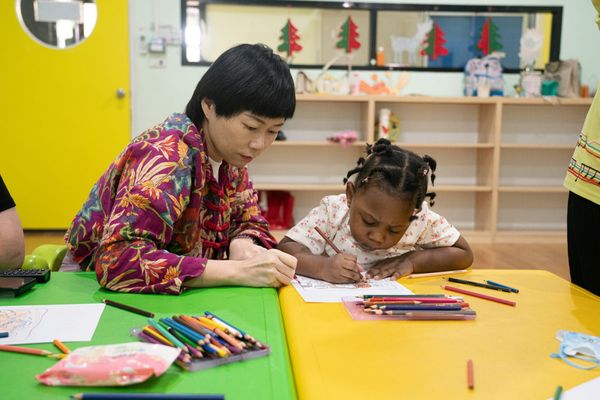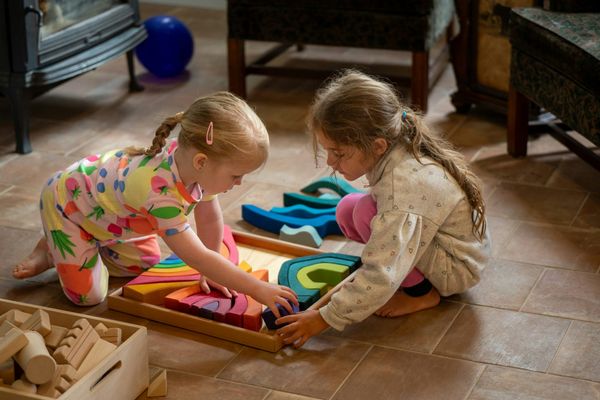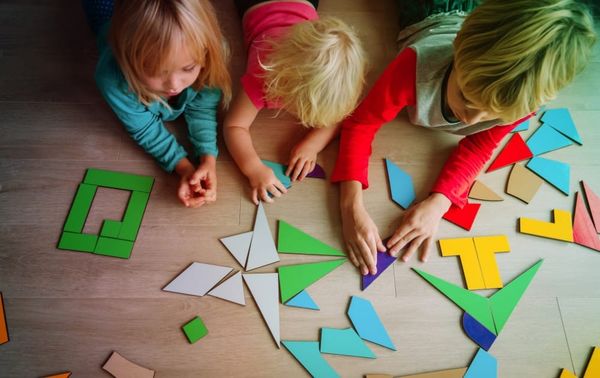
Importance & Practical Tips for Early Childhood Learning
Content repurposing examples to try: reuse long-form content across TikTok, Reels, YouTube Shorts, LinkedIn, email, and blogs.

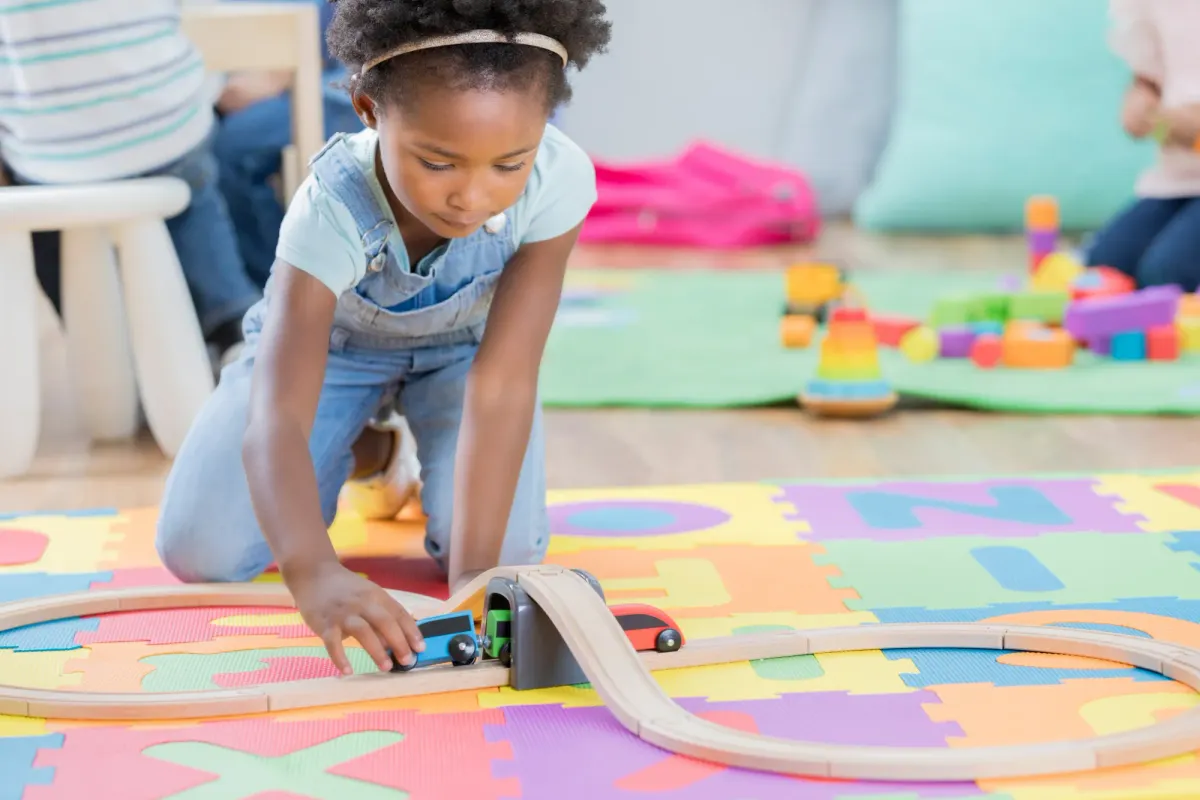
The skills and habits children develop in their earliest years shape how they think, learn, and engage with the world long after they leave the classroom. Early childhood learning thrives when it is grounded in creativity, movement, and hands-on exploration rather than passive instruction. Parents and educators who understand this have a real advantage in building environments where curiosity becomes a natural habit.
Practical tools matter just as much as good intentions, especially when children need variety to stay engaged. Art, motor skill activities, and imaginative play all support cognitive growth in ways that feel effortless to a child. For ready-to-use resources that fit directly into daily learning routines, families and teachers can download 75,000+ free coloring pages from My Coloring Pages.
Table of Contents
- Is Strict Teaching Important in Early Childhood Learning?
- Importance of Early Childhood Learning
- What Happens When You Neglect Early Childhood Learning
- 15 Things to Include in Early Childhood Learning
- 15 Practical Tips for Early Childhood Learning
- Make Each Early Learning Activity Solve a Real Problem
- Turn One Learning Moment Into Something They Can Take Over
Summary
- Brain development in early childhood is more concentrated than most parents realize. According to multiple early education sources, 90% of brain development occurs before age 5, meaning the window for building foundational cognitive architecture is narrower than it appears. What gets established in those years does not just shape what a child knows. It shapes how they process and respond to learning for the rest of their schooling.
- Guided play consistently outperforms strict instruction for early cognitive development. A meta-analysis of 39 studies involving 3,893 children ages 1 to 8 found that guided play produced measurably better outcomes than direct instruction for early maths (effect size g = 0.24), shape knowledge (g = 0.63), and task switching (g = 0.40). These are not peripheral skills. They form the cognitive scaffolding children carry into formal schooling.
- Over-directing children during learning tasks quietly closes off independent thinking. Classic experimental research showed that preschoolers who received explicit demonstrations of how a toy worked discovered an average of only 0.50 additional functions on their own, compared to 1.31 in less prescriptive conditions. Completing a task efficiently and actually understanding it are two different outcomes, and adults often cannot tell which one they are getting.
- Early learning gaps do not stay small. Skills in early childhood build sequentially, where each step depends on the one before it, and a weakness at any single link compounds over time. What seems like a manageable delay at age four can become a confusing and exhausting difficulty by age seven, particularly in areas like language, letter recognition, and following multi-step instructions.
- Neglected early learning affects measurable cognitive outcomes, not just readiness. Research published in PMC found that neglected children scored significantly lower on cognitive functioning measures, with mean IQ scores approximately 10 points below non-neglected comparison children. That gap reflects reduced opportunity to practice independent thinking, not fixed ability, which means timing and environment matter more than most people account for.
- Children who attend quality early childhood programs are 25% more likely to graduate high school, according to Sensoria CDC's Early Childhood Education 2025 report. That figure reflects not just academic content, but the compounding effect of habits like persistence, self-regulation, and tolerance for uncertainty that build in the earliest years and carry forward through every grade that follows.
- My Coloring Pages's Download 75000+ Free Customized Worksheets addresses the common problem of generic materials by letting parents and teachers generate activity pages tied to the specific concept, theme, or story a child is already exploring, so the activity reinforces active thinking rather than sitting beside it.
Is Strict Teaching Important in Early Childhood Learning?
Strict teaching has a narrow role in early childhood learning. When adults control every step, correct every move, and script every outcome, the child's thinking participation shrinks—and that is where real learning lives.
"When adults control every step and script every outcome, the child's thinking participation shrinks—and that is where real learning lives."
🎯 Key Point: Early childhood development thrives on exploration and autonomy, not rigid control. Overly strict teaching can suppress critical thinking at the most formative stage of a child's growth.
💡 Tip: The most effective early childhood educators balance structure and safety with meaningful space for child-led discovery, curiosity, and independent problem-solving.
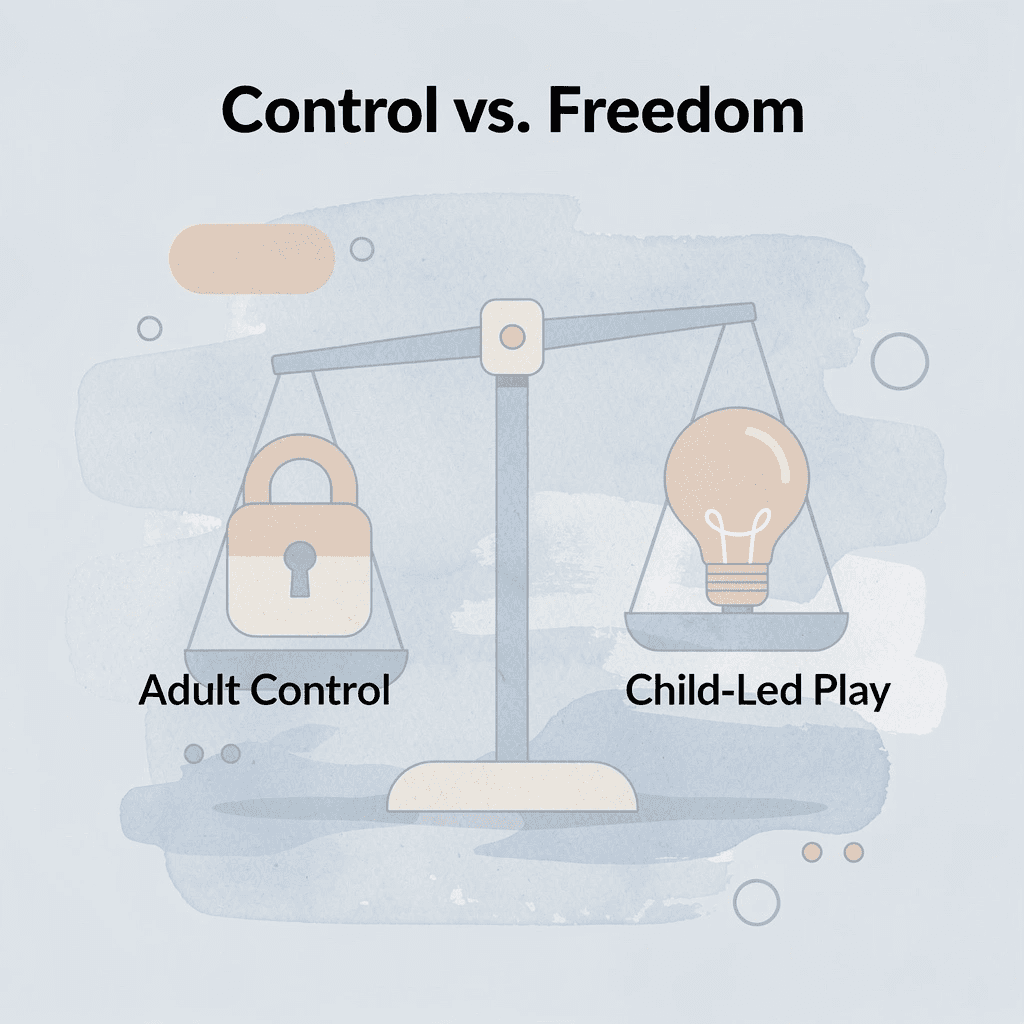
Teaching Approach | Impact on Child |
|---|---|
Strict / Adult-Controlled | Reduces independent thinking, limits creativity |
Guided / Child-Led | Builds curiosity, strengthens problem-solving |
Balanced Structure | Optimal learning outcomes, fosters confidence |
What does research say about guided play versus direct instruction?
Young children are active sense-makers, not empty containers. A meta-analysis of 39 studies involving 3,893 children ages 1 to 8 found that guided play produced measurably better outcomes than direct instruction for early maths (effect size g = 0.24), shape knowledge (g = 0.63), and task switching (g = 0.40). These skills form the thinking foundation children carry into formal schooling. Direct instruction worked best when paired with space for children to think, choose, and attempt something independently.
What happens when adults over-direct?
The failure point is usually invisible. A child completes the task, the adult feels satisfied, and both move on. But completion is not the same as understanding. Classic experimental research showed that preschoolers who received clear demonstrations of how a toy worked discovered an average of only 0.50 additional functions on their own, compared to 1.31 in conditions where the demonstration was less specific. The instruction worked efficiently for the target skill and excluded everything else.
How does matching materials to the child's learning moment deepen engagement?
Most early learning materials assume one-size-fits-all approaches: worksheets, coloring pages, activities. The child adapts to the material rather than the material adapting to the child. Teachers and parents using Download 75,000+ Free Customized Worksheets from My Coloring Pages can create materials built around the specific concept a child is exploring—animal habitats, number patterns, or a story they are writing. When the material matches the learning moment, the child's thinking stays connected to something real and personally relevant, deepening cognitive engagement.
What "who is doing the thinking?" actually reveals
The American Academy of Pediatrics, in its clinical report reaffirmed in January 2025, describes play as directly supporting executive-function skills including working memory, mental flexibility, and attention. A child playing a movement game that requires listening for a category rule, remembering it, and stopping the wrong response exercises the same brain pathways that strict instruction claims to develop, often with more sustained engagement and less resistance.
Why does collapsing the teaching cycle cost children the most valuable cognitive work?
The better early learning model is not a choice between teaching and playing, but a cycle: an adult introduces a concept, the child explores it, a problem arises, the adult offers enough support to keep the child moving, and the child takes the next step independently. Strict teaching breaks that cycle by removing the steps where children do their hardest and most valuable thinking work.
Importance of Early Childhood Learning
The brain undergoes its most intensive development before formal school begins. According to Chroma Early Learning Academy, 90% of brain development happens before age 5. Early experiences shape not just what children know, but how they learn everything that follows.
"90% of brain development happens before age 5, making the earliest years the most critical window for shaping lifelong learning." — Chroma Early Learning Academy
🔑 Takeaway: The first 5 years of life are the single most important period for building the cognitive foundation that determines how a child learns throughout life.
💡 Key Insight: Because 90% of neural development occurs before kindergarten, investing in early childhood learning delivers far greater returns than interventions introduced later in a child's education.
Why small gaps compound faster than you think
A child who struggles to follow a two-step instruction at age three may seem fine: happy, curious, and engaged. But learning builds sequentially. When a foundational step still requires full effort, the next step arrives before the first is solid. The child must handle two things simultaneously: mastering the base skill and learning the new one. This design problem compounds with every grade.
What happens when expression can't keep up with understanding?
The same pattern shows up in language development. A child may understand something clearly but lack a reliable way to demonstrate that knowledge. Without early practice through conversation, storytelling, and explaining their creations, the gap between internal understanding and external expression widens quickly. School immediately asks children to follow instructions, describe reasoning, and use vocabulary as tools.
How does matching materials to the child close the gap faster?
Most early learning materials are made for the average child, so they rarely match what a specific child is working on. When a coloring page addresses the exact idea a child is exploring—letter recognition, sequencing, or a story they are living in pretend play—it becomes a working tool rather than a time-filler. Download 75,000+ Free Customized Worksheets from My Coloring Pages lets parents and teachers generate pages tied to specific learning themes, reinforcing what the child is already building.
What early learning actually builds
Attention, working memory, problem-solving, and cognitive flexibility are skills that children build in early childhood. A puzzle gives a child something to complete. A multi-step game exercises memory. A collapsing block structure offers a low-stakes problem to solve independently. Each moment matters: children who experience these opportunities in high-quality early education settings are 25% more likely to graduate high school, according to Chroma Early Learning Academy.
How does early childhood learning shape a child's confidence?
Confidence is built during this time. Before children compare themselves to peers daily, they collect proof that they can try something, struggle, and figure it out. That proof becomes protection. Without it, when schoolwork gets hard, it doesn't feel like a normal part of learning—it feels like a judgment about who they are. What matters is not a child who knows every answer, but one who meets something new and thinks, "I don't know this yet, but I know how to start." That way of thinking is built early, or built much harder later. The cost of waiting is rarely as invisible as it first appears.
Related Reading
What Happens When You Neglect Early Childhood Learning
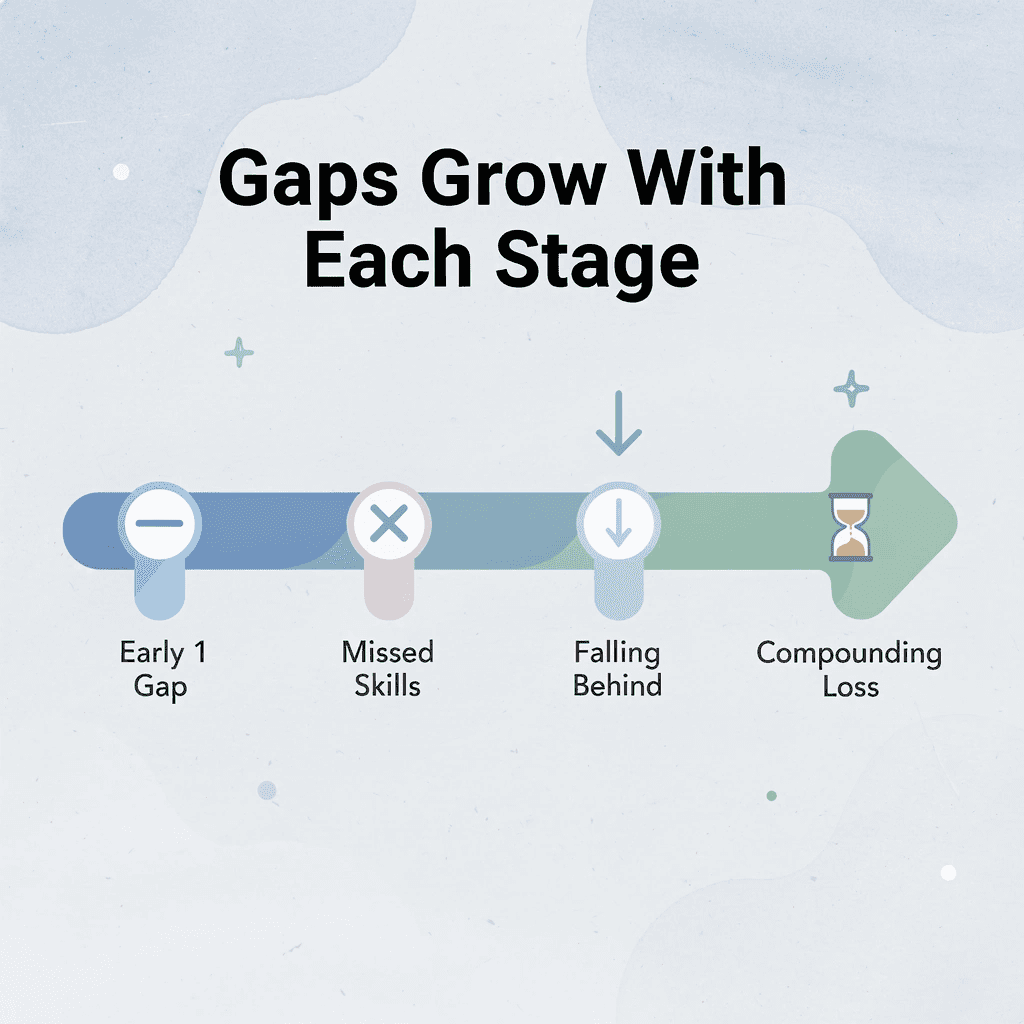
Skipping early childhood learning creates quiet gaps that grow larger over time, with each gap making it harder to meet subsequent challenges.
"The earliest years of life are the most critical window for brain development — gaps formed here compound with every passing stage." — Early Childhood Development Research
⚠️ Warning: These gaps don't stay small. A minor developmental delay in early childhood can snowball into significant learning barriers by school age.
🔑 Takeaway: Early intervention is more effective than closing compounding gaps later. The cost of neglect grows exponentially with time.
1. Simple School Tasks Can Start Feeling Harder Than They Should
When a child walks into a classroom, they're expected to recognize letters, follow multi-step directions, listen to stories, work with peers, and answer questions immediately. Without prior practice, a typical school day can feel overwhelming. The child may seem slow, distracted, or unwilling when they're working harder than peers to keep up. Adults then say things like "everyone else has already started," and the child begins comparing themselves to peers before they have tools to close the gap.
2. Small Learning Gaps Can Start Stacking on Top of Each Other
Early skills form a chain where each step depends on the one before it: letter recognition → letter-sound knowledge → blending → word reading → comprehension. A weakness at any link quietly multiplies. What looks like a manageable delay at age four becomes a confusing and exhausting difficulty by age seven. The assumption that "they'll catch up later" underestimates how sequentially these capacities build, and by the time the gap becomes visible, it has usually widened beyond easy correction.
3. "I Don't Know" Can Appear Before They Even Try
When children rarely predict, experiment, or make choices independently, uncertainty becomes unfamiliar rather than interesting. Ask "what do you think?" and the answer comes immediately: "I don't know"—not after a failed attempt, but before one. The habit that forms is uncertainty leading directly to waiting for an adult, rather than uncertainty leading to thinking and trying something. That reflex becomes a serious problem once formal learning requires independent reasoning, because no teacher can be beside every child for every question.
4. They May Need Someone Beside Them for Everything
The pattern worsens predictably: "help me start," then "what do I do next?," then "can you stay here?" Eventually, the adult breaks down every task, reminds them of each step, checks every answer, and fixes every mistake. The work gets done, but the child loses chances to practice starting, planning, remembering, and checking independently.
What happens when children get fewer chances to think independently?
Research published in PMC found that neglected children scored significantly lower on cognitive functioning measures, with mean IQ scores approximately 10 points below non-neglected comparison children. This gap reflects not fixed ability but the compounding effect of reduced opportunity to practice thinking independently. The cycle becomes: the child struggles, the adult helps more, the child practices less independence, and the next task needs even more help.
How can independent activities break the cycle of constant rescue?
Most parents aren't doing anything wrong on purpose. They see a struggling child and help, because that's what caring adults do. The problem is that constant rescuing removes the chances the child needs to build confidence and ability. A coloring page tied to a specific letter or story theme gives a child a task they can finish independently, at their own pace, without adult management. Platforms like My Coloring Pages let parents and teachers create pages that match what a child is working on, turning a simple creative activity into a low-stress, independent practice moment that builds the habit of starting and finishing without rescue.
5. Curiosity Can Shrink Into Waiting for Answers
Young children start with "why?" and "what happens if?" and "how does that work?" Those questions drive early brain development, building flexible thinking, language, and problem-solving skills. But when adults consistently give answers and next steps, the child's role becomes passive. Instead of a question leading to investigation, it becomes question → adult → answer. Over time, "tell me" becomes easier than "let me find out," and the instinct to explore shrinks into a habit of waiting. This shift is subtle enough to miss in the moment and significant enough to reshape how a child approaches every learning challenge for years.
6. One Mistake Can Feel Like Proof They Cannot Do It
Children who lack safe opportunities to fail, adjust, and try again often interpret a single wrong answer as proof they can't do it. The drawing looks different from what they imagined: "you do it." The puzzle doesn't work: "I can't." The answer is wrong: "I'm bad at this." The problem emerges when a child starts treating difficulty as a statement about who they are rather than as a normal signal to try differently. That progression—from "I don't know this" to "I'm bad at this" to "I hate school" to "I'm just not good at learning"—reflects not intelligence but what happens when early childhood learning lacks room to build the one thing that matters most: the quiet belief that difficulty is temporary and effort is worth it.
15 Things to Include in Early Childhood Learning
Early childhood learning includes fifteen connected skills that children build at the same time, and each skill helps the others grow stronger. When any one skill is missing, the whole system becomes weaker.
"Early childhood is the most critical window for development — fifteen interconnected skills form the foundation that shapes every stage of learning that follows."
🎯 Key Point: These fifteen skills don't develop in isolation — they form a deeply interconnected system where each skill reinforces the others.
💡 Tip: Focus on balanced development across all skill areas. Neglecting even one foundational skill can create gaps that ripple through a child's entire learning journey.
Skill Type | Why It Matters | Impact When Missing |
|---|---|---|
Cognitive Skills | Builds reasoning and problem-solving | Weaker academic foundation |
Social-Emotional Skills | Supports connection and self-regulation | Difficulty with relationships |
Language & Literacy | Enables communication and reading | Delayed comprehension |
Motor Skills | Develops physical coordination | Reduced classroom readiness |
Creative Skills | Encourages exploration and expression | Limited adaptability |
1. Opportunities to Think, Explore, and Solve Problems
The failure point is usually this: adults explain, children copy, adults check. That cycle produces compliance, not thinking. Early learning should regularly flip the sequence, giving children a chance to observe, make predictions, experiment, and test their own ideas before an adult provides the answer. Ask "Which of these do you think will float?" before the child touches the water, then ask why one object behaved differently from another. This shift moves learning from passive reception to active reasoning and builds the habit of attempting before waiting.
2. Language and Communication
When a child builds something, praise the result less and ask them to explain it instead. "Tell me how it works" requires turning a thought into organized language, a different cognitive task than creation itself. This matters because school eventually shifts from "What is the answer?" to "How do you know?" Children who practice turning thinking into words are better prepared for that shift. Language development is the vehicle through which every other subject gets expressed.
3. Independence and Self-Regulation
Children who are prompted through every step gradually stop initiating things on their own—not because they cannot act, but because waiting produces the same result as trying. Early learning should move deliberately in the opposite direction, starting with small choices like selecting an activity or putting materials away, and gradually reducing adult help as the child's ability grows. The goal is building the internal experience of "I started this, and I finished it," which forms the foundation of self-confidence in learning contexts.
4. Social Learning
Worksheets cannot teach a child what to do when someone else wants the same toy. Social learning happens in real time, when there is friction, when two children want different things and an adult does not decide for them. The better prompt is "You both want it. What could you do?" Those uncomfortable moments are where children practice communication, perspective-taking, and negotiation. The mess is the point. Tidying it too quickly removes the learning.
5. Predictable Routines
Predictable routines reduce cognitive load during transitions, freeing children to focus on activities rather than expending energy figuring out what comes next. A simple sequence like arrival, activity, snack, active play, quiet time, and rest creates a framework children learn. Once they know the rhythm, they stop needing reminders: the start of self-management.
6. Play-Based Learning
Play is one of the main ways young children learn, not a reward after learning is done. A pretend shop involves counting, communication, and collaboration. Block building requires spatial reasoning and problem-solving. Pretend play stretches memory and flexibility. The activity looks casual, but the cognitive work is substantial. According to Sensoria CDC's Early Childhood Education 2025 report, 90% of brain development occurs before age 5, when children learn through play, and the brain is most receptive to forming durable cognitive patterns. Treating play as optional is a significant miscalculation.
7. Creativity and Open-Ended Activities
When every task has a predetermined answer, children become skilled at copying and anxious about creating. Eventually, school asks "What do YOU think?" and the child has no practiced response.
Why does open-ended play build stronger creative thinking?
Instead of "copy this house," try "Can you build somewhere your animal could live?" Now the child must devise the plan. This open-ended creative activity builds thinking skills consistently over time.
How can parents and teachers find genuinely open-ended creative materials?
Most early learning materials use fill-in-the-blank formats because they are simple to create and grade. Teachers and parents seeking genuine creative choices often turn to My Coloring Pages, which offers over 100,000 customizable coloring pages for specific themes, stories, or learning moments. This turns passive coloring into a personalized creative prompt children can make themselves.
8. Curiosity and Discovery
When a child asks "Why does ice disappear?", answering immediately stops further wondering. Instead, ask "What do you think is happening?" and explore it together. This pattern—question to prediction to exploration to discovery to another question—helps children build comfort with uncertainty that serves them for years. The goal is to make children feel sure that not knowing is the start of finding out, not a reason to stop.
9. A Safe Place to Make Mistakes
Early learning should not teach children that every mistake needs immediate correction or adult rescue. When something fails, "What happened?" is more helpful than "No, do it like this." The first question keeps the child in control; the second takes it away. Children need to practice the same steps repeatedly: try something, make a mistake, examine what went wrong, make a change, and try again. When kids practice this cycle in early learning environments where mistakes carry minimal consequences, school challenges that matter feel manageable rather than permanent.
10. Emotional Development and Confidence
Learning involves waiting, uncertainty, frustration, and failure. How a child responds to these feelings shapes their engagement with difficulty for years. A child working on a hard puzzle practices not only problem-solving but also managing the emotions that arise when something isn't working. Early learning environments that treat emotional development as separate from cognitive development miss their interconnection. A child who cannot manage frustration will not persist, and a child who cannot persist will not learn deeply.
11. Movement and Motor Development
Young children are not small adults. They cannot sit still at tables for long periods. Motor development—building, drawing, sorting, constructing, and manipulating physical materials—is how learning gets stored in their brains at this age, not a break from it. For young children, touching, moving, and doing are how thinking happens, not alternatives to it. Early learning environments that ignore this create a mismatch between how children are designed to learn and what they are asked to do.
12. Age-Appropriate Structure and Guidance
Early childhood guidance can fail in two ways: controlling everything or providing nothing. The better way: the adult shows a possibility, the child explores, the child gets stuck, the adult gives targeted support, the child tries again. The adult holds the structure. The child holds the cognitive ownership. This distinction matters because it determines what the child walks away with. If the adult solves the problem, the child watched a solution. If the child solves the problem with support, the child experienced one.
13. Opportunities to Persist Through Difficulty
Persistence is a habit built through repeated low-stakes practice, not something you are born with. When a tower falls, a puzzle proves difficult, or a drawing doesn't turn out right, ask "What else could you try?" This lets children practice persistence rather than simply being told to have it. Research from Sensoria CDC shows children in quality early childhood programs are 25% more likely to graduate high school, reflecting the compounding effects of building persistence, adaptability, and resilience early.
14. Learning That Feels Meaningful and Enjoyable
Meaningful does not mean fun. Children still need to face challenge and frustration. But early learning should offer enough discovery, choice, and successful problem-solving that children don't start viewing learning itself as something to endure. Once formed, that association is hard to change.
When a child connects a learning activity to something they are curious about or experiencing in their own life, engagement shifts. The activity stops being a task and becomes a reason to think. That shift is worth designing for intentionally, not leaving to chance.
15. Gradually Building Lifelong Learning Habits
The real question early childhood learning should answer is not "How much does this child know?" but "What kind of learner are they becoming?" The habits built in these years—curiosity, persistence, self-regulation, tolerance for uncertainty, and the ability to ask for help—determine how children respond to difficulty long after the early years end.
The progression worth building toward looks like this: a child becomes curious, tries, asks questions, solves, makes mistakes, adjusts, and needs slightly less support the next time. That arc, repeated across hundreds of small moments in early childhood, produces a learner who can handle what school eventually demands.
Related Reading
15 Practical Tips for Early Childhood Learning
1. Ask for a Try Before Giving the Answer
This tackles: “I don’t know” immediately turning into adult help.
When your child gets stuck, resist answering straight away.
Instead ask:
“What do you think?”
Or:
“What could you try first?”
If they truly do not know, narrow the problem:
“Which part do you understand?”
“What have we tried already?”
Then give the smallest hint necessary.
The goal is not to withhold help.
It is to change the sequence from:
Stuck → adult answers
to:
Stuck → think → attempt → get targeted help → try again.
That teaches children that uncertainty is something they can work through, not simply escape.
2. Give Them Real Choices During Learning
This tackles: “What should I do?” and “Is this right?” following every decision.
Let children make choices that genuinely affect the activity.
For example:
“Which book should we read?”
“Which material do you think will make the strongest bridge?”
“Which character should be in your story?”
Avoid correcting preferences that do not have a right answer.
Instead ask:
“Why did you choose that?”
Now the child experiences:
Choice → consequence → explanation → adjustment.
That builds independence much more effectively than repeatedly telling them:
“Be independent.”
3. Use My Coloring Pages to Remove the Starting Barrier, Not the Thinking
This tackles: blank-page hesitation, passive screen use, copying instead of creating, and “Tell me what to make.” If your child wants to create something but freezes at a blank page, give them a starting scaffold rather than a finished idea.
Ask first:
“What would YOU like to make?”
Maybe they invent:
- A dinosaur at school
- An animal that lives on another planet
- Their own fairy-tale character
- An underwater city
Then use My Coloring Pages to turn their description or image into a printable outline, or choose from its 75,000+ community coloring pages.
The important part is what happens next:
Child supplies an idea → My Coloring Pages creates a starting outline → print → child chooses colors and details → adds or changes something → explains creation.
Ask:
“Why did you add that?”
“What happens next?”
“What would you change if this character lived somewhere cold?”
Now the printable supports:
- Decision-making
- Imagination
- Language
- Flexible thinking
- Application
My Coloring Pages removes the:
“I don’t know how to start.”
barrier without replacing:
“What do I want this to become?”
That is the cognitive work you want the child to keep.
4. Turn Instructions Into Memory Practice
This tackles: constantly hearing “What was I supposed to do again?”
Instead of repeating every instruction immediately, gradually help children hold more information themselves.
Start with:
“Get your shoes and bring your bag.”
Later:
“Put your book away, get your shoes, and bring your bag.”
If they forget, ask:
“What do you remember?”
Rather than automatically repeating the entire sequence.
The progression becomes:
- Adult remembers everything for child
- Child remembers one step
- Child holds several steps
- Less prompting is needed
That directly practices the memory demands children will encounter in everyday routines and school.
5. Give Attention Something Worth Focusing On
This tackles: constant “Focus!” and “Pay attention!” battles.
Young children often focus better when attention serves a meaningful goal.
Instead of:
“Sit still and concentrate.”
Try:
“Can you find five things beginning with B?”
“Listen for the word ‘dog’ and clap whenever you hear it.”
“Can you finish this tower without letting it fall?”
Now the learning mechanism becomes:
Goal → attention → action → result.
The adult does not have to supply every moment of focus.
The activity begins pulling the child's attention itself.
6. Move Skills Out of Worksheets and Into Real Life
This tackles: knowing facts but freezing when the same knowledge appears differently.
If your child can count on paper, count:
- Fruit
- Stairs
- Plates
- Toys
- Coins
If they know shapes, find them:
- In windows
- On road signs
- On packaging
- In furniture
If they learn about measurement, use it while:
- Cooking
- Building
- Comparing objects
This creates:
Learn → recognize elsewhere → apply.
That helps prevent:
“But we didn't learn it like THIS.”
Because the child starts understanding that a concept is useful beyond the format in which it was first taught.
7. Ask “What Else Could Work?” After Failure
This tackles: one failed strategy → “I can’t.”
When something doesn't work, don't immediately replace the child's strategy with yours.
Ask:
“What else could we try?”
If necessary:
“Can you think of two other possibilities?”
For example, if a tower falls, they could:
- Make the base wider
- Use fewer blocks
- Change the order
- Choose different materials
Now failure creates:
Feedback → another strategy
Instead of:
Feedback → defeat.
That is how persistence and cognitive flexibility become behaviors rather than motivational slogans.
8. Let Mistakes Stay Visible Long Enough to Learn From Them
This tackles: “I got it wrong, so I’m bad at this.”
Adults often correct children's mistakes so quickly that the child never gets to investigate them.
Instead of:
“No, that's wrong.”
Try:
“Something didn't work. What do you notice?”
If a puzzle piece does not fit:
“What tells you it doesn't belong there?”
If a prediction is wrong:
“What actually happened?”
Then:
“What do you think now?”
The sequence becomes:
Mistake → inspect → understand → revise.
That teaches children that being wrong is not the end of learning.
Sometimes it is the part that creates the next piece of learning.
9. Include Activities With More Than One Correct Answer
This tackles: children becoming comfortable copying but uncomfortable creating.
Not every task should end with:
“Did you get the right answer?”
Try prompts such as:
“How many different houses can you build with these blocks?”
“Invent an animal that could live in the snow.”
“What are three ways we could cross this pretend river?”
“How else could this story end?”
Open-ended activities require children to:
Generate → choose → test → justify.
That directly counters the pattern:
No example → no idea → wait for adult.
10. Turn “Why?” Questions Into Investigations Before Giving Explanations
This tackles: curiosity becoming simple answer-seeking.
If your child asks:
“Why does ice melt?”
you can certainly explain it.
But first ask:
“What do you think?”
Then:
“How could we test that?”
Put ice in different places.
Predict.
Observe.
Compare.
Then explain what is happening.
The learning cycle becomes:
Question → prediction → experiment → observation → explanation.
That preserves the child's role as an investigator instead of teaching:
Question → adult delivers answer.
11. Ask Children to Teach You What They Learned
This tackles: correct answers without real explanation or understanding.
After an activity, say:
“Teach me how you did it.”
Ask:
“What did you do first?”
“Why did you choose that?”
“What would happen if I changed this?”
Teaching requires children to:
- Retrieve information
- Organize it
- Explain it
- Respond to questions
That reveals much more than:
“Did you understand?”
followed by an automatic:
“Yes.”
12. Build Learning Into Play Instead of Always Separating the Two
This tackles: passive learning and the belief that learning only happens during “lesson time.”
Use activities such as:
- Pretend shops for counting
- Building challenges for problem-solving
- Treasure hunts for memory and attention
- Story games for language
- Simple experiments for prediction
The learning skill remains real.
Only the context changes.
For example:
Pretend shop → child counts because the customer needs five apples.
Now maths serves a goal.
That can create stronger engagement than:
“Complete five more counting questions.”
The point is not to disguise every lesson as entertainment.
It is to give children opportunities to use skills for something meaningful.
13. Use Predictable Routines but Leave Space for Choice
This tackles: children struggling with transitions while also becoming over-dependent on adult direction.
Children often benefit from knowing the day's broad sequence.
For example:
Breakfast → get ready → activity → outside play → lunch → quiet time.
Routines reduce the cognitive load of constantly wondering:
“What happens next?”
But avoid controlling every detail.
Within the routine, give choices:
“It's activity time. Do you want blocks, drawing, or a puzzle?”
That combines:
Structure + autonomy.
The routine provides security.
The child still practices decision-making.
14. Give Just Enough Help to Get Them Moving Again
This tackles: both extremes—children becoming dependent on adults OR becoming overwhelmed when told to figure everything out alone.
Imagine a child cannot complete a puzzle.
Three responses are possible.
Too much help:
“That piece goes here.”
The problem disappears.
Too little help:
“Figure it out.”
The child may remain stuck.
Useful scaffold:
“Look at the colors on the edge. Which pieces have the same color?”
Now the adult changes what the child notices without completing the reasoning.
The sequence becomes:
Child stuck → targeted clue → child thinks → child attempts.
Good support should make the child's next independent action easier, not replace that action.
15. Finish Activities by Asking, “What Can You Do Without Me Now?”
This tackles: parents gradually doing more of the learning as tasks become harder.
After helping, always look for a point where responsibility can go back to the child.
If you helped with one example:
“Now you try the next one.”
If you helped start a story:
“Okay, what happens next?”
If you gave one clue:
“What can you try now?”
The progression should be:
- Adult models
- Adult and child do together
- Child does with a hint
- Child does independently
That is one of the simplest tests of whether support is actually helping.
Do not ask only:
“Did we finish?”
Ask:
“Can my child now do something they needed me to do 10 minutes ago?”
Make Each Early Learning Activity Solve a Real Problem
These tips directly reverse the problems discussed earlier.
- “I don't know” before trying → Require an attempt or prediction before giving the answer.
- Every choice needs approval → Provide meaningful decisions.
- Blank pages create immediate defeat → Use My Coloring Pages as a starting scaffold while leaving the ideas and decisions with the child.
- Multi-step directions are forgotten → Gradually practice remembering sequences.
- Attention needs constant reminders → Attach focus to a goal.
- Facts cannot transfer → Practice the same skill in real situations.
- First attempt fails → “I can't” → Explicitly generate another strategy.
- Mistakes feel personal → Investigate them instead of immediately correcting them.
- Children copy but struggle to create → Use open-ended problems.
- Curiosity becomes answer-seeking → Predict and investigate first.
- Children struggle to explain → Have them teach back.
- Learning becomes passive → Use active play.
- Transitions require constant management → Combine routines with choices.
- Adults either solve everything or leave children stuck → Provide the smallest useful scaffold.
- Parents keep doing more of the work → Deliberately return the next step to the child.
That changes the early learning cycle from:
Adult decides → adult explains → child follows → adult corrects → activity finished
to:
Child encounters something interesting → thinks → chooses or predicts → tries → gets feedback → receives only the support needed → tries again → explains → does more independently next time.
That is what strong early childhood learning should gradually produce.
Not simply a child who can say:
“I know the answer.”
But a child who increasingly responds to something unfamiliar with:
“I don't know yet. Let me try something.”
Turn One Learning Moment Into Something They Can Take Over
You do not need to add another lesson to your child's day. Take one moment already happening and shift who is doing the thinking inside it.
"The most powerful learning happens not when we add more instruction, but when we shift the thinking from adult to child — turning passive observation into active ownership."
🎯 Key Point: You don't need more time — you need a smarter handoff. One small shift in who does the thinking changes everything.
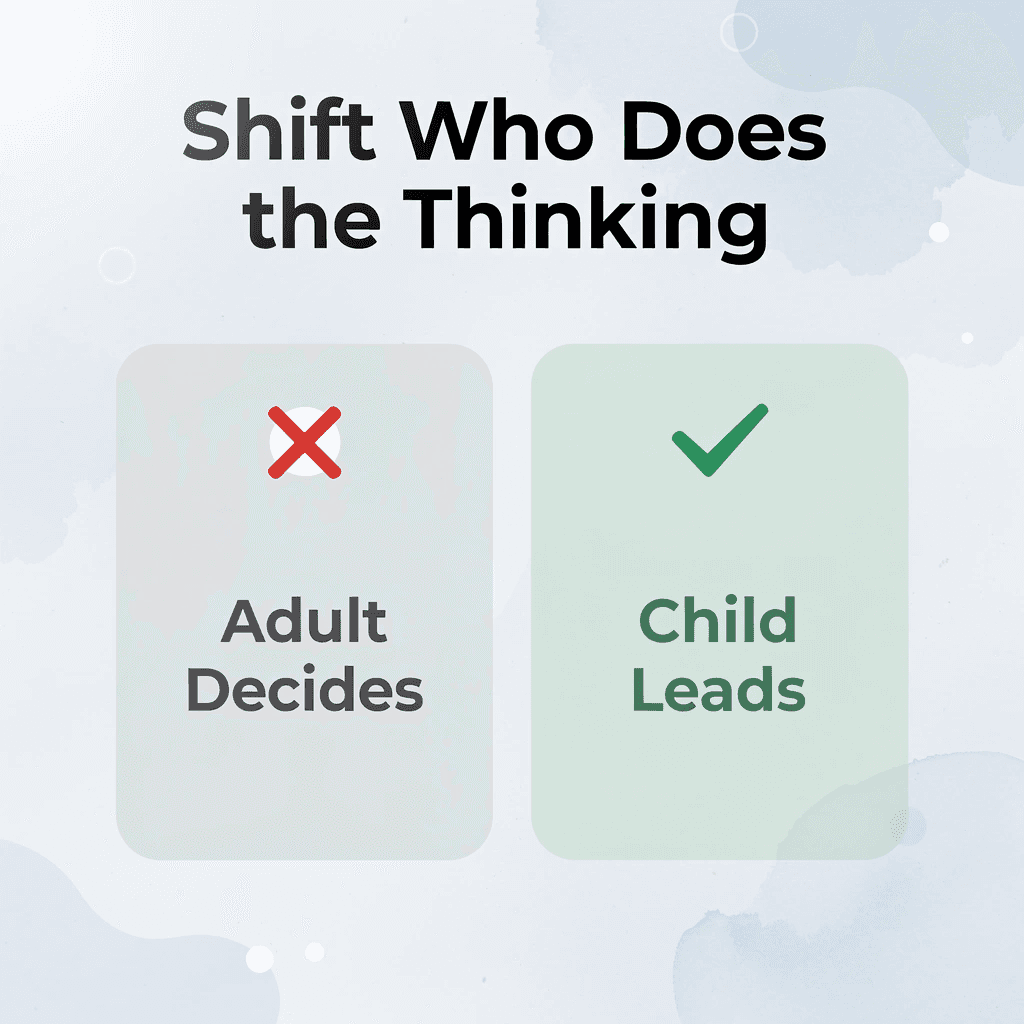
If your child waits for you to decide, freezes without an example, or spends most of their time watching instead of creating, that is the starting point. Pick one idea they already care about and give them just enough structure to begin, then step back. My Coloring Pages makes that practical: a child names the concept, our platform generates a personalized printable outline from our library of 75,000+ free customized worksheets, the screen closes, and the child takes over. You ask one question instead of giving the next instruction. That single shift, repeated across small moments, is what early childhood learning actually builds on.
💡 Tip: Watch for these three signals that your child is ready for a thinking handoff:
Signal | What It Looks Like | Your Move |
|---|---|---|
Waits for decisions | Asks "what should I do?" before trying | Offer one choice, then step back |
Freezes without examples | Stalls until shown exactly what to do | Give just enough structure to start |
Watches instead of creates | Observes passively rather than engaging | Hand them the tool and ask one question |
⚠️ Warning: Giving too much instruction — even with good intentions — keeps the thinking on your side. The goal is to make yourself unnecessary, one small moment at a time.