15 Positive Strategies for Early Child Development and Learning
Early child development thrives with the right strategies. My Coloring Pages shares 15 proven ways to boost learning and growth.

Early childhood development research consistently shows that the strategies and tools children encounter in their first years shape how they think, learn, and create long into the future. Finding approaches that genuinely hold a child's attention while building real skills is one of the most practical challenges parents and educators face. Hands-on, engaging activities tend to produce the strongest results, particularly when they make learning feel less like a task and more like play.
Coloring pages and creative worksheets are a simple but effective way to support fine motor skills, language development, and social-emotional growth without overwhelming young learners. For families and educators looking for ready-to-use resources, My Coloring Pages makes it easy to download 75,000+ free coloring pages organized by theme and skill area.
Summary
- Early childhood development is not a slow, gradual process that can wait until formal schooling begins. Research confirms that 90% of brain development occurs in the first five years of life, and more than one million neural connections form every second during this window. The experiences children have before kindergarten do not simply prepare them for learning. They determine the cognitive, emotional, and social architecture that all future learning is built on.
- Development across early childhood spans fifteen interconnected areas, including cognitive growth, language, emotional regulation, fine motor control, executive function, creativity, resilience, and a child's developing sense of self. These domains do not grow in isolation. Progress in one consistently accelerates growth in others, so the most effective developmental activities engage several capacities at once rather than targeting a single skill in a controlled, one-answer format.
- Nearly one in five children does not reach expected developmental milestones across all five core domains by age two to two and a half, according to UK government data from 2024 to 2025. The gap is rarely explained by intelligence or parental effort. It is almost always a function of opportunity and environment, specifically how often a child encounters experiences that require them to think, persist, communicate, and create within a context that feels relevant to them.
- When early development is neglected or left entirely to generic materials and passive screen time, the consequences compound quietly. Executive function skills develop most rapidly between ages three and five, and children who miss sufficient independent practice during this period are significantly more likely to show low academic self-concept by second grade, according to a 2021 analysis from the National Institute for Early Education Research. Behaviors that adults often label as stubbornness or inattention frequently reflect missing developmental skills rather than attitude problems.
- Personalization plays a larger role in developmental outcomes than most parents and educators expect. Generic worksheets and coloring books rarely hold a child's attention long enough for real skill-building. When children engage with content connected to their own interests, their pets, their stories, their specific curiosities, the creative session becomes a genuine exercise in decision-making, communication, and focused attention rather than a fill-in task they tolerate and abandon.
- Confidence and a developing sense of self may be the most underestimated dimension of early childhood development. It does not appear on skills checklists or kindergarten assessments, but it shapes how a child responds to every developmental challenge they encounter. Children who have collected evidence that they can figure things out approach difficulty differently than those who have mostly watched adults solve problems for them, and they build that internal record through small, repeated wins across cognitive, creative, and social experiences.
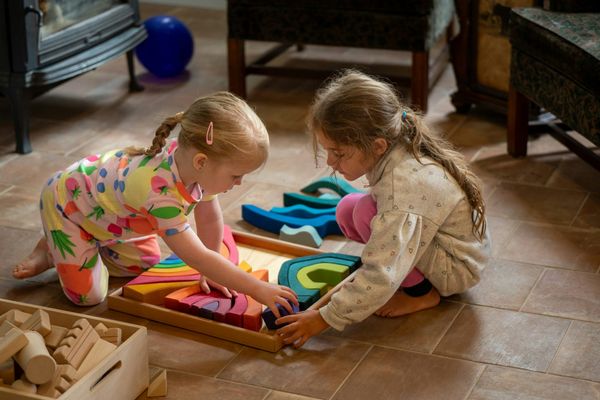
- My Coloring Pages's Download 75000+ Free Customized Worksheets addresses the personalization gap directly by letting parents and educators generate printable coloring pages and activities built around a child's specific interests, so the creative work holds attention long enough for fine motor skills, language, focus, and decision-making to develop simultaneously.
What is Early Child Development?
Early child development is a continuous process that is shaped by experience and starts from birth. It is actively built through relationships, repetition, and the quality of what a child practices — not a passive unfolding of milestones. It doesn't switch on at age four or click into place once school begins.
"Development is actively built through relationships, repetition, and quality of experience — beginning at birth, long before formal education ever starts."
💡 Key Insight: Early child development begins the moment a child is born. Every interaction, routine, and environment directly shapes how the brain grows and learns.
⚠️ Common Misconception: Many parents assume development becomes critical only when school starts — but the earliest years are the most formative period of a child's entire life.
Why does early child development matter so much in the first five years?
According to the Australian Bureau of Statistics: Measuring What Matters, 90% of brain development happens in the first five years of life. This concentrated period shapes how children think, manage emotions, learn language, and interact with others in interconnected ways. The relationships, conversations, challenges, and creative experiences a child receives during this window significantly influence their lifelong development.
What actually gets built during early development?
Early childhood development includes five connected areas: thinking skills, language and talking, social and emotional growth, physical and movement skills, and how children learn (curiosity, persistence, self-control). These areas work together: a child with strong talking skills handles social problems better; practicing fine motor skills through drawing builds the focused attention that supports reading. The best strategies create conditions where multiple abilities grow simultaneously through play, conversation, movement, and hands-on creative work, rather than focusing on one skill at a time.
Why does environment matter more than most parents realize?
The failure point is usually not a lack of love but the assumption that a child's environment is a neutral background. While basic care works to a point, Child Development Outcomes, 2024 to 2025, from the UK's Office for Health Improvement and Disparities found that 81.4% of children achieved expected development across all five domains at age two to two and a half years; nearly one in five did not. The gap is rarely about intelligence; it is almost always about opportunity and environment.
How does personalized activity change a child's engagement and skill-building?
Most parents use generic activities because finding materials that match a child's developmental level and interests takes effort. A child who loves dinosaurs receives the same generic worksheet as every other child, causing interest and learning to decline. Platforms like Download 75000+ Free Customized Worksheets let parents create activities built around a child's specific interests, making creative work personal enough to sustain attention for real skill-building.
Why environment shapes more than we expect
The critical difference between children who build strong early foundations and those who struggle is not talent, but the number and quality of developmentally rich moments they have before age five. Responsive interaction, hands-on problem-solving, language-rich play, and age-appropriate creative challenges form neural pathways when the brain is most ready to learn. Waiting for readiness without building the conditions that create it is like keeping a plant in a dark room: the biology is there, but it needs the right environment to flourish.
This is why what comes next matters more than most people expect.
Importance of Early Child Development
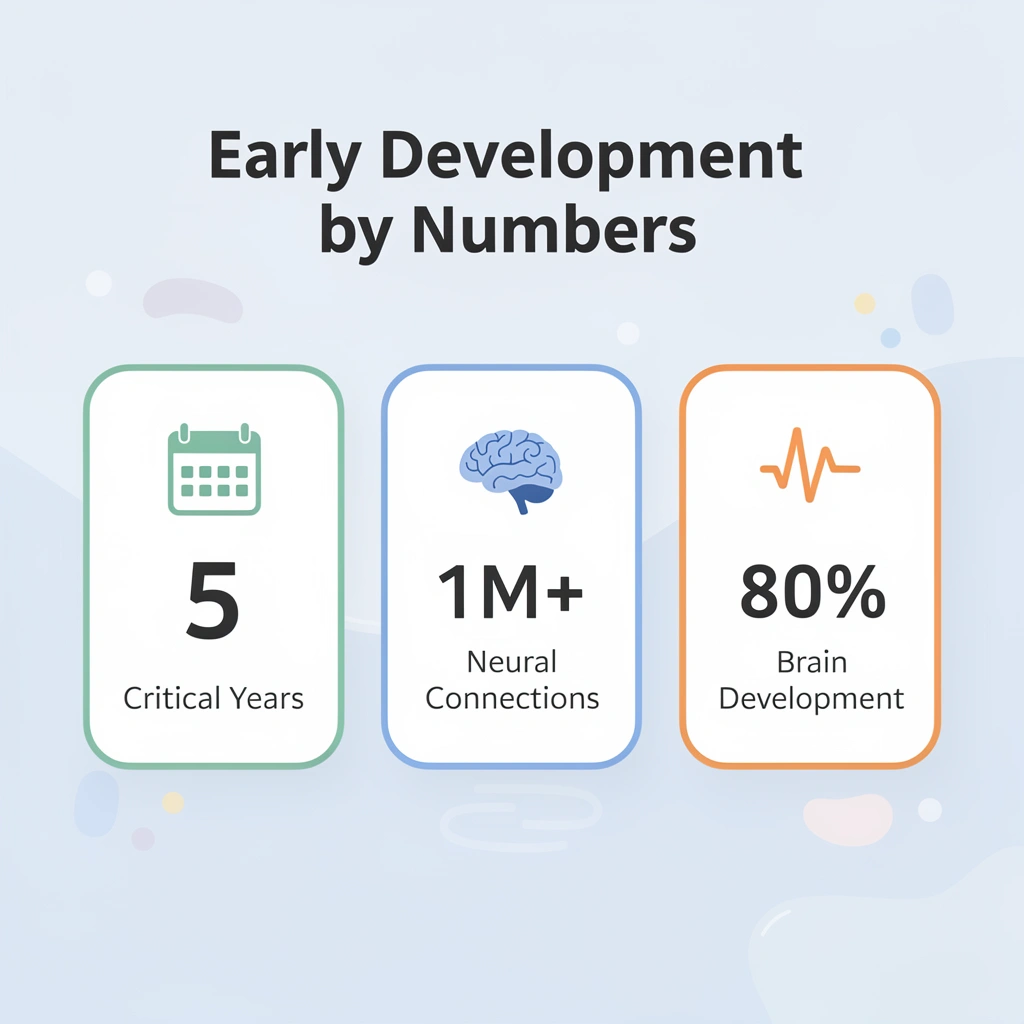
What happens in the first five years of a child's life is learning at its most concentrated and important. More than one million neural connections form every second during early childhood, and research from Crawford International confirms that over 80% of brain development occurs before age five. These early experiences lay the foundation everything else is built on.
"Over 80% of brain development occurs before age five — making early childhood the single most critical window for lifelong learning." — Crawford International
🔑 Takeaway: The first five years aren't just important — they are irreplaceable. Neural connections form at a rate of 1,000,000+ per second, meaning every interaction, environment, and experience during this window has an outsized, lasting impact on a child's future.
💡 Why It Matters: Missing this critical developmental window doesn't just slow progress — it can reshape the entire trajectory of a child's cognitive, emotional, and social growth. Early investment in child development is always more effective than intervention later.
When the foundation shapes everything above it
The failure point is usually invisible until the structure above it cracks. A child entering school without strong language exposure, problem-solving practice, or emotional regulation is behind because the scaffolding was incomplete before formal expectations arrived. Formal schooling demands listening, following multi-step instructions, managing frustration, collaboration, and persistence, often all within the same morning. When early development builds those capacities gradually, school feels like growth. When it has not, everything feels hard at once.
Why does the gap show up so quietly in early child development?
The gap shows up quietly as extra effort, repeated corrections, and accumulated "this is too hard for me" experiences that harden into identity. Research from Crawford International links high-quality early childhood development to reduced need for extra help later and stronger long-term school retention—not because early stimulation creates prodigies, but because it prevents years of catching up on foundations that should precede academic content.
How does personalized activity deepen early developmental outcomes?
Most parents rely on generic workbooks, screen time, or preschool. Children learn better when engaging with content connected to their world—their pets, stories, and interests. Platforms like My Coloring Pages let parents create personalized, printable coloring pages around a child's interests, turning creative activity into a hands-on experience that builds fine motor skills, focus, and language at the same time.
Development is not only about cognition
A child who knows their letters and numbers but cannot handle frustration, understand a social situation, or bounce back from failure will struggle in ways no worksheet can measure. Crawford International's framework for early childhood development includes emotional intelligence, physical wellbeing, creativity, and critical thinking alongside cognitive growth because these abilities develop at the same time and depend on each other. A child who never practices working through a difficult puzzle, disagreeing with a friend, or sitting with an unsolved problem doesn't build resilience.
Why does equity matter in early development?
Early development has a fairness dimension that often goes unexamined. Children start kindergarten with vastly different access to books, safe environments, language-rich settings, and adult attention. Quality early experiences close achievement gaps in ways that persist for years. The child who talks, explores, creates, and solves problems before school begins enters a system expecting these capabilities from all students, regardless of their starting point.
What happens next is harder to accept: neglect in this window does not stay in one place.
Related Reading
What Happens When You Neglect Early Childhood Development
Ignoring early childhood development causes problems that compound over time, with each issue building on the last and creating a cycle that becomes increasingly difficult to reverse.
"Early childhood is the most critical window for brain development — neglect during this period doesn't just delay progress, it compounds into lifelong challenges." — Child Development Research Consensus
⚠️ Warning: The consequences of neglecting early development are interconnected — each gap triggers the next, making early intervention the single most important factor in a child's long-term success.
🔑 Takeaway: Early childhood neglect creates a domino effect where cognitive, emotional, and social deficits accumulate, meaning the longer action is delayed, the harder and more costly recovery becomes.
Small problems become permanent patterns
The failure point is usually invisible at first. A child who never works through a stuck puzzle or broken toy misses the repetition of "notice, think, try, adjust" that builds problem-solving instinct over time. According to research published by the Harvard Center on the Developing Child, executive function skills—including planning, focus, and self-regulation—develop most rapidly between ages three and five. When that window passes without enough independent practice, children arrive at school expecting an adult to bridge every gap. The classroom asks, "What could you try?" and the child has no answer, not from lack of intelligence, but because the mental habit was never built.
Why doesn't emotional regulation catch up on its own?
A block tower falls down. A game goes wrong. The real problem disappears under crying, quitting, or asking for help. Children need repeated experiences of feeling frustrated, receiving calm support, calming down, and trying again. If every uncomfortable moment gets removed before the child sits with it, they never build the internal bridge between "I feel upset" and "I can still figure out what to do next." That skill does not appear automatically at age seven.
How does personalized creative work keep children engaged long enough to develop?
Generic coloring books and printed worksheets rarely connect to what a child cares about, and engagement drops when the subject feels unimportant. When children work with content tied to their own world—their pets, favorite stories, real curiosities—the creative session becomes genuine problem-solving and communication, not a fill-in task. Our Download 75000+ Free Customized Worksheets platform lets parents and educators generate personalized coloring pages from a library of over 100,000 options, so creative work holds a child's attention long enough for developmental benefits to occur.
Dependence grows quietly while confidence shrinks loudly
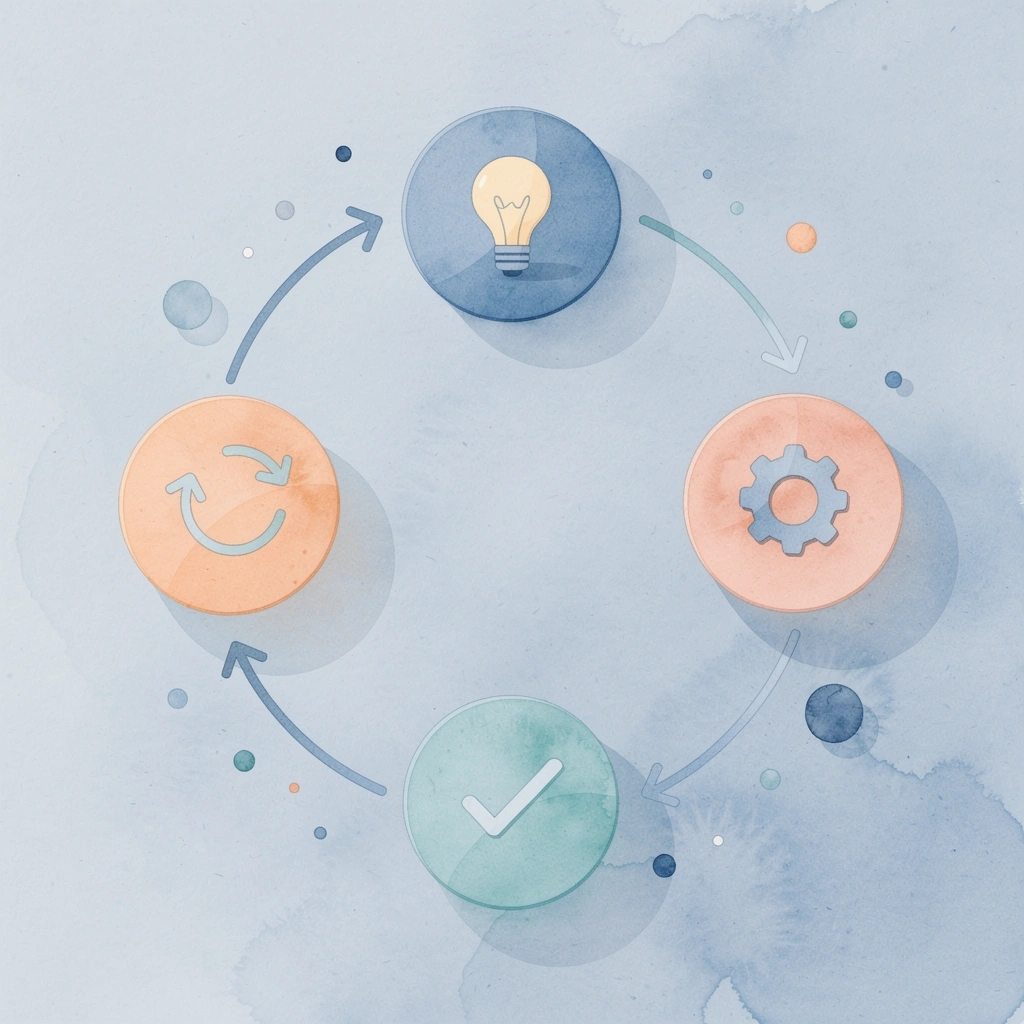
The pattern that concerns developmental specialists most is a cycle: the child waits, the adult directs, the child follows, and the adult directs again. Open-ended situations become uncomfortable without outside guidance. Over time, "I need help with this" becomes "I can't do this," and eventually "I'm not capable." A 2021 analysis from the National Institute for Early Education Research found that children with limited early chances for independent play and problem-solving were significantly more likely to show low academic self-concept by second grade. The gap between ability and belief is where long-term confidence damage lives.
Behavior that looks like defiance is often a missing skill
Many behaviors adults label as laziness or stubbornness are skill deficits. A child who repeatedly interrupts, forgets instructions, avoids hard tasks, or has a meltdown at transitions is communicating: "I do not yet have the skill this situation requires." When adults respond only with pressure—"try harder," "pay attention," "do it"—the child receives correction without practice in the missing ability. They struggle and are blamed for struggling, which accelerates the identity shift from "I need help here" toward "I am not capable."
The cycle that traps families
When parents don't let children develop skills independently, it makes adult work harder over time, not easier. As the child grows older, their demands increase while their ability to do things stays the same. Parents end up managing homework, conflicts, morning routines, and emotional recovery that should have gradually shifted to the child years before. Every time an adult steps in, the child misses a chance to practice the skill that everyone wants them to learn. The cycle tightens: the child depends on the parent, the parent helps more, the child gets less practice being independent, and the child depends more.
The skills most affected—creativity, self-regulation, communication, resilience—are exactly the ones no single lesson teaches.
Related Reading
What is Included in Early Child Development
Skills that develop through repeated, low-stakes practice—where the child does the work—follow this pattern across every aspect of early childhood development.
💡 Key Insight: Low-stakes practice means the child builds skills through real doing, not passive observation. This is the foundation of all meaningful early development.
"Early child development covers fifteen distinct but deeply connected areas—and progress in one area often accelerates growth in another." — Core Principle of Child Development
Early child development covers fifteen distinct but deeply connected areas: cognitive growth, language and communication, social skills, emotional regulation, physical and motor control, self-regulation, executive function, creativity, play, independence, curiosity, attention, resilience, early academic readiness, and a child's developing sense of self. These areas connect constantly, and progress in one often speeds up growth in another.
⚠️ Warning: Focusing on only academic readiness while neglecting areas like emotional regulation or self-regulation can undermine a child's long-term success.
🔑 Takeaway: All fifteen areas are equally essential—development is not a checklist but an interconnected system where every part supports the whole.
Why do children develop multiple skills at the same time?
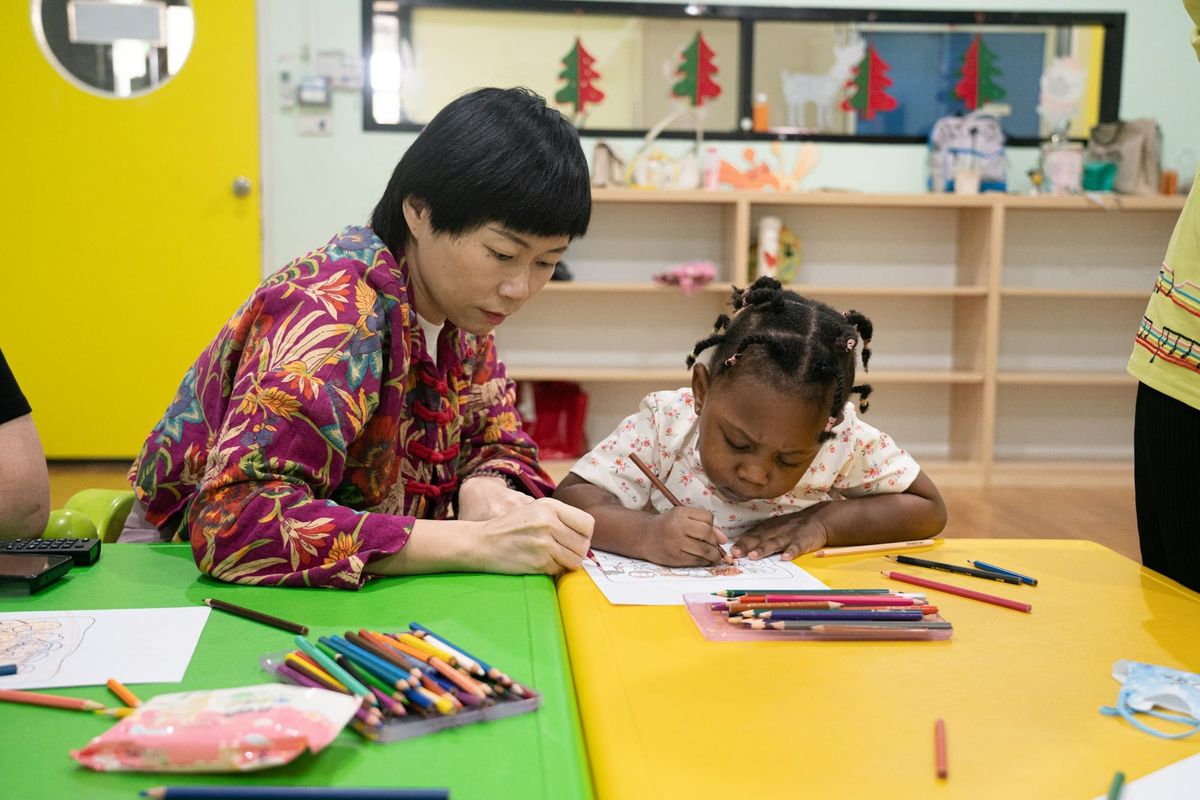
When a child colors a page with their own dog or made-up character, they exercise executive function by making decisions, develop fine motor skills by holding a crayon with precision, sustain attention, and build confidence through personal creation rather than copying. Research from the Cleveland Clinic confirms that early development works this way: children grow through experiences demanding multiple skills simultaneously, not one skill at a time.
What gets left out when every task has one correct answer?
Most parents and teachers choose structured instruction because progress feels clear and easy to measure: a finished worksheet, a traced letter, a written number. The hidden cost is what gets left out. Children rarely decide anything, persist through uncertainty, or explain their thinking. When every task has one correct answer and method, executive function and creative reasoning receive minimal practice. Tools like Download 75000+ Free Customized Worksheets shift this by letting children start with their own idea—a pet, story, or place they love—and engage with content that already means something to them, deepening attention, language, and motivation at once.
Why are confidence and curiosity the most underestimated areas?
Confidence and a developing sense of self may be the most underestimated areas on this list. It doesn't appear on skills checklists or kindergarten entry assessments, but it shapes how a child responds to every developmental challenge. A child who has collected evidence that they can figure things out approaches difficulty differently than one who has mostly watched adults solve problems. That internal record, built through small wins across cognitive, social, emotional, and creative experiences, becomes the foundation for everything else.
Curiosity works the same way. When a child asks "what happens if I mix these two colors?" and an adult answers immediately, the question closes. When the child is encouraged to try it, the question becomes an experiment. That shift from passive recipient to active investigator builds the learning orientation that serves children through formal schooling and beyond. Multiply this across thousands of daily interactions and the developmental difference becomes significant.
What does knowing these areas actually require in practice?
Knowing what these fifteen areas are is not the same as knowing how to build them into a Tuesday afternoon.
15 Positive Strategies for Early Child Development and Learning
1. Ask “What Could You Try?” Before Fixing the Problem
This tackles: every small problem becoming an adult problem.
A toy will not work.
A block structure falls.
A puzzle piece does not fit.
Instead of immediately saying:
“Here, let me do it.”
Ask:
“What could you try?”
If the child genuinely does not know, narrow the problem:
“Which part keeps falling?”
“What could you move?”
“Which piece looks closer?”
Now the sequence becomes:
Problem → observe → think → attempt
instead of:
Problem → adult rescue.
This gives the child practice with problem-solving, persistence, and flexible thinking while still knowing help is available.
2. Name Emotions Before Trying to Stop Them
This tackles: frustration immediately turning into crying, shouting, quitting, or adult rescue.
When a child is upset, jumping straight to:
“Stop crying.”
does not teach them what to do with the feeling.
Try:
“You're frustrated because the tower fell.”
Then:
“Let's calm down. What could we try next?”
The developmental sequence becomes:
Feel emotion → recognize it → regulate → communicate → continue.
The goal is not to eliminate strong emotions.
It is to gradually help the child build more options between:
“I feel upset”
and
“I can't continue.”
3. Use My Coloring Pages as a Starting Scaffold, Not the Finished Idea
This tackles: blank-page hesitation, passive screen use, copying, constant “What should I make?”, and dependence on adult ideas.
Start by asking the child:
“What would YOU like to create?”
Maybe they invent:
- An underwater dinosaur
- A superhero version of themselves
- An animal designed for the desert
- A house on the moon
Then use My Coloring Pages to turn their description or image into a printable starting outline, or choose from 75,000+ community coloring pages when they need inspiration.
But the important developmental work should happen after the outline appears.
Use this sequence:
Child supplies idea → My Coloring Pages removes the blank-page barrier → print → child chooses colors and details → adds or changes something → explains why → parent asks what happens next.
For example:
“Why does your animal have those feet?”
“What would you add if it lived somewhere cold?”
“What happens next in this picture?”
Now one simple printable can involve:
- Creativity
- Language
- Fine-motor control
- Decision-making
- Flexible thinking
- Confidence
The tool gives the child somewhere to start.
The child still decides where the idea goes.
4. Give Children Real Choices Every Day
This tackles: constant “What should I do?” and dependence on adult approval.
Give choices where either answer genuinely works.
For example:
“Do you want the blue cup or the green one?”
“Should we read first or build first?”
“Which material do you want to try?”
Then avoid replacing their choice unnecessarily.
Ask:
“Why did you choose that?”
Now choice creates:
Decision → action → consequence → reflection.
That is how independence develops.
Not by repeatedly telling a child:
“Be independent.”
but by actually giving them age-appropriate things to decide.
5. Use Short Multi-Step Tasks to Build Memory and Independence
This tackles: “What do I do next?” and repeated adult reminders.
Start small.
“Get your shoes and bring your bag.”
Later:
“Put your book away, get your shoes, and bring your water bottle.”
If they forget, ask:
“What do you remember?”
Before repeating everything.
The progression becomes:
- Adult remembers all steps
- Child holds one or two
- Child holds more
- Adult prompts less
This develops working memory, sequencing, attention, and everyday independence.
6. Turn Everyday Conversations Into Language Practice
This tackles: children struggling to explain what they need, what happened, or what they are thinking.
You do not need a formal language lesson.
Ask questions such as:
“What happened?”
“How did that make you feel?”
“Why do you think that happened?”
“What do you think happens next?”
If the child gives a one-word answer, gently extend it.
Child:
“Dog.”
Adult:
“Yes, a big brown dog. What is it doing?”
Now language becomes:
Notice → describe → organize → communicate.
That supports both everyday communication and later learning.
7. Let Social Problems Become Small Problem-Solving Opportunities
This tackles: every disagreement requiring an adult referee.
Two children want the same toy.
Instead of immediately deciding:
“You had it first, so you keep it.”
When appropriate, ask:
“You both want it. What could we do?”
Help them generate possibilities:
- Take turns
- Play together
- Set a timer
- Choose another shared activity
The point is not to leave children alone during serious conflict.
It is to move from:
Social problem → adult verdict
toward:
Social problem → communicate → consider options → agree.
That builds cooperation, empathy, negotiation, and social confidence.
8. Let Mistakes Stay Long Enough to Teach Something
This tackles: mistakes feeling threatening and children becoming afraid to try.
Adults often correct mistakes instantly.
Instead try:
“What happened there?”
“Which part should we check?”
“What could you change?”
If a tower falls, do not immediately rebuild it.
If a prediction is wrong, do not immediately replace it with the right answer.
The sequence becomes:
Mistake → notice → investigate → adjust → retry.
That helps children experience:
“Something went wrong.”
without turning it into:
“Something is wrong with me.”
9. Give Attention a Goal Instead of Constantly Saying “Focus”
This tackles: attention depending on adult redirection.
Instead of:
“Pay attention.”
try:
“Can you find three red things?”
“Listen for the word ‘cat’ and clap when you hear it.”
“Can you finish this tower without letting it fall?”
Now attention has a purpose.
The process becomes:
Goal → focus → action → result.
This helps move the child from:
Adult manages my attention
toward:
I stay focused because I am trying to accomplish something.
10. Build Movement Into Development
This tackles: physical development becoming neglected while activities become increasingly passive.
Children need regular opportunities to:
- Run
- Jump
- Climb
- Balance
- Throw
- Draw
- Build
- Cut
- Manipulate objects
You can combine movement with learning.
Try:
- Jumping onto number cards
- An obstacle course with instructions
- Sorting objects across the room
- Acting out story characters
Now physical development and learning happen together.
The goal is not simply:
“Burn energy.”
The child can also practice:
- Coordination
- Memory
- Sequencing
- Attention
- Body control
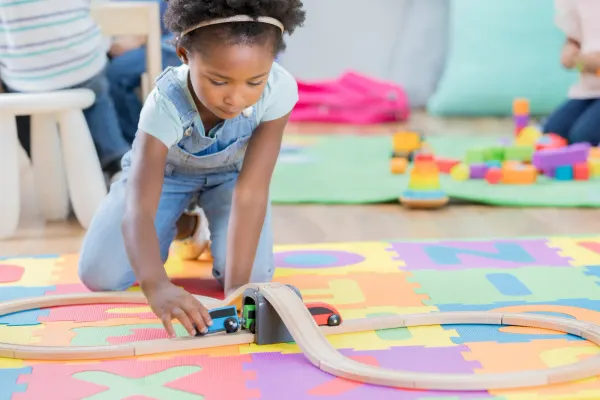
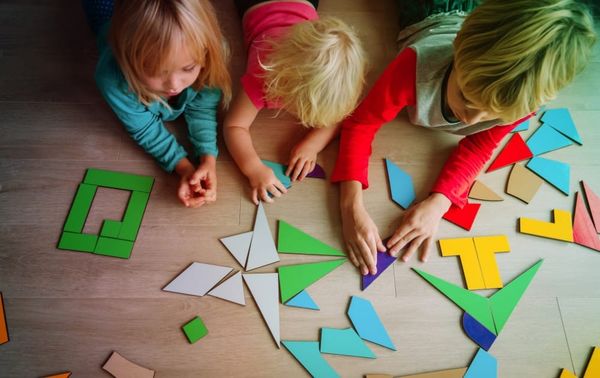
11. Use Open-Ended Play With No Single Correct Result
This tackles: copying instead of creating and “Show me what I'm supposed to make.”
Give children materials such as:
- Blocks
- Boxes
- Paper
- Toy animals
- Craft materials
and offer a broad goal:
“Can you build somewhere this animal could live?”
Or:
“What could this box become?”
Avoid showing a finished example immediately.
Now the child needs to:
Generate → choose → plan → create → adjust.
That directly builds creativity, confidence, planning, and problem-solving.
12. Turn “Why?” Into a Mini Investigation
This tackles: curiosity becoming “Just tell me the answer.”
If a child asks:
“Why does ice melt?”
Instead of answering immediately, try:
“What do you think?”
Then test it.
Put one ice cube:
- In sunlight
and another:
- Somewhere cooler
Ask:
“Which do you think will melt first?”
Then observe.
The cycle becomes:
Question → prediction → test → observation → explanation.
That teaches children:
“When I don't know something, I can explore it.”
Instead of only:
“Someone else has the answer.”
13. Give Manageable Challenges Instead of Removing Every Frustration
This tackles: “I can't” appearing before the child has really tried.
A challenge should sit between:
- Too easy
- So difficult that the child is overwhelmed
If they can easily complete a six-piece puzzle, try a slightly harder one.
If they can remember two instructions, try three.
If they can build a simple tower, ask:
“Can you make one that holds this toy?”
The learning sequence becomes:
Current ability → slightly harder challenge → effort → support → success.
That gives children evidence that:
“Hard doesn't automatically mean impossible.”
14. Help Less as the Child Becomes More Capable
This tackles: parents doing more and more as the child gets older.
Support should change.
At first:
“I'll show you.”
Then:
“Let's do it together.”
Then:
“What should you do first?”
Finally:
“You try.”
The progression becomes:
- Adult does
- Adult + child
- Child + hint
- Child independently
If the adult keeps doing the same amount forever, the child has little reason to take over.
A useful question is:
“What part of this can my child now do without me?”
Then let them do that part.
15. End Activities by Asking the Child to Explain or Show What They Learned
This tackles: passive participation and adults being unable to tell whether the child actually understood.
After an activity, do not stop at:
“Good job.”
Ask:
“Tell me what you did.”
“What was difficult?”
“What did you change?”
“What would you do differently next time?”
Or:
“Can you teach me?”
The child has to:
Remember → organize → explain → reflect.
That strengthens language, memory, confidence, and understanding while also showing you what the child actually took from the activity.
How These Strategies Directly Support Child Development
These strategies are not random parenting tips.
Each reverses a developmental problem discussed earlier.
- Every problem becomes an adult problem → Ask the child what they could try first.
- Strong emotions stop the activity → Name, regulate, then return to the problem.
- Blank pages and open-ended tasks cause “I don't know” → Use My Coloring Pages as a starting scaffold while keeping the choices with the child.
- Every decision needs adult approval → Provide real choices.
- Instructions are constantly forgotten → Gradually practice multi-step routines.
- Children struggle to communicate → Build language into everyday conversation.
- Every social disagreement needs an adult → Coach children through simple solutions.
- Mistakes feel threatening → Investigate them before correcting.
- Attention needs constant reminders → Attach focus to meaningful goals.
- Physical development becomes passive → Include movement and hands-on activity.
- Children copy instead of create → Use open-ended play.
- Curiosity becomes answer-seeking → Predict and investigate before explaining.
- Difficulty instantly becomes “I can't” → Provide manageable challenges.
- Parents keep doing more → Deliberately reduce support.
- Children complete activities without reflecting → Ask them to explain, teach, or demonstrate.
That changes the developmental pattern from:
Adult chooses → adult explains → adult solves → adult regulates → child follows
to:
Child encounters an opportunity → chooses → communicates → tries → experiences a manageable challenge → receives appropriate support → adjusts → explains → does slightly more independently next time.
That is the solution bridge.
The goal of positive child-development strategies is not to create a child who:
- Never becomes upset
- Never makes mistakes
- Never needs help
- Develops faster than everyone else
It is to make sure that everyday support increasingly gives the child opportunities to practice:
- Thinking
- Communicating
- Regulating
- Moving
- Creating
- Solving
- Doing more for themselves
Because the strongest sign that developmental support is working is not:
“My child never struggles.”
It is:
“When my child struggles, they increasingly have something they can try before I have to do it for them.”
Turn One Developmental Skill Into Something They Can Practice Today
Picking one developmental area and acting on it today matters more than knowing all fifteen. The gap between understanding child development and supporting cognitive growth, emotional regulation, and creative problem-solving closes through one specific action, not a complete overhaul.
If the blank page is the barrier, My Coloring Pages removes it without removing the child's responsibility to think. A child describes their idea, receives a printable starting outline from our 75,000+ customized worksheets, and then makes every decision that follows. The developmental work happens at the table, pencil in hand.
Pick the one skill you keep noticing your child needs most. One idea, one page, one conversation about what they created and why. Repeat it consistently; that proves it matters.