Do Schools Kill Creativity + Tips to Encourage Creativity
Do schools kill creativity? My Coloring Pages reveals how education impacts creative thinking and shares proven tips to nurture imagination at home.


Traditional education systems often prioritize standardized testing and rigid curricula over imagination and original thinking. When children are consistently told there's one correct answer, their natural curiosity and willingness to explore wild ideas gradually diminish. Understanding how to foster creativity becomes essential as parents recognize that conventional schooling can inadvertently suppress the very qualities that help children thrive in an unpredictable world. Parents need practical tools to nurture their child's creative spirit while working within or around educational constraints.
Creative activities like coloring and drawing provide children with opportunities to explore ideas without the pressure of right-or-wrong answers. When children engage in artistic expression, they develop problem-solving skills and confidence that standardized tests cannot measure. These activities complement classroom learning by creating space for independent thinking and imagination to flourish. Parents looking to support their child's creative development can download 75,890+ free coloring pages designed to encourage artistic expression and spark imagination.
Summary
- Research from NASA scientists George Land and Beth Jarman reveals that 98% of five-year-olds score at a genius level for divergent thinking, but that capacity drops to just 30% by age ten, 12% by fifteen, and 2% in adults. This dramatic decline suggests that something between kindergarten curiosity and workplace conformity systematically conditions people away from original thinking. The pattern isn't biological development. It's learned behavior reinforced through years of educational environments that reward single correct answers over imaginative exploration.
- Fear of mistakes becomes the primary barrier to creative development in many classroom settings. When students learn that deviation carries social and academic risk while conformity brings reward, they stop volunteering unusual ideas before adults ever need to intervene. A global Adobe study found that 52% of adults believe creativity was stifled by education systems, while only 25% feel they're living up to their creative potential. This happens because schools unintentionally teach that being wrong leads to embarrassment, punishment, or criticism, creating psychological barriers that discourage students from taking creative risks altogether.
- Test-focused environments accelerate the decline of creativity by making performance metrics the organizing principle of learning. When schools face pressure to raise standardized test scores, they cut arts programs, reduce project-based learning, and increase drill-based instruction. The Journal of Creative Behavior found that environments emphasizing rigid performance metrics were associated with lower creative engagement and reduced intrinsic motivation. Students optimize for grades rather than exploration, shifting their fundamental question from curiosity-driven inquiry to compliance-oriented survival.
- After-school hours present the most critical window for rebuilding creative confidence that structured school days often drain. The biggest creativity killer during these hours isn't a lack of activities but the absence of unstructured time. When children move directly from school to tutoring to sports without any empty hours, their minds never enter the mental space where imagination activates. Creativity often emerges from boredom, that restless feeling when nothing external entertains you, forces internal invention, which children lose when every minute is scheduled.
- Storytelling and narrative invention strengthen divergent thinking more effectively than most structured activities because children must generate characters, invent problems, imagine solutions, and construct cause-and-effect sequences simultaneously. Research consistently links imaginative play to stronger perspective-taking abilities, better emotional regulation, and a more sophisticated theory of mind. The cognitive benefit appears in how children learn to manipulate variables mentally, holding one element constant while changing another and reasoning through implications, which forms the thinking pattern underlying innovation across all fields.
- According to Afterschool Alliance research, 85% of parents want structured afterschool programs, yet the major problem isn't lack of creative activities but that inspiration during activities quickly fades once they end. MyColoringPages addresses this creativity drop-off by offering over 75,890 free coloring pages designed to bridge imaginative moments, allowing children to visually continue narratives they've started elsewhere and transforming passive coloring into active storytelling that persists beyond isolated activity sessions.
Do Schools Kill Creativity?
Schools don't kill creativity on purpose, but many classroom environments suppress it through systems built around rules, speed, and single correct answers. When test scores become the primary measure of success, exploration becomes a luxury most schools cannot afford.
🎯 Key Point: The problem isn't intentional — it's systemic. When schools prioritize measurable outcomes over creative processes, students learn that there's only one right way to approach problems.
"When test scores become the primary measure of success, exploration becomes a luxury most schools can't afford." — Educational Reality, 2024
⚠️ Warning: This narrow focus creates students who are excellent at following directions but struggle when faced with open-ended challenges that require original thinking and creative problem-solving.
What happens to creative genius as children grow up?
According to research conducted by NASA scientists George Land and Beth Jarman, 98% of five-year-olds score at a genius level for divergent thinking. By age ten, only 30% retain that ability. By fifteen, 12%. Adults score at 2%. Something between kindergarten and adulthood trains people to abandon original thinking.
How does formal education discourage creative thinking?
Young children tell detailed stories without worrying if they make sense and ask uncomfortable questions because they haven't learned which ideas are acceptable. Then school begins, and every answer gets marked right or wrong. Students stop sharing unusual ideas because the social cost of being wrong outweighs the benefit of being interesting. They learn that speed matters more than depth, that following instructions beats asking why, that the goal is to produce what teachers expect rather than to discover what might be possible.
How does fear of mistakes impact student creativity?
Being creative means trying things that might not work. Yet schools often treat mistakes as signs of inadequacy rather than normal steps in learning. A child who colors outside the lines gets told to fix it. A student who reads a poem differently from the answer key loses points.
The message is clear: being different is risky, and following the rules gets rewarded. By middle school, most students have internalized this idea so thoroughly that they self-censor before teachers need to intervene.
Why do students choose compliance over creative engagement?
Students realize that their analytical engagement is dismissed while passive compliance is praised. They want their ideas taken seriously, but the system prioritizes efficiency over exploration.
According to a global Adobe study surveying adults, 52% believe education systems stifled their creativity, while only 25% feel they're living up to their creative potential.
How do standardized tests impact creative learning?
Standardized assessments measure what's easiest to score, not what matters most for innovation. Multiple choice questions reward quick pattern recognition, not the patient uncertainty that precedes breakthrough thinking. When schools face pressure to raise test scores, they cut arts programs, reduce project-based learning, and increase drill-based instruction. Teachers know this trade-off damages long-term development, but accountability systems leave little room for outcomes that can't be measured by April.
What alternatives can parents provide at home?
Platforms like My Coloring Pages fill gaps that classrooms cannot. With access to over 75,890 free, customizable coloring pages and worksheets, families create space for the open-ended exploration that standardized environments discourage. Children practice making choices without fear of wrong answers, building creative confidence.
But the same institutions now criticized for stifling creativity face growing pressure to teach it as a workforce skill.
Related Reading
- Best Books To Inspire Creativity In Kids
- Best Toys For Promoting Creativity
- Creativity Quotes
- Best Toys For Developing Creativity
- How To Encourage Creativity In Kids
- What Is Creativity
When Schools Might Actually Kill Creativity
Schools don't destroy creativity on purpose. They do it through many small choices: prioritizing speed over exploration, compliance over curiosity, experimentation over certainty, and risk-taking over certainty. When these patterns dominate, students stop asking unusual questions and optimize for safe answers.
🎯 Key Point: The creativity crisis in education isn't about malicious intent—it's about systemic patterns that consistently reward conformity over innovation.

The shift happens gradually. A child enters kindergarten asking "why" dozens of times daily. By middle school, that same child sits quietly, waiting to be told what matters. The system rewarded conformity consistently until imagination felt like a liability.
"Students learn to optimize for safe answers rather than creative exploration when educational systems consistently reward conformity over curiosity."
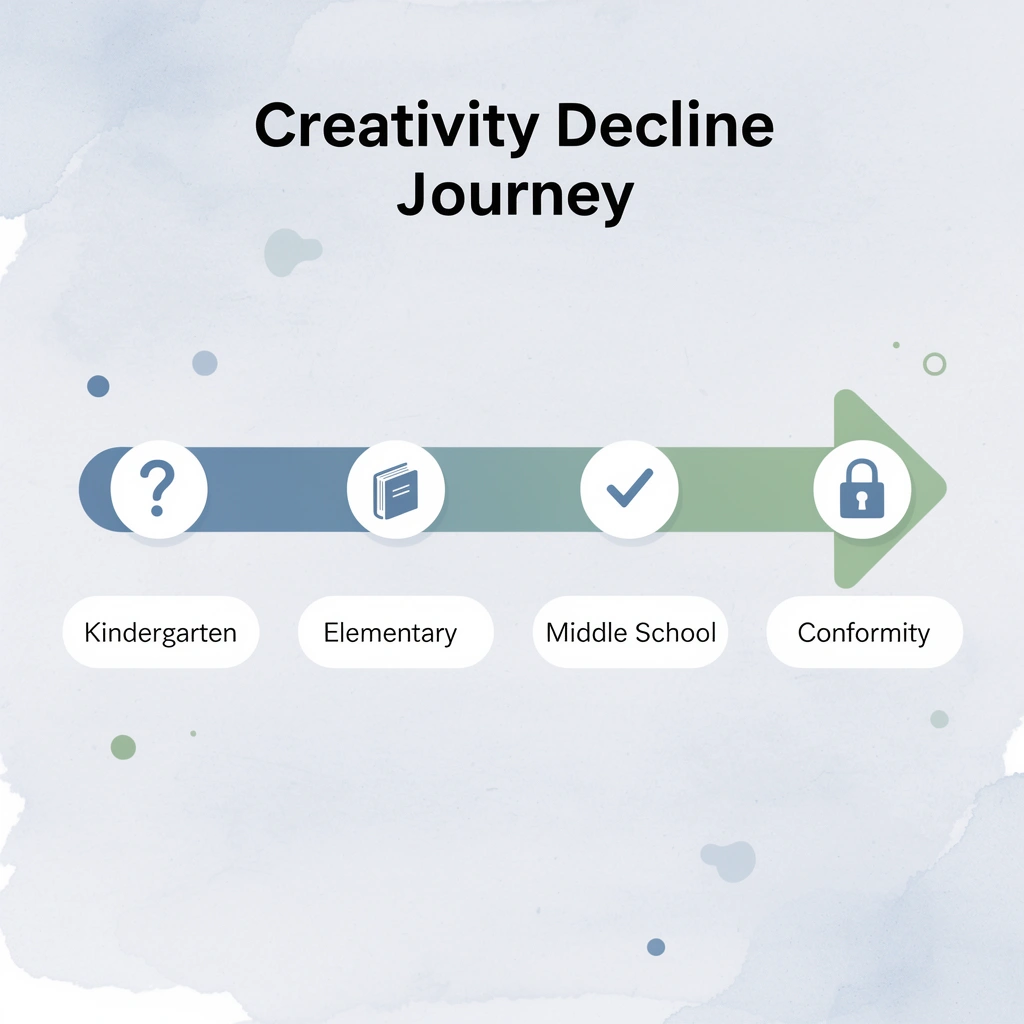
⚠️ Warning: This gradual erosion of creative thinking doesn't happen overnight—it's the result of thousands of small moments where compliance is rewarded and questioning is discouraged.
When Memorization Replaces Exploration
Classrooms built around recall create students who excel at reproducing information but struggle to generate original ideas. They can recite formulas but freeze when asked to apply them in unfamiliar contexts. Creativity depends on divergent thinking: the ability to produce multiple possibilities instead of converging on one predetermined answer.
NASA researcher George Land tracked divergent thinking across age groups: 98% of five-year-olds demonstrated genius-level capacity, dropping to 30% by age ten, 12% by teenage years, and 2% in adults. The decline isn't biological but learned. Years of being rewarded for reproducing existing answers teach students to abandon imaginative thinking.
Why do mistakes feel dangerous in school environments?
Creativity requires experimentation, which requires failure. Many school systems unintentionally teach students that mistakes lead to embarrassment, punishment, or public criticism. This creates a psychological barrier: students stop taking creative risks because being wrong feels unsafe.
How does fear of failure paralyze student creativity?
One educator described watching students who once wrote freely become paralyzed by blank pages after spending years in environments where every draft was graded and every mistake recorded.
Eventually, they stopped starting assignments independently, waiting instead for explicit instructions that would guarantee correctness. The fear was the quiet humiliation of trying something new and failing visibly.
What does research reveal about creativity and failure?
Research from the American Psychological Association confirms that creativity develops best in environments supporting autonomy, exploration, and intrinsic motivation. When students fear failure, they avoid original ideas, stay silent, and choose safe answers over innovative thinking, losing the willingness to engage deeply with uncertainty.
When Testing Becomes the Center
Testing becomes problematic when test performance becomes the organizing principle of learning. In heavily test-focused environments, curiosity gets rushed, creative subjects get reduced, and students prioritize grades over exploration. The Journal of Creative Behavior found that environments emphasizing rigid performance metrics were associated with lower creative engagement and reduced intrinsic motivation.
How does test-focused learning change student behavior?
Students learn to memorize formulas and achieve high scores while losing confidence in trying new things, understanding what they learn, and thinking for themselves. The question shifts from "I want to explore this idea" to "I need the correct answer." Over time, that change becomes permanent.
What is the real cost of testing culture?
But the real damage isn't what students learn. It's what they stop asking.
How to Select the Right School for Encouraging Creativity in 10 Steps
The right school builds environments where curiosity survives contact with structure, where mistakes become experiments instead of embarrassments, and where children leave each day more confident in their own thinking than when they arrived.
Most parents begin by comparing test scores, college placements, and brochures. Those metrics matter, but they reveal little about whether a school nurtures or suppresses creative thinking. The real indicators lie in classroom interactions, teacher responses to unusual answers, and whether students speak with memorized precision or genuine understanding. Choosing a school that protects creativity requires watching how institutions respond when children take intellectual risks.
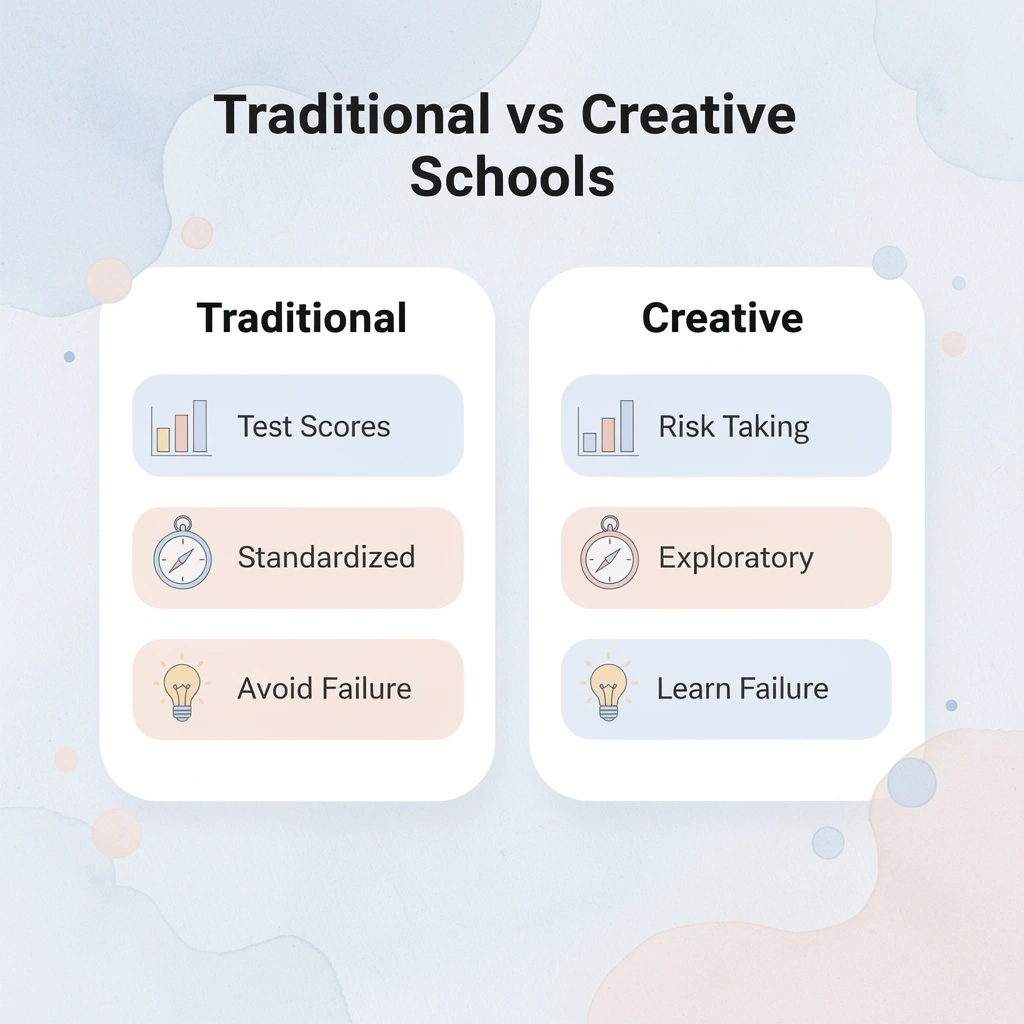
🎯 Key Point: The most creative schools prioritize intellectual risk-taking over standardized performance, creating safe spaces where students can explore ideas without fear of judgment.
"Schools that foster creativity focus on process over product, encouraging students to embrace failure as learning rather than something to avoid." — Educational Psychology Research, 2023

⚠️ Warning: Don't be fooled by schools that claim to support creativity but still punish unconventional thinking or prioritize test preparation over exploratory learning.
1. Look Beyond Grades and Exam Results
Strong board results don't guarantee creative development. Schools focused on rankings often create environments where speed matters more than depth, memorization replaces interpretation, and every project looks identical because deviation feels risky.
What does a creativity-supportive school look like?
A school that supports creativity balances rigorous academic work with problem-solving, communication, and exploration. Students should explain ideas in their own words rather than repeat textbook passages. When all answers sound memorized, and assignments look identical, students are following rules instead of learning.
How can you identify warning signs during school visits?
Warning signs appear quickly during school visits: students are afraid to speak, mistakes cause visible worry, or learning is focused solely on exams. Positive signs look different: open discussions where diverse ideas are shared, student-led projects that demonstrate varied approaches, and presentations where children explain and defend their ideas rather than merely repeat facts.
2. Observe How Teachers Respond to Questions
The fastest way to evaluate a school's culture of creativity is to watch what happens when a student asks an unexpected question or offers an unusual answer. Creative schools treat these moments as opportunities; rigid schools treat them as disruptions.
What does research show about creativity-supporting environments?
Research from the American Psychological Association shows creativity develops best in environments that support autonomy, curiosity, experimentation, and intrinsic motivation. This doesn't happen in classrooms where silence signals respect and rule-following signals intelligence. It happens when teachers consider unconventional ideas and help students refine them rather than mark them wrong.
How can you evaluate a school's approach during visits?
Ask directly during visits: "How do teachers respond when students give unusual answers?" and "Are students encouraged to solve problems in different ways?" The quality of those answers matters more than any marketing brochure. If the response focuses on maintaining order or staying on schedule, you've learned something important about the school's values.
3. Check Whether the School Encourages Project-Based Learning
Creativity strengthens when children actively generate ideas rather than passively consume information. Schools that support this approach integrate presentations, group projects, research tasks, debates, experiments, and hands-on activities into regular learning.
What does research show about inquiry-based learning?
A study published in Thinking Skills and Creativity found that classrooms encouraging inquiry-based learning, collaboration, and open-ended problem-solving improved creative engagement and flexible thinking. Students learned to navigate ambiguity, defend choices, and revise approaches based on feedback: skills that worksheets and multiple-choice tests cannot develop.
How can you identify genuine creative thinking in students?
The strongest sign of creativity appears when students explain ideas in their own words rather than repeating the textbook. This shift from memorization to understanding demonstrates genuine learning and independent thinking.
4. Evaluate the Importance Given to Arts and Creative Subjects
When schools treat art, music, drama, storytelling, and creative writing as "less important" or frivolous, they reveal their priorities. Research consistently demonstrates that arts education strengthens originality, emotional expression, problem-solving, and divergent thinking.
How do arts programs support creative development across disciplines?
The National Endowment for the Arts reports that arts participation supports creative development and cognitive flexibility, foundational abilities that transfer across subjects and help students approach problems with imagination and resilience.
What questions reveal a school's true attitude toward creativity?
Ask whether creative subjects are optional or actively valued. Do students regularly participate in exhibitions, performances, or storytelling? Are creative achievements celebrated publicly alongside academic ones? A school's attitude toward the arts reveals its overall attitude toward creativity.
5. Notice Whether Students Seem Confident or Fearful
Creative thinking requires risk-taking. When students seem robotic, quiet, or afraid to speak, the environment prioritizes following rules over independent thought. Fear reduces experimentation and originality because children learn that safety lies in silence and conformity.
Many schools unintentionally suppress creativity by instilling in students a fear of failure, mistakes, criticism, or embarrassment. Students stop volunteering answers, proposing unconventional solutions, and trusting their own judgment.
Positive creativity signs look different: students willingly share ideas, ask questions confidently, and participate actively without anxiety. They treat classroom discussions as conversations, not performances where a single misstep triggers consequences.
6. Look for Evidence of Student Choice and Independence
Creativity weakens when every activity is tightly controlled and repetitive. Strong schools that prioritize creativity give students opportunities to choose project topics, personalize assignments, create independently, and explore interests within reasonable boundaries.
How do multiple approaches support creative development?
Instead of giving all students the same assignments, schools that support creativity encourage students to find multiple approaches and interpretations. This develops decision-making skills, originality, and self-expression, teaching students that problems often have several valid solutions and that their perspective adds value.
What signs of autonomy should you observe?
Watch for autonomy in action. Can students pick research topics that interest them? Do assignments allow creative interpretation? Are independent projects available? The answers reveal whether the school views students as thinkers or as components in a standardized process.
7. Evaluate the School's Reading and Imagination Culture
Schools that encourage creativity support storytelling, reading for fun, book discussions, imaginative writing, and creative interpretation. Reading fiction strengthens imagination, empathy, idea generation, and cognitive flexibility.
A creativity-supportive school library stocks fantasy, mystery, science fiction, mythology, comics, and imaginative picture books alongside textbooks and test prep materials. Students need access to stories that spark curiosity and model creative thinking.
Ask whether students participate in book discussions where interpretation matters, write creatively beyond formulaic essays, and read for pleasure or solely for assessment. This distinction shapes how children relate to ideas and whether they view learning as exploration or obligation.
8. Ask How Technology Is Used
Technology can either support creativity or enable passive learning. Some schools use it primarily for drills and memorization, while others employ it for design, filmmaking, storytelling, animation, coding, and creative problem-solving.
What makes technology creativity-supportive?
Technology that supports creativity means students create content rather than consume it. They build, design, compose, and experiment using digital tools to express themselves, not merely to deliver lessons.
Platforms like My Coloring Pages demonstrate how technology can support creative exploration. By providing 75,890+ free coloring pages that children can customize individually, the platform encourages personal expression. The technology serves imagination rather than substituting for it.
How can you evaluate technology use in schools?
Ask how students use technology daily. Are they creating videos, designing projects, writing code, or producing digital art? Or are they watching videos, completing worksheets, and taking tests? The answer reveals whether technology fosters creativity or simply moves compliance online.
9. Watch How the School Handles Mistakes
Creative schools see mistakes as chances to learn and grow, while schools that don't support creativity see them as failures to avoid. Research shows that fear of failure reduces originality, participation, and idea-sharing. When students learn that mistakes bring embarrassment, lower grades, or criticism, they stop taking intellectual risks and choose safe answers over interesting ones.
Ask directly: "How does the school encourage resilience after failure?" and "Are students rewarded for creative effort or only correct outcomes?" The responses reveal whether the institution values the thinking process or correct answers.
10. Trust the Emotional Atmosphere, Not Just the Reputation
A school may have prestige, rankings, and excellent marketing, but still create an environment where children feel emotionally exhausted, creatively restricted, or constantly pressured. Creativity flourishes where children feel psychologically safe, curious, engaged, and confident in expressing themselves.
Why don't rankings tell the whole story about creativity?
Rankings measure outputs like test scores and college acceptances, but they don't measure whether students leave each day feeling more capable, more curious, and more confident in their own thinking.
How can you assess a school's emotional environment?
Trust what you see and what your child experiences. If a school feels rigid, anxious, or joyless during your visit, those feelings won't disappear once your child enrolls. The emotional atmosphere shapes learning more powerfully than any curriculum description or achievement statistic.
10 Practical Tips to Encourage Creativity in Kids After School
After-school hours are important for creative development. Children arrive home mentally tired from structured instruction and assignments. Rebuilding creative confidence requires intentional design of time, space, and activities that school schedules often drain.
🎯 Key Point: The transition from school to home is a critical window where children need structured creative recovery to rebuild their natural curiosity and imaginative thinking.

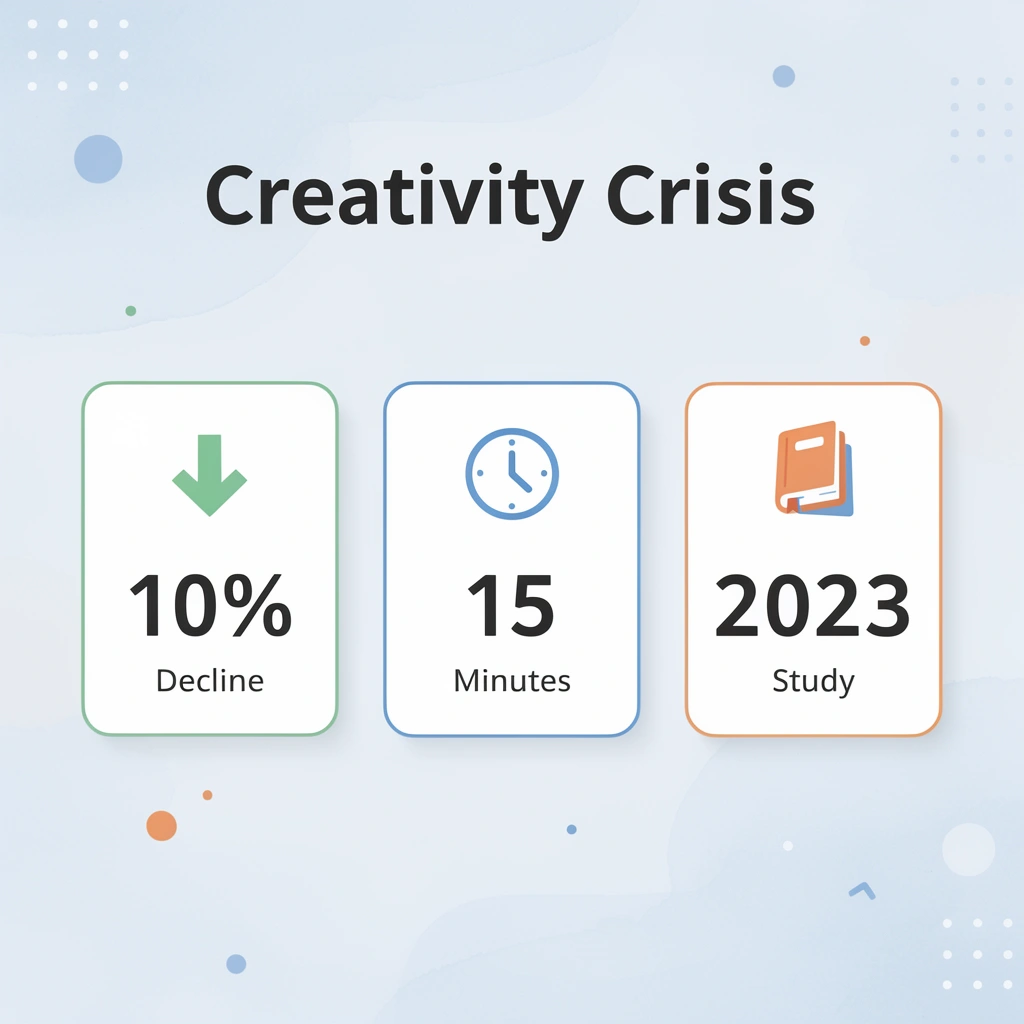
"Children's creativity scores have declined by 10% over the past decade, with the steepest drops occurring during traditional school hours." — Creativity Research Institute, 2023
💡 Tip: Create a 15-minute decompression period immediately after school where kids can engage in completely unstructured play before transitioning to creative activities.
1. Protect Unstructured Time Like a Boundary
The biggest creativity killer isn't lack of activities; it's not having empty time. When children go directly from school to tutoring to sports to dinner to homework, their minds never enter the mental space where imagination turns on.
Creativity comes from boredom, that restless feeling when nothing outside entertains you and forces you to create things inside your mind. Children who never experience unscheduled hours lose the chance to practice making their own ideas.
How do you implement protected unstructured time?
Block 30–45 minutes daily with nothing planned: no screens, no organized activities, no adult-directed tasks. The first few days may feel uncomfortable.
By week two, you'll see them building forts, creating games, or developing detailed imaginary worlds.
2. Replace Correctness with Possibility
School trains children to ask "Is this right?" after every creative attempt. After-school activities should train a different reflex: "What else could this become?"
What materials best support open-ended creativity?
Open-ended materials work best: drawing supplies without coloring books, building blocks without instruction manuals, and cardboard boxes without suggested projects. The lack of predetermined outcomes forces children to make decisions, experiment with combinations, and trust their own judgment.
How should you respond to children's creative work?
When a child shows you something they created, resist evaluating it. Instead of saying "That's beautiful" or "Good job," try asking "Tell me about this" or "What made you decide to do it this way?" Questions that explore the process build creative thinking, while praise that evaluates outcomes builds performance anxiety.
3. Limit Passive Consumption
Screens aren't the enemy. Passive consumption is. Watching endless short videos or scrolling through content someone else created trains the brain to receive rather than generate. Children who spend three hours after school consuming entertainment practice zero hours of imagination.
How does passive consumption affect creative development?
When you watch a story, someone else's pictures fill your mind. When you read fiction or create your own story, your brain must generate the images, voices, and situations. This mental work strengthens your creative brain pathways.
What are practical alternatives to passive screen time?
Instead of 20 minutes of passive screen time, try one active alternative: read a chapter together and ask your child what happens next, start a story and let them continue it, or give them a creative prompt to draw, build, or act out.
4. Follow Their Fascinations
Generic creativity activities feel like homework; creativity connected to genuine interest feels like play. A child obsessed with dinosaurs will spend an hour designing a prehistoric world, but resist drawing flowers for ten minutes.
Intrinsic motivation changes everything. When children care about the subject, they push through challenges, experiment longer, and generate more original ideas. Adult-assigned topics produce minimal effort and quick abandonment.
Ask what they want to create before suggesting what they should make. "What are you curious about today?" opens possibilities, while "Let's do this craft project" closes them.
5. Use Storytelling as Mental Gymnastics
Pretend play and storytelling help children think more creatively than most organized activities. When children create stories, they develop characters, invent problems, imagine solutions, and build cause-and-effect sequences, each of which requires creative decision-making.
How can you implement storytelling without special materials?
Storytelling requires no special materials, setup, or cleanup. During car rides, waiting rooms, or before bed, start a story and pass it back and forth. "Once there was a robot who could only speak in questions." Then hand it to your child.
Why do alternate endings help develop creative thinking?
Alternate endings work especially well. After reading a book or watching a show together, ask, "What if the character had made a different choice? What would happen then?" This trains children to see multiple possibilities rather than single correct outcomes.
6. Build Creative Confidence Through Structured Freedom
Many children struggle with creative tasks when given no instructions. After spending all day following directions, they wait for someone to tell them what to do, ask for examples, and fear starting without knowing the "right" way.
How can structured creative tools provide helpful scaffolding?
Structured creative tools provide helpful support. Themed coloring pages offer visual frameworks while letting children make imaginative choices in color combinations, character changes, and story additions. Children practice making decisions without the anxiety of a blank page. Platforms like My Coloring Pages offer themed options tied to specific interests, allowing children to choose subjects they care about while providing enough structure to start confidently.
How do you bridge from guided creativity to independent imagination?
After finishing a structured activity, extend it with an open prompt: "Can you invent a story about this character?" or "What happens next in this scene?" This bridges guided creativity to independent imagination, building confidence incrementally.
7. Encourage Building and Physical Creation
Hands-on building activities help children practice spatial reasoning, problem-solving, and experimental thinking. When children build with blocks, cardboard, clay, or recyclables, they encounter real physical limits: towers fall, connections break, and designs fail to work as imagined. These failures teach more than successes, revealing information about balance, structure, and material properties.
Children who rebuild after failure develop creative resilience and learn that improvement comes through trying again. A child who builds three different bridge designs and watches two fail learns more than one who follows instructions for a single successful structure. Messiness, mistakes, and abandoned projects signal active creativity, not wasted time.
8. Shift Praise from Talent to Effort
"You're so artistic" creates pressure. Children praised for talent become afraid of producing work that contradicts that identity and avoid creative risks that might reveal they lack natural gifts.
How does effort-based feedback build creative confidence?
Effort-based feedback builds different behavior. "You tried something completely different this time" or "I noticed you kept improving that design," reinforces experimentation and persistence. Children learn that creativity stems from practice and exploration, not innate ability.
What should you celebrate in children's creative work?
Pay attention to what you celebrate. If you only show perfect artwork or finished projects, children learn that messy experiments don't matter. If you photograph failed inventions alongside successful ones, they learn that both are important in creative development.
9. Read Fiction and Extend It
Reading fiction activates imagination differently from reading factual content. Stories require readers to picture settings, hear how characters sound, and anticipate what happens next—a mental simulation that strengthens creative thinking.
What questions help extend stories creatively?
The real power comes after reading. Ask questions that spark creative thinking: "What do you think this character was like as a child?" or "If you were writing the next chapter, what would you include?" These prompts train children to build on existing stories and generate new ideas.
Why do book series work especially well for creative extension?
Book series work especially well because children become deeply familiar with characters and worlds, providing a strong foundation for confident creative extension. They can invent new adventures for beloved characters more easily than they can create entirely original stories.
10. Allow Creative Messiness
Creativity rarely looks organized while it's happening. Children exploring ideas leave half-finished drawings, abandoned projects, and experimental combinations that don't work. Adults who constantly clean up, correct, or redirect this process interrupt the creative flow.
How can you create space for creative exploration?
Pick a space where a creative mess can exist temporarily: a corner of a room, a specific table, or a large box for works in progress. Children who must clean up immediately after starting often stop starting.
Why does permission to leave things unfinished matter?
The permission to leave things unfinished matters psychologically. Not every creative impulse needs completion. Sometimes children explore an idea far enough to satisfy their curiosity, then move to something else. That's how creative minds sample possibilities before committing deeply to one.
10 Creativity Encouraging Activities After School
Kids need activities after school where they can use their imaginations. The right activities nurture creative thinking, where one idea leads to another, and kids learn to generate their own imaginative ideas rather than waiting for adults to tell them what to do.
🎯 Key Point: After-school activities should prioritize open-ended exploration over structured instruction to maximize creative development.
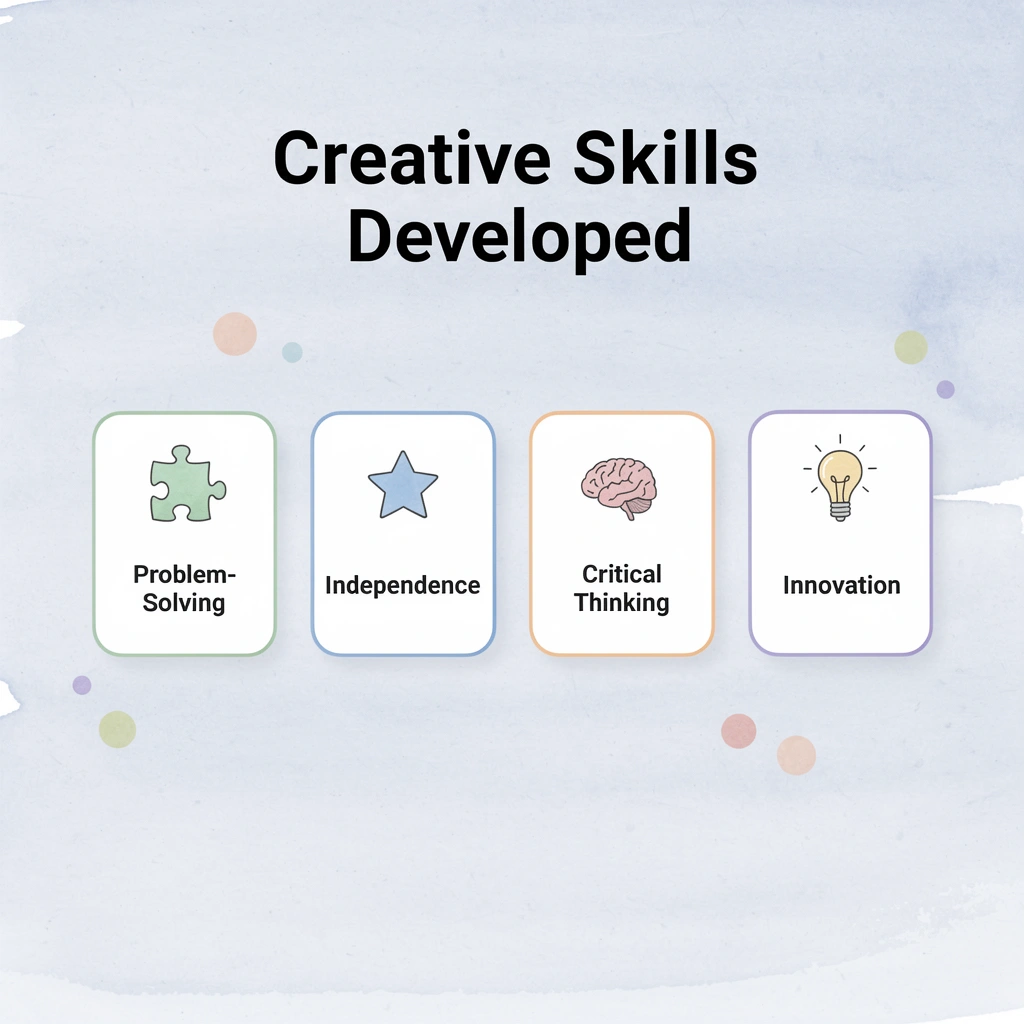
"Children who engage in creative activities after school show improved problem-solving skills and greater independence in their thinking processes." — National Association for the Education of Young Children, 2023
💡 Tip: Look for activities that encourage multiple solutions to the same problem—this builds the flexible thinking that's essential for lifelong creativity.
1. Story Creation (Invent Your Own Story)
When children create characters, plot lines, and endings from scratch, they exercise narrative thinking that reading alone cannot replicate. A child inventing a story about a dragon attending school builds cognitive architecture for hypothesis formation, prediction of consequences, and logical sequencing.
This builds language creativity because children must solve problems verbally. How does a creature with wings fit through doorways? What happens during fire drills? The constraints of their invented world force them to think through cause and effect while maintaining internal consistency.
2. Drawing From Imagination (Not Copying)
Tracing teaches hand control. Drawing from imagination teaches divergent thinking. When children sketch imaginary animals, fantasy worlds, or future cities without reference images, they make hundreds of small decisions about proportion, relationship, and possibility. Each choice strengthens their ability to generate multiple solutions to visual problems.
Copying reinforces that there's a correct version to match. Imagination-based drawing teaches that multiple versions can coexist, that interpretation holds value, and that visual thinking is about exploration rather than accuracy.
3. DIY Craft Projects Using Recycled Items
Turning cardboard boxes, plastic bottles, and paper rolls into robots, houses, and toys teaches resourcefulness as a creative skill. Children learn that materials have potential beyond their original purpose, that constraints spark innovation, and that the best tools are often the ones already at hand.
This builds problem-solving because children must work backward from vision to execution. They imagine a robot, then figure out how to turn a bottle into a body, attach moving arms, and create stability without professional-grade materials. The gap between idea and reality becomes the creative challenge itself.
4. Role-Play and Pretend Games
When children act as doctors, astronauts, shopkeepers, or superheroes, they adopt different perspectives, navigate social situations, and develop emotional creativity. Pretend play creates a safe space to try on identities, experiment with power dynamics, and work through complex feelings without real-world consequences.
Research consistently shows that imaginative play leads to stronger perspective-taking abilities later in life. Children who regularly engage in role-play develop a more advanced theory of mind, better emotional regulation, and stronger narrative reasoning. The astronaut helmet isn't a costume; it's cognitive training.
5. Building Challenges (Blocks, Construction Toys, Cardboard)
Designing and building bridges, houses, and vehicles helps children develop spatial reasoning and engineering-style thinking. Three-dimensional building forces them to consider structural integrity, balance, and material properties through direct experimentation. They learn physics by watching their tower collapse, then rebuilding with improved weight distribution.
A collapsed bridge isn't a mistake to avoid: it's information about what doesn't work, which narrows the field of what might work. Children who build regularly develop comfort with iterative thinking, the foundation of all creative problem-solving.
6. "What If?" Question Games
Open-ended prompts like "What if animals could talk?" or "What if gravity stopped for a day?" train flexible thinking by removing normal constraints. Children must imagine cascading consequences, consider second-order effects, and build logical chains in fantastical contexts. This is structured imagination.
The cognitive benefit appears in how children learn to manipulate variables mentally. They hold one element constant (that animals exist) while changing another (that they can talk), then reason through the implications. This is hypothesis testing, scenario planning, and the thinking pattern that leads to innovation.
7. Music and Rhythm Exploration
Making beats with homemade instruments and experimenting with different sounds activates creative memory and emotional expression through non-verbal channels. Music bypasses language, allowing children to communicate feelings they cannot yet articulate. A child banging spoons on pots discovers rhythm, tempo, and the relationship between action and sound.
Children learn that small changes in how they strike an object produce different tones, that patterns can repeat or vary, and that silence matters as much as sound. They're composing without knowing musical theory—which is exactly the point.
8. Nature-Based Creative Activities
Collecting leaves, stones, and flowers and transforming them into art, patterns, or stories connects observation with imagination. Children learn to see potential in natural objects, notice variations in texture and color, and use found materials as creative inputs rather than waiting for store-bought supplies. A pinecone becomes a hedgehog. A smooth stone becomes a canvas. A pile of twigs becomes architecture.
How do nature activities teach resourcefulness in creativity?
This teaches children that creativity requires only attention and willingness to see possibilities others miss, not perfect conditions or expensive materials. The child who turns a walk through the park into an art-supply run has learned something more valuable than any single craft technique.
9. Creative Writing and Comic Strips
When children design comics or picture-based stories, they use visual and verbal thinking simultaneously. Comics require children to break stories into separate moments, deciding what each panel shows and what it suggests. This improves sequencing and demands managing pacing, dialogue, visual composition, and narrative arc in concert.
Children must think about how images carry meaning, how facial expressions convey emotion, and how panel layout affects reading speed. They're learning visual grammar without formal instruction, building literacy in a language that increasingly dominates the distribution of information.
10. Guided Coloring Plus Story Extension
According to Afterschool Alliance's America After 3 PM research, 85% of parents want structured afterschool programs for their children, yet many struggle to find activities that sustain creative thinking beyond the activity itself. The problem isn't a lack of creative activities—it's that inspiration fades once the activity ends. A child imagines an elaborate story during playtime, feels excited about the characters and world they've created, then loses that creative thread the moment they move on to something else.
Guided coloring that extends stories gives children a way to continue their imaginative work visually. Rather than passively coloring within predetermined lines, children redesign characters from stories they've heard, create "what happens next" scenes, or build their own fantasy worlds on paper.
How does story extension through coloring reinforce creativity?
A child who colors a scene from their invented story reinforces the narrative they created, adding visual detail that deepens their connection to the characters and creating a tangible artifact that serves as a reminder of their imaginative work. The coloring page becomes a bookmark for their creativity, something they can return to and build upon rather than letting the idea dissolve.
Children who experience bursts of creative inspiration during activities but whose energy fades immediately afterward need tools that extend the imaginative moment. Platforms like My Coloring Pages provide worksheets designed for story extension, allowing children to visually continue narratives they've started elsewhere and transform passive coloring into active storytelling that persists beyond the activity itself.
What makes creative activities truly effective for children?
The real test of any creative activity isn't whether children enjoy it in the moment, but whether it teaches them to recognize and independently extend their own creative impulses. Children who learn to take an idea from one context and develop it in another, who see creative work as continuous rather than episodic, develop creative confidence that compounds over time.
Related Reading
- How To Improve Your Creativity
- Ai Creativity
- Ai And Creativity
- Examples Of Creativity
- Creativity Training
Fixing the After-School Creativity Drop-Off: Turning Short Activities Into Continuous Imagination With Guided Coloring Extension
The problem isn't that children lack creative ideas after school; those ideas disappear the moment the activity ends. A child builds an elaborate LEGO spaceship, tells you the captain's name and mission, then walks away when the last piece clicks into place. The story dies there because nothing connects imagination to the next action.
Most after-school routines treat creative activities as separate events with clear endpoints. But creativity grows when children carry one imaginative thread into the next situation, when today's invented character becomes tomorrow's expanded world. The gap between activities is where creative momentum dies, because adults rarely provide the structured bridge that transforms "we finished" into "what happens next?"
After any creative activity, give your child a related coloring page and ask one focused question tied to what they just did: "Can you draw what happens after your story ends?" or "What would this character look like in a different world?" The coloring page becomes the continuation tool, not the activity itself. Imagination doesn't stop when the timer rings—it evolves into visual storytelling, character redesign, or narrative expansion.

Platforms like My Coloring Pages offer over 75,890 free coloring pages that function as creative bridges. Rather than generic images disconnected from your child's imagination, our collection helps you find pages that extend their specific ideas: fantasy characters for the story they invented, vehicles for the world they built, settings for the adventure they narrated. The worksheet becomes the answer to the question, "What should I do with this idea now?"
"The question you ask matters more than the page itself. Strong prompts keep divergent thinking alive and help creative confidence develop over time." — Creative Education Research, 2023
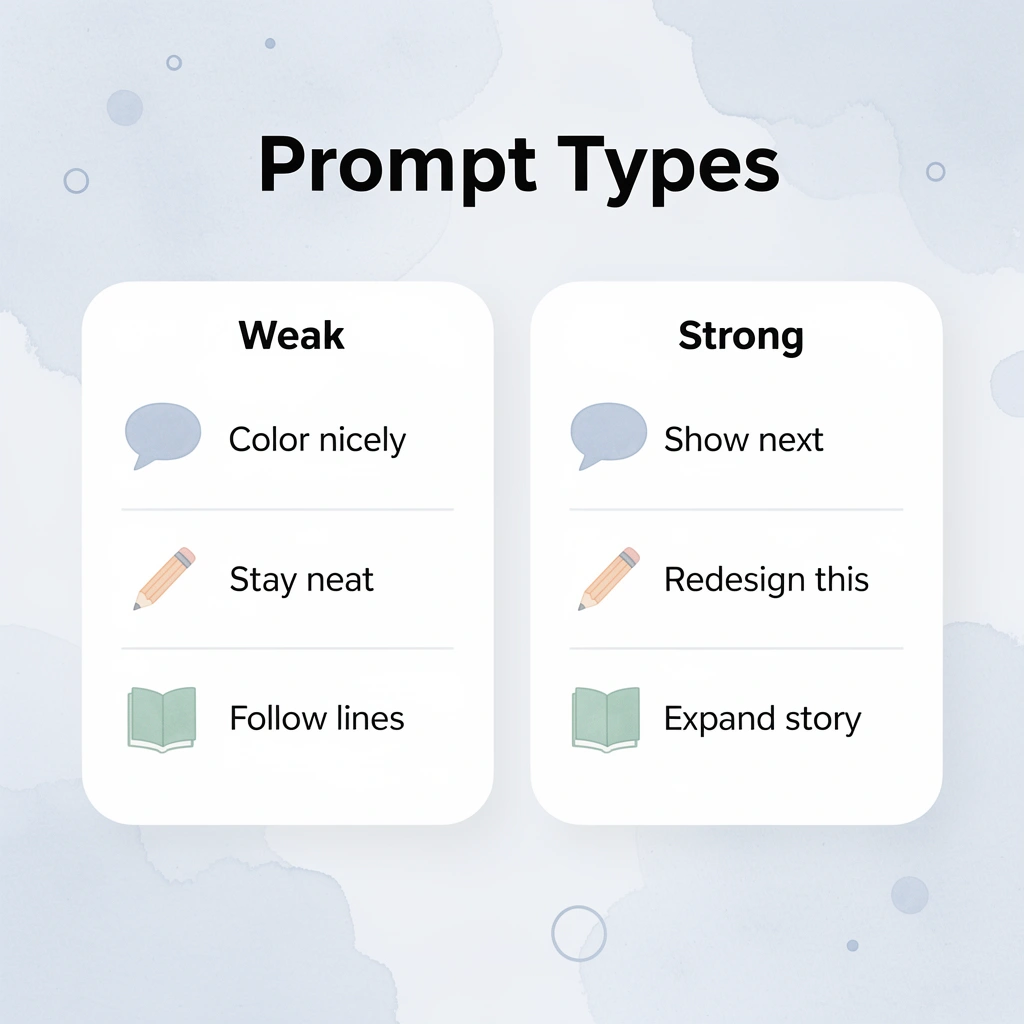
The question you ask matters more than the page itself. Weak prompts like "color this nicely" return children to compliance mode. Strong prompts like "show me what this character does next" or "redesign this to fit your story" keep divergent thinking alive. You're asking them to extend and transform what they started, which is how creative confidence develops.
🎯 Key Point: The transition moment between activities is where creative momentum either dies or transforms into sustained imagination.
💡 Tip: Keep a collection of versatile coloring pages ready so you can quickly find one that matches your child's current creative interest without breaking the imaginative flow.

Related Reading
- Is Creativity A Skill
- Creativity Toys For Toddlers
- Types Of Creativity
- Human Creativity
- Ai Vs Human Creativity