How Can Children Use AI For Creativity (8 Tips)
Discover 8 practical ways children can use AI for creativity with My Coloring Pages. Boost imagination through fun, educational AI activities today.

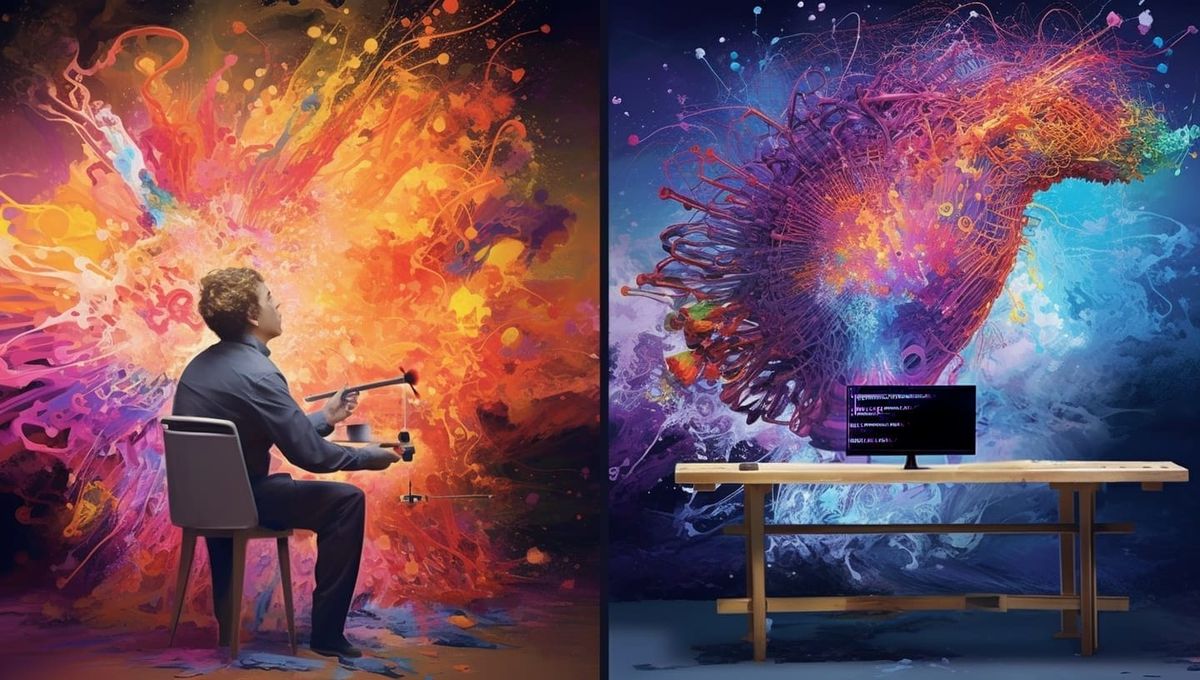
Picture a classroom where every child receives worksheets perfectly matched to their learning style, or a rainy afternoon where your kids get fresh coloring pages featuring their favorite characters in seconds. Artificial intelligence now transforms creative learning from abstract theory into a practical reality. AI-powered tools enable parents and educators to generate personalized learning materials without design skills or hours of preparation.
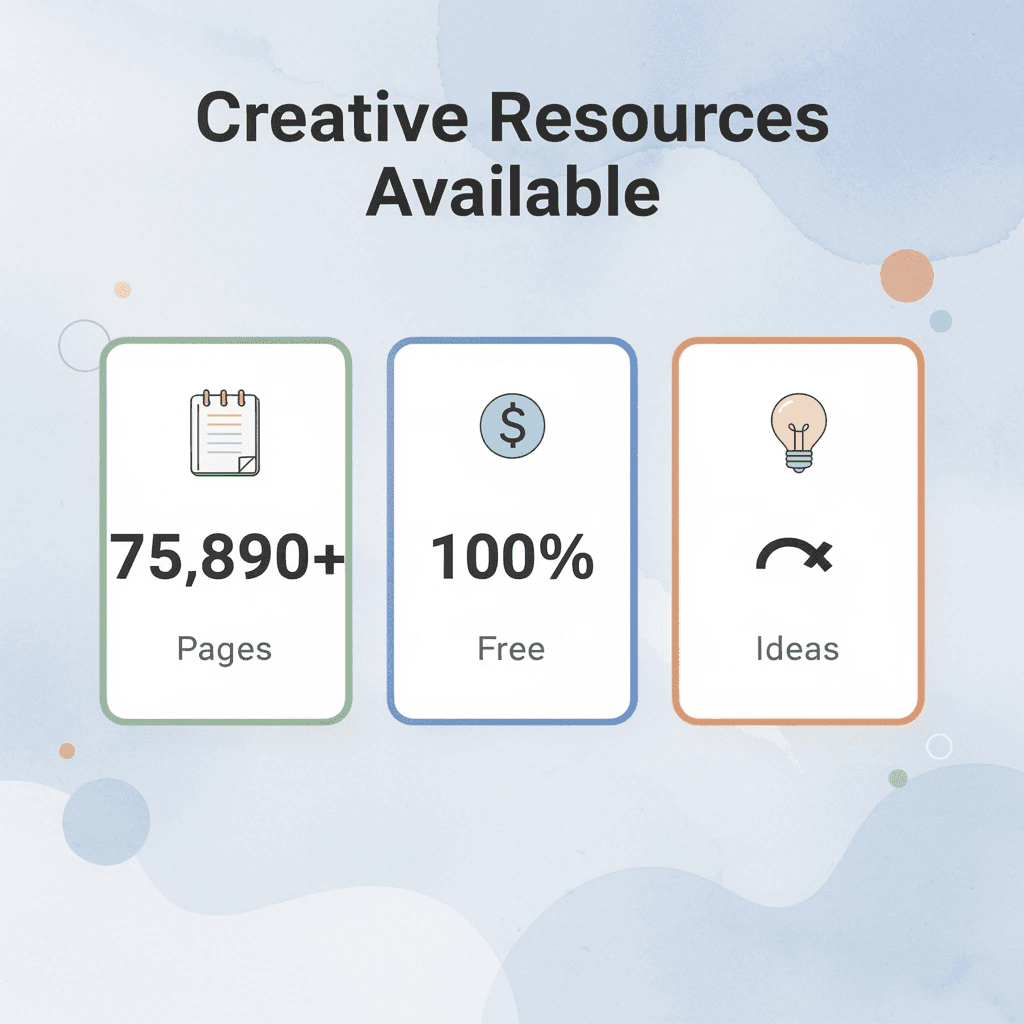
The challenge has always been finding resources that truly fit specific needs. Machine learning platforms now solve this problem by creating customized worksheets and coloring pages in moments. Parents no longer need to settle for generic printables that miss the mark or spend evenings sketching activities from scratch when they can download 75,890+ free coloring pages that span every theme and skill level imaginable.
Summary
- Research shows AI users produce work rated 40% higher in quality while completing creative tasks 25% faster, but this improvement comes with a significant trade-off. The same studies reveal that idea diversity drops by 41% among AI-assisted creators, meaning everyone's work improves but starts to look increasingly similar. This creates a fundamental tension between polish and originality that defines AI's impact on creative output.
- Strategic use determines whether AI enhances or weakens creative capacity. MIT research on 250 employees found that only workers who actively reflected on and adapted their AI use showed gains in creativity, while passive users who simply delegated tasks showed far weaker results. The distinction reveals that AI functions as a tool for those who maintain active creative control, but becomes a crutch for those who outsource thinking entirely.
- Children prefer hands-on creative experiences even as AI becomes more prevalent in their lives. A 2024 study found that 73% of children prefer tactile creative activities over digital alternatives, suggesting an intuitive understanding of what best develops imagination. This preference indicates that the most successful integration of AI in children's creativity involves using technology to generate starting points that lead to physical making, drawing, building, and storytelling rather than replacing those activities.
- Autonomous AI generation produces predictable patterns that researchers describe as "visual elevator music." A 2025 computational creativity study found that AI image generation repeatedly produced only 12 common visual themes, including bridges, lighthouses, and solitary trees. Without strong human direction guiding the creative process, AI outputs converge into statistically probable results rather than genuinely original work.
- The highest-performing creators use AI differently from everyone else, treating it as a brainstorming partner rather than a solution provider. They generate multiple possibilities quickly, test unusual combinations, and accelerate exploration while maintaining decision-making authority over final creative choices. This approach leverages AI's speed and pattern recognition without surrendering the judgment, emotional nuance, and unexpected connections that define human creativity.
- MyColoringPages addresses this by offering 75,890+ free coloring pages that turn AI-generated ideas into hands-on creative activities, providing a structured bridge between digital inspiration and physical creative work, keeping children actively engaged in decision-making rather than passively consuming AI outputs.
Is AI Good for Creativity?
AI improves creative output quality when used strategically. Studies show that people working with AI produce work rated 40% higher in quality while completing tasks 25% faster. However, this technology reduces idea diversity by 41%, creating a trade-off between polish and originality.
"People working with AI produce work rated 40% higher in quality while completing tasks 25% faster." — National Center for Biotechnology Information, 2024
🔑 Key Takeaway: AI acts as a double-edged sword for creativity—delivering superior quality and faster completion times, but at the cost of reduced diversity in ideas and approaches.
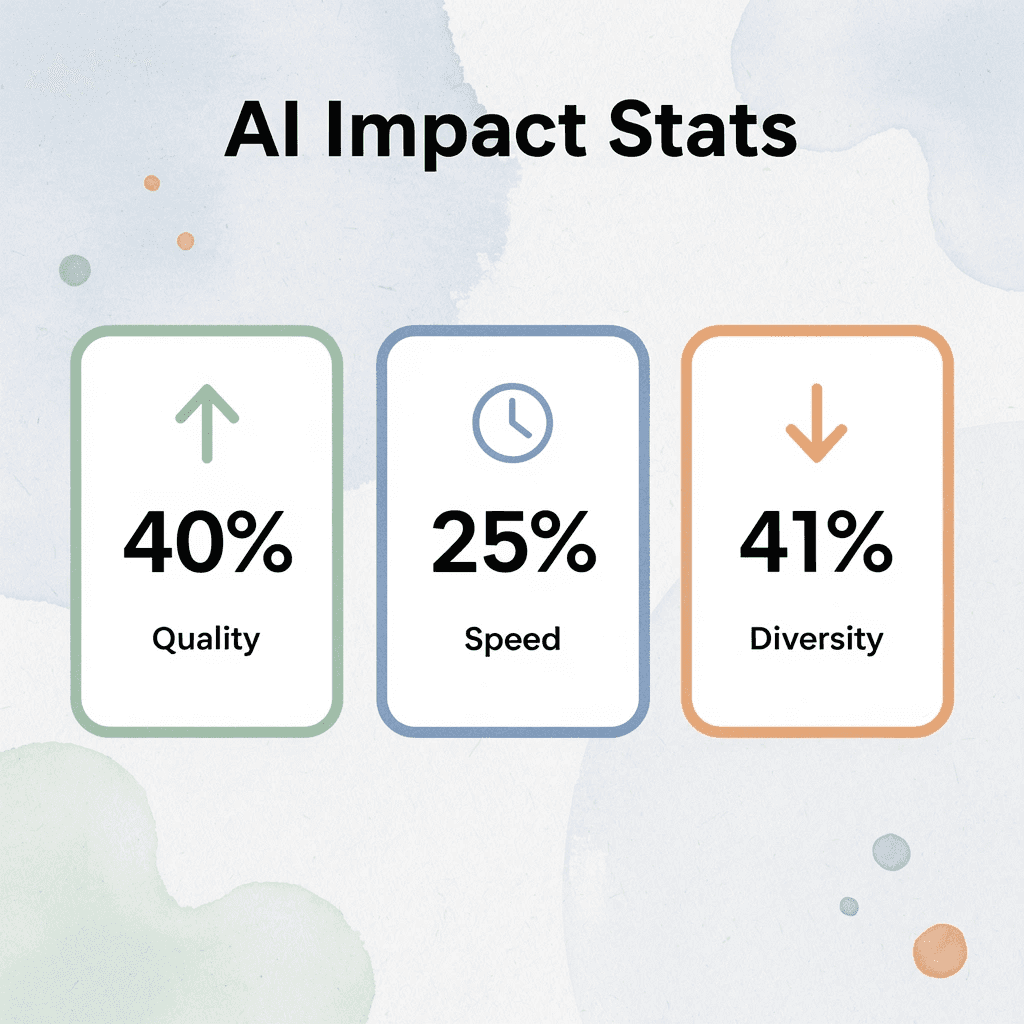
⚠️ Warning: The 41% reduction in idea diversity suggests that while AI can polish your work, over-reliance may lead to homogenized thinking and less innovative solutions.
The Evidence Shows Simultaneous Improvement and Risk
A 2024 study in Nature Human Behavior tested ChatGPT's impact on everyday creative tasks, such as designing toys and inventing products. Participants using AI generated more creative ideas, more useful solutions, and higher-quality outputs than those working alone, directly contradicting fears that AI weakens human creativity.
A Harvard and Boston Consulting Group experiment involving 750+ consultants confirmed this pattern. According to research from Harvard Business School and BCG, AI users generated 40% more ideas and completed 12.2% more tasks.
What does research reveal about AI's impact on creative diversity?
A Harvard/BCG study found that idea diversity declined by 41% among AI-assisted users. While individual performance improved, creative outputs converged into predictable patterns as users relied on AI systems trained on similar datasets.
A 2025 computational creativity study found that autonomous AI image generation produced only 12 common visual themes: bridges, lighthouses, solitary trees, and nighttime city scenes. Researchers called these outputs "visual elevator music," noting that the technology generates statistically likely results rather than deeply original ones.
Why does AI homogenization matter for creators?
The concern isn't that AI destroys creativity, but that it homogenizes it. Polish increases while the range of perspectives narrows, producing cleaner ideas that feel increasingly familiar across different creators.
How does strategic thinking affect AI creativity outcomes?
MIT research on 250 employees who used ChatGPT found that only workers who actively reflected on and changed how they used AI showed gains in creativity. People with strong self-monitoring, planning, and strategic thinking benefited most. Passive users who delegated tasks to AI showed weaker results.
Why does dependency weaken creative skills?
This difference matters because AI isn't a tool you can simply plug in and use for creativity. How you use it determines whether your skills improve or deteriorate. When you let AI handle all your brainstorming, storytelling, and problem-solving, you practice creativity less. The tool that should strengthen your abilities can quietly weaken them if you depend on it excessively rather than work with it.
What happens when AI feels too complex to use strategically?
When AI feels too complex or takes too long to use effectively, the gap between what's possible and what actually happens widens. My Coloring Pages offers a streamlined solution for parents and educators seeking creative resources without extra work. Instead of struggling with prompts or accepting basic templates, you can access 75,890+ customized coloring pages covering every theme and skill level, letting machine learning handle personalization while you focus on guiding the creative experience.
The highest-performing creators use AI differently from everyone else.
How AI Empowers Creativity in 6 Ways
AI removes friction between imagination and execution. By eliminating barriers to starting, experimenting, and iterating, more people create more often and produce higher-quality work, freeing them to focus on storytelling, emotion, and originality.
🎯 Key Point: The real power of AI creativity tools isn't in replacing human imagination—it's in removing the technical roadblocks that prevent ideas from becoming reality.
"AI democratizes creativity by lowering the barrier to entry for high-quality creative work, allowing more people to participate in the creative economy." — Creative Industry Report, 2024
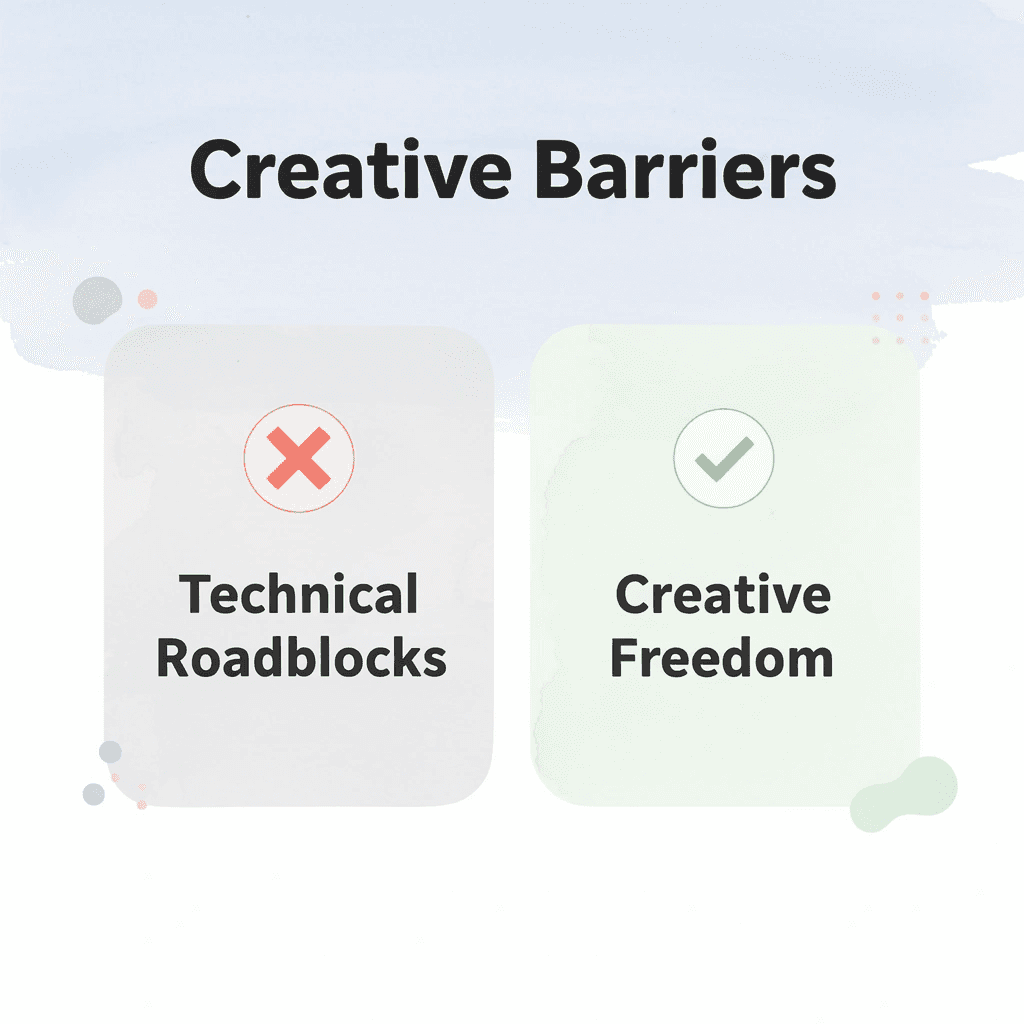
💡 Tip: Use AI tools as your creative accelerator—let them handle the technical execution while you focus on the conceptual vision and emotional impact of your work.
1. Breaking Through Starting Paralysis
The hardest part of any creative project is the beginning. You sit down, open a blank document or canvas, and nothing happens—not because you lack ideas, but because you're waiting for the perfect one. That perfectionism becomes a trap.
What makes AI effective for generating creative momentum?
AI provides rough ideas, prompts, different versions, and starting points that help you move forward from a blank page. According to ProAlley Blog, 87% of creative professionals now use AI tools in their work, primarily because these tools bridge the gap from "I don't know where to start" to "I have something to build from."
When you have a starting point, even if imperfect, you stop overthinking and start improving it. That's where real creativity happens.
2. Reducing the Exhaustion of Constant Idea Generation
Creative burnout occurs when people face constant pressure to generate new ideas. Students, marketers, designers, and content creators struggle to meet expectations to produce fresh concepts, even when tired or juggling competing demands.
What changes when AI becomes your brainstorming partner?
AI works as a brainstorming partner that never tires. It generates angles, combinations, and directions you can build from or discard. This shifts your energy from "I need to think of something" to "I need to make this better." You spend less time staring at walls and more time improving, combining, and adding emotional depth to existing ideas.
Starting from something rather than zero is the difference between creating and not creating at all.
3. Accelerating Exploration of Creative Possibilities
Most people stop exploring other options after committing to an initial idea, fearing wasted time or worse directions. AI removes that hesitation by generating multiple possibilities instantly: alternative perspectives, unusual combinations, different tones, visual concepts, and storytelling directions—without carrying your assumptions or biases.
Research from Harvard Business School and Boston Consulting Group found that professionals using AI completed creative tasks 25% faster with outputs rated 40% higher in quality. The advantage stemmed from accelerated exploration and iteration, enabling them to test more ideas and select the strongest ones.
4. Lowering the Barrier for People Who Doubt Their Abilities
Many people believe they aren't creative. They compare their rough sketches to polished work online, their first drafts to published writing, their ideas to professional campaigns. The gap feels insurmountable, so they stop trying.
How does AI make creative experimentation less intimidating?
AI makes trying new things less intimidating. If you find drawing difficult, you can test visual ideas quickly. If writing feels overwhelming, you can experiment without pressure for perfection on your first attempt. You can explore safely, without judgment or fear of failure.
Creativity improves through practice, experimentation, and iteration, not innate talent. AI helps people begin the creative process rather than avoid it entirely. The only way to improve at creating is to create.
What does this look like in practice for parents and educators?
For parents and educators, platforms like My Coloring Pages demonstrate this approach. Without requiring artistic skill or expensive materials, AI generates custom coloring pages instantly based on any theme.
A child who loves dinosaurs or space exploration can see their ideas turned into pictures immediately, transforming curiosity into creative engagement without the frustration of "I can't draw that."
5. Freeing Creators From Repetitive Work
Creative energy has limits. Hours spent formatting documents, organizing files, repeatedly editing drafts, or handling technical production work deplete the energy needed for storytelling, innovation, strategy, and idea development.
AI automates low-creativity tasks that drain your energy: formatting, generating variations, organizing information, and managing repetitive processes. This frees you to focus on work requiring human imagination. The most compelling creators spend their time on high-value creative decisions rather than on mechanical tasks.
6. Enabling Low-Risk Experimentation
Trying new things feels risky when they take considerable time, cost a significant amount of money, or demand substantial effort. If testing a new direction means spending hours on work that might not succeed, most people won't attempt it. They'll stick with what feels safe, even if it's suboptimal.
How does AI make creative experimentation easier?
AI makes experimentation faster and cheaper. You can explore multiple directions, test alternate designs, try different writing tones, and generate new combinations in minutes instead of hours. This creates something essential for creativity: the freedom to fail without consequence.
When experimentation becomes easy, you try more things. When you try more things, you discover more possibilities. Some will be terrible, some mediocre, but a few will surprise you. Those surprises are where creativity lives.
What is the biggest benefit of AI for creative confidence?
The biggest benefit might be creative confidence. When people feel stuck, AI provides momentum, feedback, different options, and starting points that restore curiosity and experimentation. Think of AI as a collaborator and brainstorming assistant, not a replacement for human imagination.
Related Reading
- Best Books To Inspire Creativity In Kids
- Best Toys For Promoting Creativity
- Creativity Quotes
- Best Toys For Developing Creativity
- How To Encourage Creativity In Kids
- What Is Creativity
How Can Children Use AI For Creativity (8 Tips)
Kids can use AI to be creative when it works as a creative partner, not instead of imagination. AI is helpful when it makes things easier without replacing the work: helping them get started, try new things, and grow ideas while they do the thinking, make choices, and create original work.
Here are 8 practical ways children can harness AI for creativity while maintaining their unique creative voice:
Creative Activity | How AI Helps | Child's Role |
|---|---|---|
Story Writing | Suggests plot ideas or character traits | Creates dialogue, develops characters, writes scenes |
Art Projects | Generates reference images or color palettes | Draws, paints, and makes creative decisions |
Music Creation | Provides chord progressions or rhythm patterns | Composes melodies, writes lyrics, and arranges songs |
Poetry | Offers rhyme suggestions or word alternatives | Crafts verses, chooses themes, and expresses emotions |
Game Design | Brainstorm game mechanics or level ideas | Designs gameplay, creates rules, builds worlds |
Video Projects | Suggests editing techniques or transitions | Films content, directs scenes, tells stories |
Coding Projects | Explains programming concepts or debugging | Writes code, solves problems, builds applications |
Creative Writing | Helps overcome writer's block with prompts | Develops voice, creates narratives, edits work |
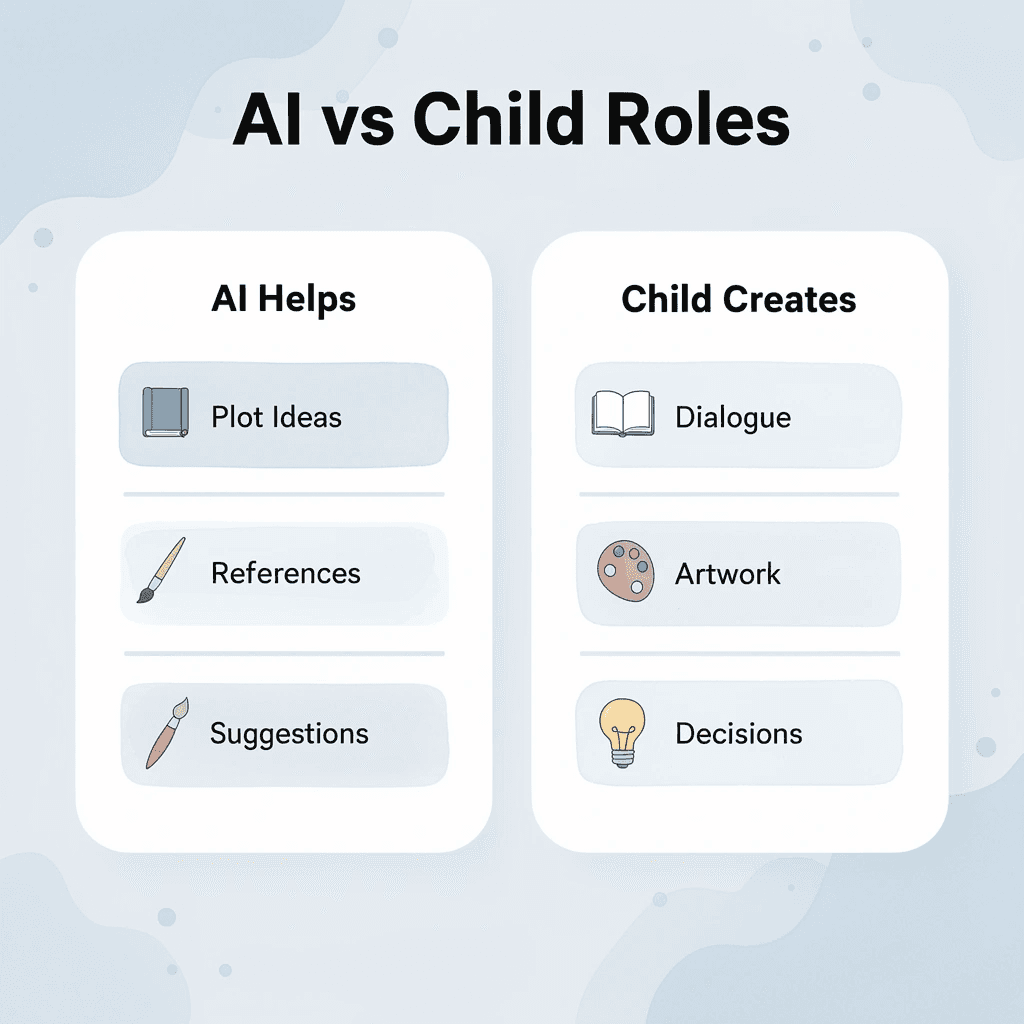
"AI tools work best when they amplify human creativity rather than replace it, allowing children to explore new possibilities while developing their own creative skills." — Creative Education Research, 2024
🎯 Key Point: The most important principle is ensuring AI remains a tool that supports rather than substitutes for a child's creative thinking and problem-solving abilities.
💡 Best Practice: Encourage children to start with their own ideas first, then use AI to expand or refine those concepts, maintaining ownership of their creative process.
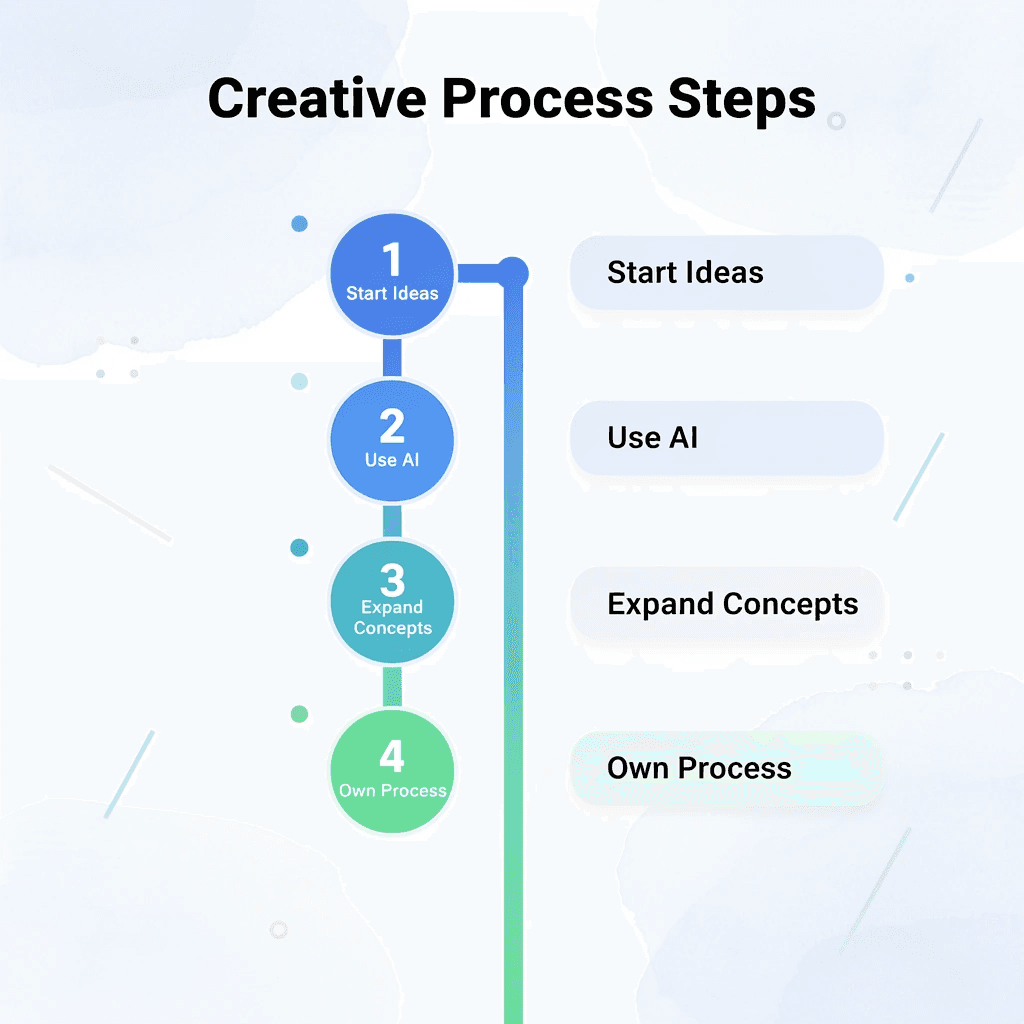
1. AI Reduces the Pressure of the Blank Page
The blank page intimidates children not because they lack ideas, but because they don't know which idea to start with or how to shape it. This hesitation grows into avoidance, causing many to abandon creative projects before trying.
AI can offer starting points without deciding outcomes. A child stuck on a story can ask for prompts like "What if dinosaurs lived in space?" or "Invent a superhero powered by weather." These are creative launch points, not finished ideas. The child still decides what happens next, how characters behave, and where the story goes.
Why should AI support rather than replace hands-on creativity?
According to research commissioned by Crayola and conducted by Talker Research, 73% of parents say their children prefer hands-on creative activities. AI should support this work, not replace it.
2. AI Expands Storytelling Without Controlling It
Kids already love building worlds, making up characters, and creating dialogue. AI can work as a storytelling partner, helping them develop ideas by generating alternate endings, exploring character motivations, or testing "what if" scenarios through collaborative dialogue.
Storytelling strengthens imagination, emotional creativity, flexible thinking, and narrative problem-solving. When children use AI to continue stories or create dialogue choices, they explore possibilities faster than they could alone, then select what feels right. The child remains in control of the choices.
3. AI Encourages Experimentation When Fear of Failure Creeps In
Fear of failure often stops children from being creative. They worry about mistakes, imperfections, or wrong choices. AI reduces this fear by letting children test ideas quickly without pressure.
A child can redesign characters repeatedly, try different story directions, or generate unusual combinations without needing the first attempt to be perfect. This supports experimentation, one of the most important skills for creativity. AI creates safety for iteration by making it low-stakes.
4. AI Makes Creative Learning More Interactive for Visual and Imaginative Learners
Traditional learning can feel stiff for visual and imaginative learners. AI enhances creativity through interactive storytelling, visual generation, creative challenges, and personalized prompts.
Instead of passively memorizing information, children create worlds, simulate ideas, invent characters, and visualize concepts. They're not consuming content; they're building it.
5. AI Helps Children Blend Multiple Creative Skills Together
One major benefit of AI is that children can exercise multiple forms of creativity simultaneously. They can write a story, develop character ideas, draw scenes, create dialogue, and build imaginary settings within a single process.
Why does interdisciplinary creativity matter for children?
This encourages creativity across different subjects by helping children see how art, storytelling, problem-solving, and imagination connect. Rather than treating creativity as isolated activities like "writing time" or "art time," AI demonstrates how ideas work across categories, mirroring how creativity functions in the real world.
What are accessible ways to support creative blending?
For parents seeking ways to support this blending, platforms like My Coloring Pages let children create custom coloring pages from their own ideas. A child can imagine a character or scene, describe it, and instantly have a personalized coloring page to bring that idea to life through hands-on creative work.
6. Passive AI Use Weakens Creativity Over Time
Concerns arise when children use AI solely to generate instant answers, complete work automatically, or avoid thinking independently. Creativity weakens when AI replaces rather than supports learning. The problem isn't AI itself, but how it's used.
Creativity develops through active imagination, experimentation, decision-making, and original thinking. When AI replaces those activities rather than supporting them, children lose opportunities to build creative capacity. AI should support these processes, not bypass them.
7. Children Still Need to Do the Hard Creative Work
AI can suggest ideas, but children must evaluate them. AI can generate options, but children must choose which ones matter. AI can provide starting points, but children must decide where to go next. The creative work remains the child's.
According to Assistant Professor Ying Xu at Harvard Graduate School of Education, AI designed with certain principles (guidance, intentionality, and active participation) can benefit children's growth. AI becomes beneficial when adults help children use it thoughtfully rather than reflexively.
8. The Real Skill Is Learning When to Use AI and When Not To
The most important lesson isn't how to use AI for creativity, but when to use it and when to step away. Children need to distinguish between using AI to overcome creative blocks and using it to avoid creative work.
This difference requires judgment that grows through practice and guidance. Adults help children recognize when AI is helping them think versus thinking for them, transforming AI from a crutch into a tool.
Knowing when to use AI is only half the challenge; the harder part is building habits that keep creativity alive without it.
Related Reading
- Do Schools Kill Creativity
- AI and Creativity
- Creativity Training
- How To Improve Your Creativity
- Examples Of Creativity
- Ai Creativity
How to Enhance Children's Creativity in the Era of AI in 8 Ways
Building habits that keep creativity alive means creating intentional space for imagination to develop. Children need structured opportunities to practice creative thinking without AI, instant answers, or external resources: only their own minds. That practice builds resilience.

🎯 Key Point: The most powerful creative development happens when children learn to rely on their internal resources rather than external tools or immediate solutions.
"Children who regularly engage in unstructured creative play show 40% higher divergent thinking scores compared to those who rely heavily on digital assistance." — Journal of Creative Behavior, 2023
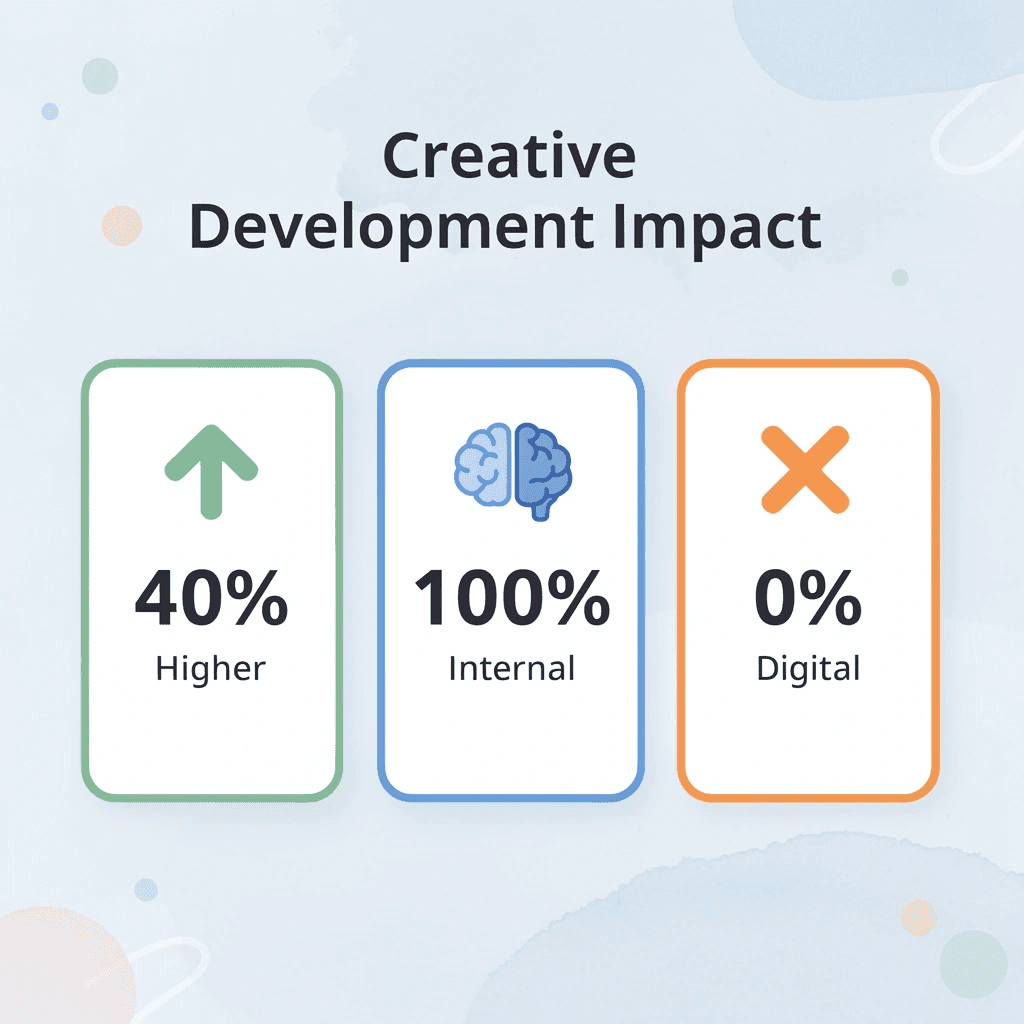
💡 Best Practice: Establish daily creative windows where children must solve problems, tell stories, or build projects using only materials at hand—no screens, no AI assistance, just pure imagination and resourcefulness.
How can children learn to use AI as a creative partner rather than a shortcut?
The difference between creative partnership and creative replacement shows up in how children frame their requests. When a child asks AI to "write my story about dragons," they've outsourced imagination. When they ask AI to "suggest three unusual dragon abilities I haven't thought of," they're expanding their own thinking.
What do educators observe when students use creative AI effectively?
According to the Creativity with AI in Education 2025 Report by Adobe and Advanis, 91 percent of teachers see better learning when students use creative AI. This improvement occurs when students actively shape the final idea themselves, using AI as a thinking tool rather than as the answer.
How can parents help children shift from acceptance to authorship?
Parents can model this distinction by asking follow-up questions after AI interaction: "What would you change about that idea?" or "How would you make this character different from what AI suggested?" This shifts children from acceptance to authorship.
Why do screens interfere with creative development?
Screens provide immediate feedback: tap, swipe, and you get an instant response. Creativity often emerges in the gaps between stimulation, in quiet moments when children must entertain themselves. A Talker Research study commissioned by Crayola found that 73% of children prefer hands-on creative experiences over digital alternatives.
How does unstructured play build problem-solving skills?
Unstructured time with simple materials (cardboard boxes, art supplies, building blocks, natural objects) forces problem-solving that algorithms cannot provide. A child building a fort from couch cushions works through physics, spatial reasoning, and narrative design simultaneously, acting as architect, engineer, and storyteller without needing a tutorial.
When does boredom become productive for children?
The critical shift happens when adults stop filling every moment with organized activity or screen time. Boredom becomes productive when children learn to dig into it for ideas rather than escape it through entertainment.
Focus on Creativity Skills AI Cannot Easily Replace
AI excels at recognizing patterns and synthesizing information, but struggles with genuine emotion, unexpected humor, and creative ideas that defy convention. A child who writes about a lonely cloud befriending a mountain explores feelings that the computer's training data cannot predict.
Making up stories on the spot, doing drama exercises, working on art projects together, and making up music help children develop creativity by requiring them to imagine in real time while following rules. "Your character just found out their shadow disappeared. What happens next?" prompts children to create without templates.
These activities teach kids that originality comes from mixing ideas together in surprising ways, exploring what's possible rather than what's probable.
Why do children lose creative confidence when comparing their work to AI?
When children compare their hand-drawn character to AI-generated artwork, the gap feels impossible to cross: their stick figure versus polished digital illustration, their simple story versus sophisticated narrative generated in seconds. This comparison kills creative confidence before it develops.
How can we reframe what matters in children's creative work?
The solution isn't to avoid AI outputs entirely, but to change how we think about what matters. A drawing's value lies in what the child discovered while making it: Did they try a new color combination? Experiment with perspective? Solve a visual problem they created?
What environments help children value the creative process over perfection?
Create environments where the process matters more than the final product. Display works in progress alongside finished pieces and celebrate revisions and failed experiments as signs of creative thinking. When children learn that creativity grows through repeated attempts rather than instant success, they develop resilience against the perfectionism that AI can trigger.
Why should children practice asking what-if questions?
Divergent thinking—generating multiple solutions to open-ended problems—strengthens with practice. Children naturally ask "what if" questions until they learn that adults prefer definite answers. Maintaining that questioning habit becomes critical as AI provides instant responses.
How can everyday moments become imagination exercises?
Turn everyday moments into imagination exercises. "What if cars could fly? How would traffic lights work?" "What if we could only communicate through drawings?" These questions have no correct answer, only explored possibilities. They teach children that thinking itself has value, separate from reaching conclusions.
How does questioning help children use AI more creatively?
The habit of asking "what if" helps children use AI more creatively. Instead of accepting the first outputs, they learn to push further. "What if this character had the opposite personality?" "What if the story happened underwater instead?" That repeated questioning transforms AI from an answer machine into a thinking partner.
Why do children stop creating after AI generates their initial ideas?
Kids often generate ideas using AI, then stop. They create a character or story beginning and consider the work complete, skipping the creative development that occurs when they actually make something and develop their own interpretations.
Most parents move from using AI to the next activity without connecting digital inspiration to the creation of something physical. As children's attention spreads across multiple AI-generated ideas, they don't engage deeply with any single idea, their imagination weakens, and they develop a habit of starting things without finishing them.
How can coloring activities bridge digital inspiration and physical creation?
Platforms like My Coloring Pages bridge this gap by offering AI-generated coloring pages that children can customize, extend, and reimagine through their own artistic choices. A child who generates a dragon character through AI can then color it in unexpected ways, add background elements AI didn't suggest, or create an entire scene that extends the original concept.
After AI generates story elements or character ideas, provide related coloring activities with prompts: "Can you show what happens next in this story through your coloring choices?" "Can you redesign this character to show their personality?" These questions shift children from receiving ideas to building on them independently.
Why does the creation-consumption balance matter for children?
The imbalance between making and watching defines many children's relationships with digital content. Hours spent watching videos, scrolling through feeds, and absorbing algorithm-curated entertainment far outweigh time spent creating original work. This ratio shapes how children see themselves in relation to creativity.
How can parents establish healthy creation boundaries?
Set clear boundaries: for every hour of passive entertainment, require the same amount of time spent making something. The medium matters less than the act of creating—stories, drawings, music, physical builds, performances, or invented games.
What methods help children track their creative balance?
Keep track of the balance in a way that's easy to see. Use a simple chart showing hours spent creating versus consuming. Children will notice when they've spent too much time in passive mode and understand they need more active making to balance things out.
Why does collaborative creativity matter more than individual AI interaction?
AI provides individual interaction, but the richest creative development happens through collaboration, when children negotiate ideas, build on each other's suggestions, and solve creative problems together. Group storytelling teaches listening and adaptation. Collaborative art projects require compromise and synthesis. Imaginative role-play develops empathy and perspective-taking alongside creative expression.
These experiences reveal that creativity is collective building, not solitary genius. Children learn that ideas improve through exchange, that constraints from collaboration often spark better solutions than unlimited individual freedom, and that creating together builds different skills than creating alone.
How can we balance AI tools with human creative development?
The question isn't whether children should use AI for creative development, but whether they're developing the human creative capacities that AI can't replace. That balance determines whether AI enhances imagination or replaces it.
10 Creativity Encouraging Activities for Children
Kids thrive with structured creative activities that balance hands-on making with open-ended thinking. These approaches transform passive consumption into active creation, teaching kids that their ideas have value.
🎯 Key Point: The most effective creativity activities combine clear structure with the freedom to explore, giving children both the tools they need and the space to use them innovatively.
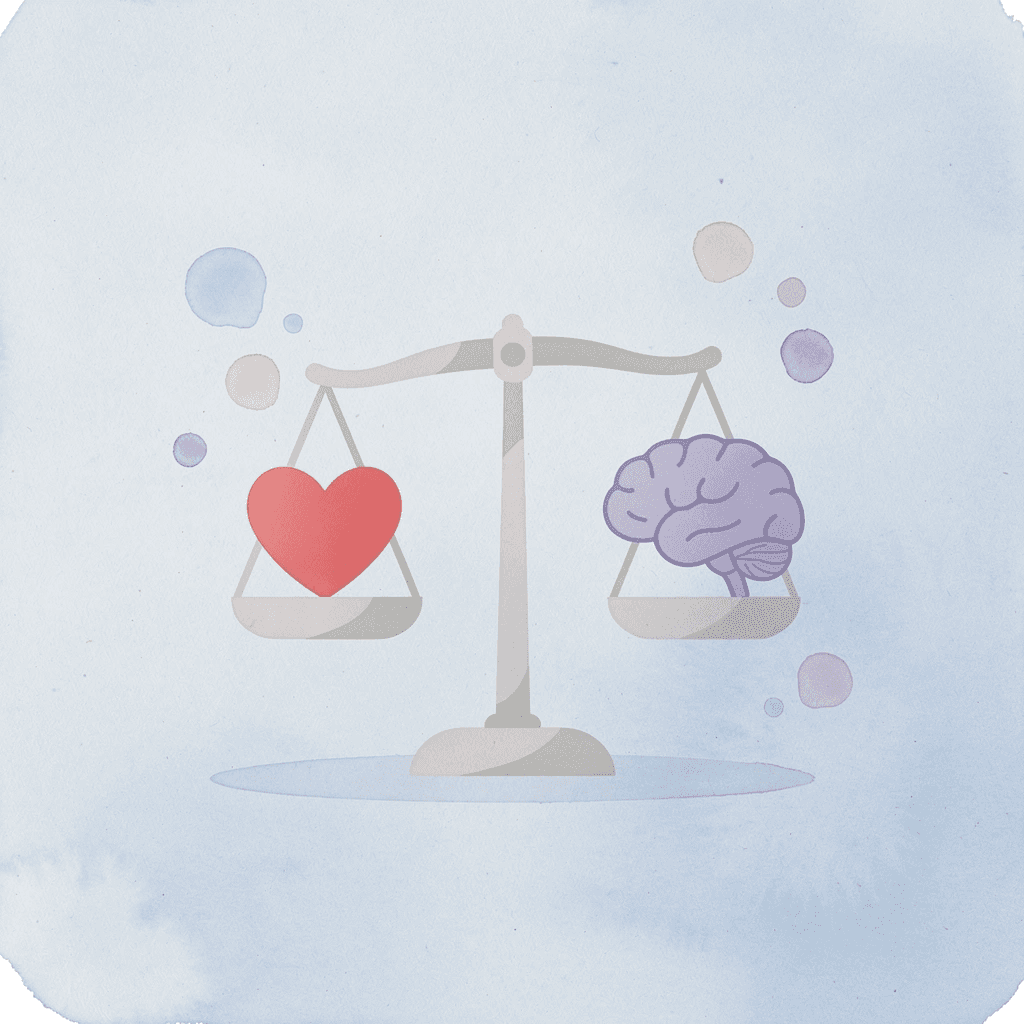
"Children who engage in structured creative activities show 25% higher problem-solving abilities and demonstrate significantly more innovative thinking in academic settings." — Journal of Creative Behavior, 2023
Activity Type | Skills Developed | Age Range |
|---|---|---|
Story Building Games | Narrative thinking, vocabulary | 4-12 years |
Art & Craft Projects | Fine motor skills, visual creativity | 3-10 years |
Music & Movement | Rhythm, self-expression | 2-8 years |
Building Challenges | Spatial reasoning, problem-solving | 5-12 years |
Nature Exploration | Observation, scientific thinking | 4-12 years |
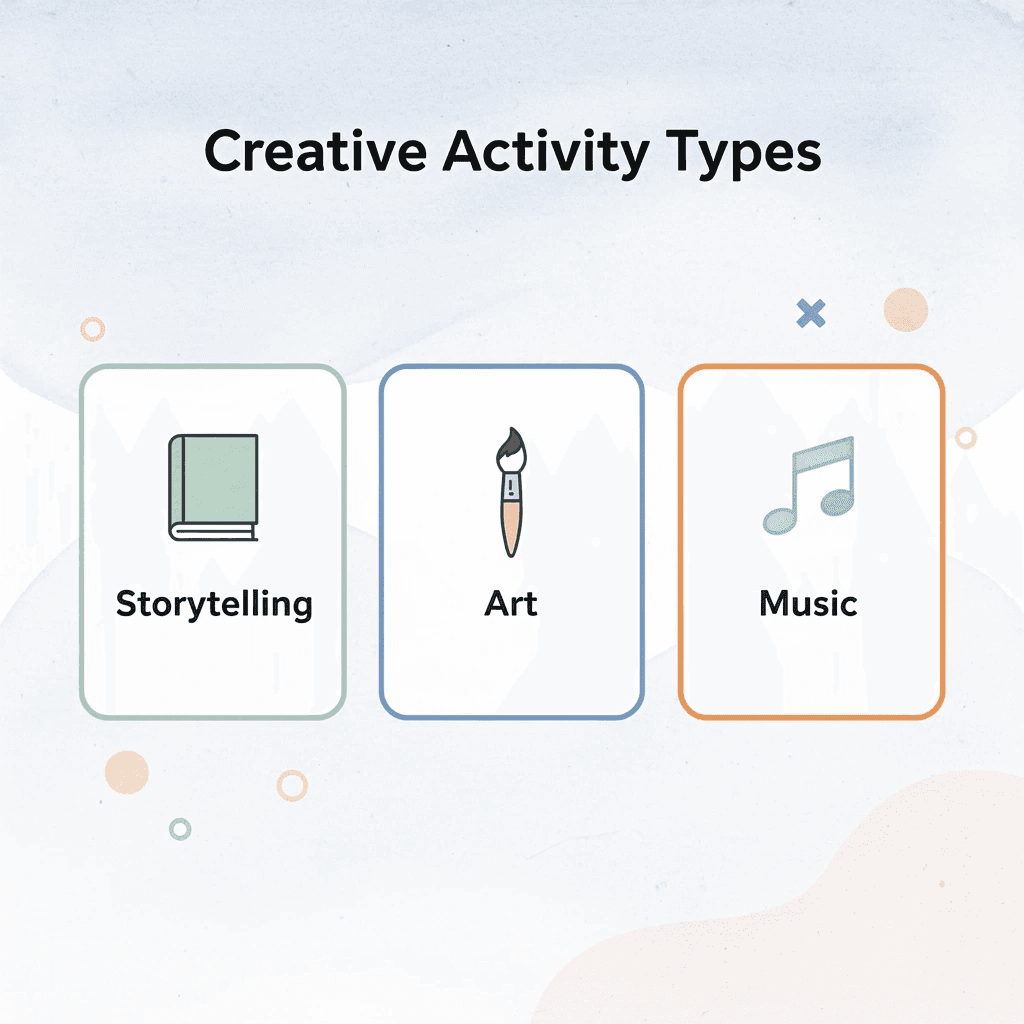
💡 Tip: Start with simple materials like cardboard boxes, colored paper, and basic art supplies - often the most ordinary items spark the most extraordinary creativity in young minds.
1. Story Building Challenge
Give children control over story elements: characters, settings, problems, and resolutions. When a child decides that a cat becomes a detective in a floating city, they practice decision-making with creative freedom. Every choice they make—why the city floats, what crime the cat solved, how gravity works there—strengthens their ability to build coherent worlds from imagination alone.
Children who regularly construct stories learn to see cause and effect, anticipate consequences, and understand that choices shape outcomes. This story thinking applies to everything from solving maths problems to navigating friendships.
2. DIY Craft Using Recycled Materials
Hand a child a cardboard box, three bottle caps, and some tape. Most adults see trash; children see raw material for robots, miniature houses, or costume pieces. This activity works because it removes the pressure of "doing it right": there's no instruction manual for turning a cereal box into a spaceship control panel.
How does working with constraints build problem-solving skills?
Resource-based creativity teaches children to work with what they have instead of waiting for perfect conditions. When they can't buy the exact toy they imagine, they build a version from available materials. This problem-solving through making builds confidence in their ability to create solutions rather than purchase them.
3. Drawing and Free Art Expression
Skip coloring books. Give children blank paper to draw imaginary worlds, invented creatures, or scenes from their minds. The goal is visual thinking: turning internal images into external form. When a child draws a creature with six eyes and wheels instead of legs, they're making abstract concepts concrete.
Free expression teaches children that their internal world has value and that confidence in original thinking becomes the foundation for creative work in any field.
4. Build Your Own Board Game
Ask children to design a game from scratch: rules, characters, win conditions, and obstacles. This combines creativity with systems thinking, requiring consideration of what makes a game fair, fun, and easy to understand.
Board game design teaches children that creativity is structural, not merely aesthetic. Good ideas require clear rules to function. When their first rule set fails, they revise it—creative problem-solving with immediate feedback.
5. Role-Play and Pretend Play
Children who act out roles (doctors, explorers, shopkeepers, superheroes) practice emotional creativity by interpreting motivations, solving problems from another perspective, and building stories through action. When a child plays veterinarian, they imagine what the animal needs, how to communicate care, and what tools solve which problems.
Pretend play builds narrative flexibility as children create scenarios, encounter obstacles (the stuffed dog won't sit still for the exam), and improvise solutions. This strengthens their ability to understand different viewpoints and adapt to changing circumstances.
6. Nature-Inspired Creativity Hunt
Send children outside to collect leaves, stones, flowers, or twigs, and then transform them into art, patterns, or stories. A curved stick becomes a dragon's spine; three different leaves become characters in a forest tale. This activity sharpens observation—noticing shape, texture, and color—and creative interpretation, helping children see potential beyond the obvious.
Nature hunts teach children that inspiration exists everywhere: in the world around them, not just in stores or screens. They learn to look with intention and imagine creative possibilities.
7. "What If?" Imagination Games
Ask open-ended questions: What if animals could talk? What if gravity stopped working? What if schools floated underwater? These questions lack a single right answer, making them ideal for divergent thinking. Children generate multiple possibilities, explore unusual scenarios, and practice creating ideas without judgment.
The habit of asking "what if?" trains children to look beyond the present, laying the foundation for innovation. Scientists, writers, and engineers all begin with hypothetical questions. Playing with impossible scenarios builds the mental flexibility to imagine better solutions.
8. Music and Rhythm Creation
Give children household objects (pots, wooden spoons, plastic containers) and let them create beats, patterns, and sounds. They experiment with rhythm, tempo, and emotional expression through sound. When a child discovers that fast tapping creates excitement and slow tapping creates suspense, they learn how creative choices shape emotional response.
Music creation teaches pattern recognition and creative coordination. Children notice which sounds work together, which rhythms feel satisfying, and how repetition with variation creates structure.
9. Building Challenges (LEGO / Blocks / Cardboard)
Set a construction challenge: build a bridge that holds weight, design a city with different zones, or create a machine with moving parts. These activities combine spatial reasoning with experimental thinking. Children visualize three-dimensional structures, test their designs, and revise based on results.
Building challenges teach children that creativity involves trying again and again. The first bridge might collapse, the second might hold. Each attempt provides information that improves the next version, demonstrating how engineers think and how creative problem-solving works in practice.
10. Guided Creative Coloring + Story Expansion
Many parents find that children finish coloring a page and stop. Research commissioned by Crayola found that 73% of parents say their children prefer hands-on creative activities, though sustaining that interest beyond the first task remains challenging.
How does structured expansion transform passive coloring?
Structured expansion transforms passive coloring into active storytelling. Rather than treating the colored page as finished, ask children to continue the story: What happens next to the character they colored in? Where is that scene taking place? What would they change about the character's design?
This shift moves children from completion to continuation. They're making creative decisions about narrative, design, and possibility. The page becomes a starting point rather than an endpoint, training children to see creative work as ongoing rather than finished.
What platforms support this creative approach?
Platforms like My Coloring Pages help by offering coloring pages that children can modify and expand. Instead of using static images, kids personalize scenes and build on them through storytelling. This transforms coloring from a passive activity into creative storytelling.
The benefit isn't the coloured page; it's learning to ask "what comes next?" and having the confidence to answer with your own ideas.
Download 75,890+ free coloring pages for encouraging creativity
The gap between AI-generated ideas and genuine creative development closes when children transform digital output into their own work. When a child uses AI to design a character or scene, have them transfer that idea onto a worksheet and redraw it in their own style, change the setting, or imagine what happens next. That shift from accepting AI output to actively reconstructing it builds lasting creative confidence.
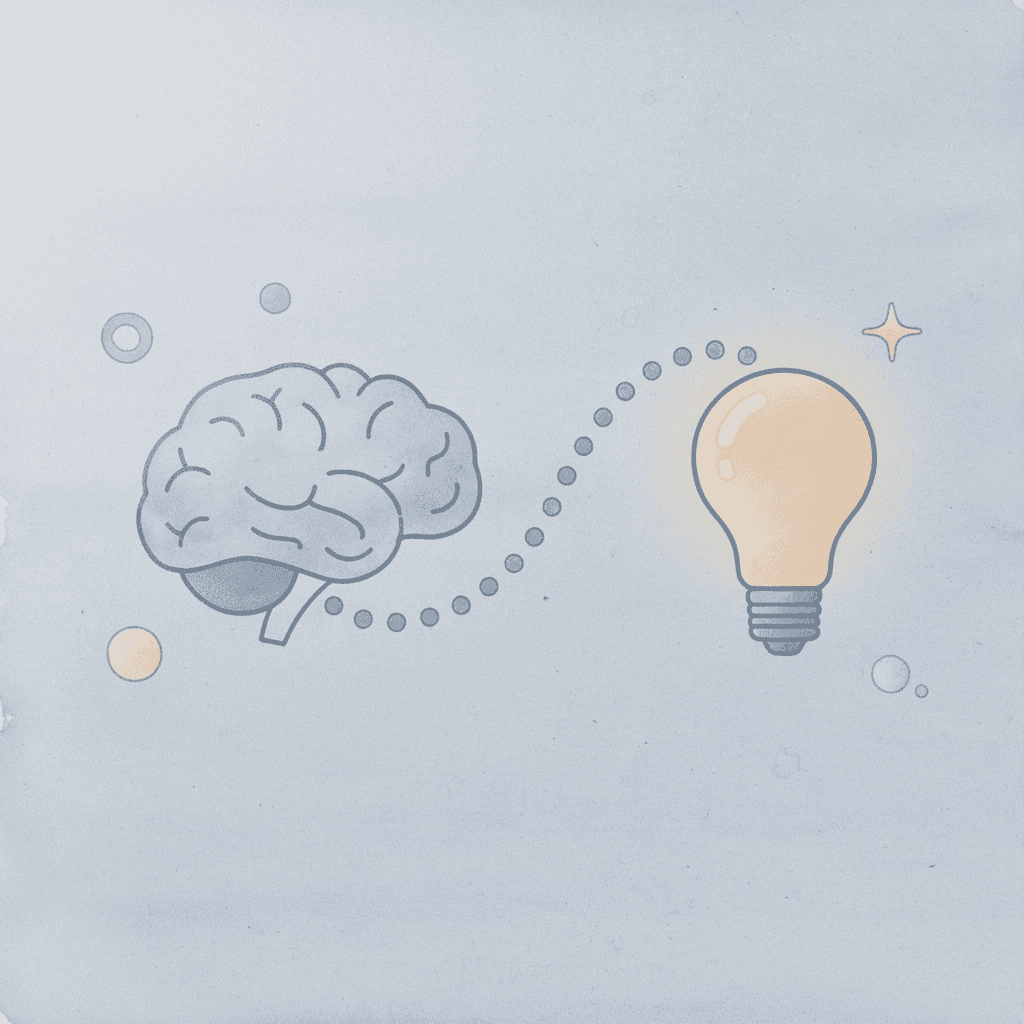
🎯 Key Point: Transform AI inspiration into hands-on creative practice through coloring and modification exercises.
"The shift from accepting AI output to actively reconstructing it builds lasting creative confidence and develops independent artistic skills."
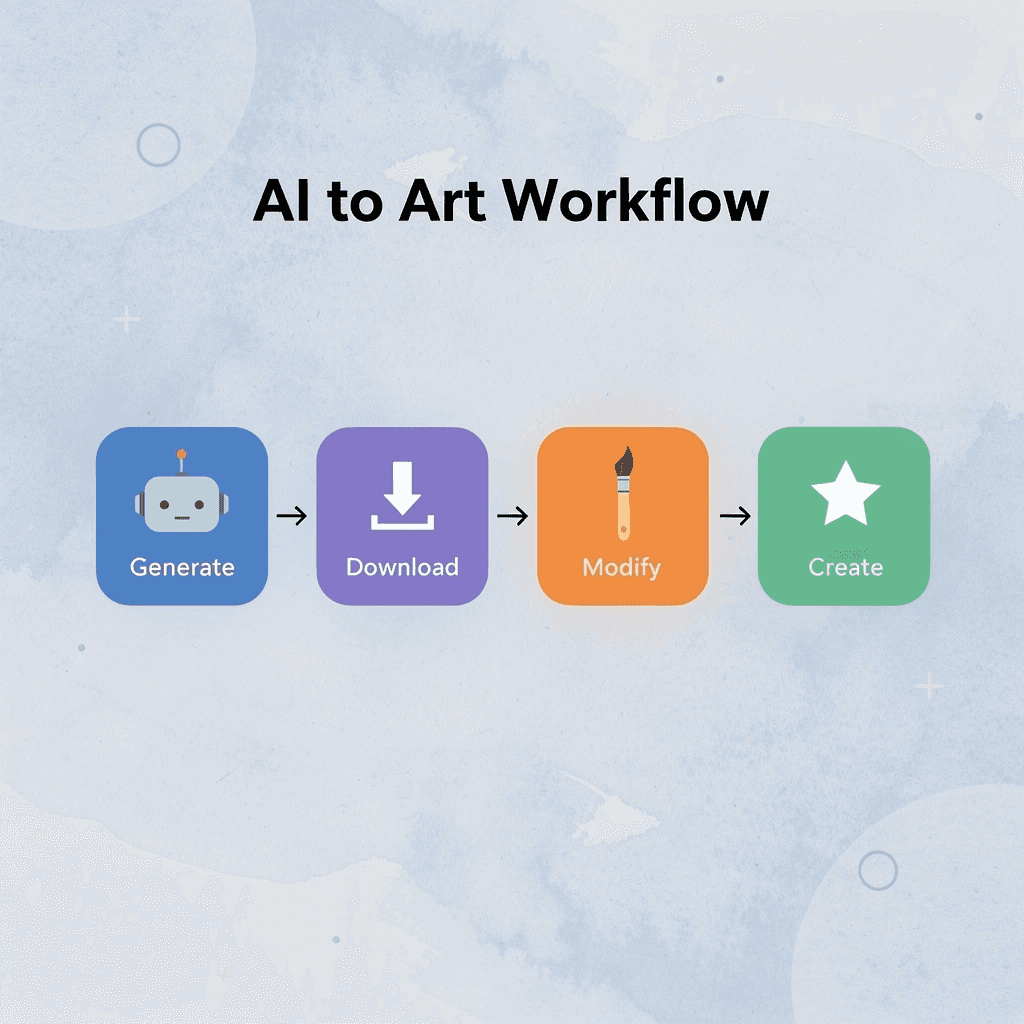
My Coloring Pages offers over 75,890 free coloring pages for this exact purpose. Download pages that align with AI-generated ideas, then ask your child to modify, extend, or reimagine what they see. Our coloring pages serve as the bridge between machine-generated inspiration and self-directed creative work, ensuring AI remains a starting point rather than a stopping point.
💡 Tip: Use our vast collection of 75,890+ pages to find the perfect match for any AI-generated concept your child wants to explore further.
Related Reading
- Is Creativity A Skill
- Creativity Toys For Toddlers
- AI Vs Human Creativity
- Types Of Creativity
- Human Creativity