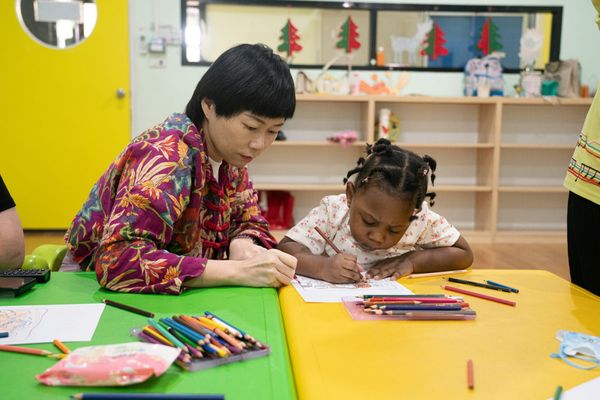
Illinois Homeschool Laws Detailed Guide
Illinois homeschool laws explained: requirements, regulations, and compliance steps. My Coloring Pages provides the complete legal guide parents need.


Choosing to homeschool in Illinois means understanding the state's unique educational requirements and freedoms. Illinois operates under some of the most flexible homeschool regulations in the country, with no mandatory registration, standardized testing, or curriculum approval needed from the state. Parents have significant freedom to design educational programs that meet both legal standards and their child's individual needs.
Building an effective homeschool curriculum requires quality educational materials that support learning goals across subjects. Whether working on letter recognition, historical topics, science concepts, or creative expression, having access to customized resources makes a real difference in daily lessons. Download 69,890+ free coloring pages to enhance your homeschool curriculum with instant, cost-effective educational materials.
Table of Contents
- Is Homeschooling Legal in Illinois?
- 9 Illinois Homeschool Laws You Need to Know
- How to Homeschool Legally in Illinois
- How to Choose the Right Homeschool Program in Illinois
- 10 Best Homeschool Programs in Illinois
- Download 69,890+ free coloring pages for homeschooling in Illinois
Summary
- Homeschooling in Illinois operates under one of the most flexible legal frameworks in the country, requiring no registration, standardized testing, or curriculum approval from any state agency. The state treats homeschools as private schools under 105 ILCS 5/26-1, meaning parents can begin teaching immediately after withdrawing their child from public school with a simple written notice. This autonomy extends to curriculum selection, daily scheduling, and assessment methods, with the only legal requirement being ongoing instruction in core subjects including language arts, mathematics, science, social studies, fine arts, and physical education.
- Homeschooling participation saw a 51% increase in recent years, according to CSG Midwest, yet Illinois maintains no statewide database or monitoring system because tracking isn't legally required. When Capitol News Illinois reported approximately 200,000 students now being homeschooled statewide, that figure came from estimates rather than official records. This absence of oversight provides complete privacy for families but also places full responsibility for educational outcomes on parents, with no external accountability or progress verification.
- The gap between legal compliance and educational success centers on implementation rather than regulation. Illinois law specifies which subjects to cover but provides no guidance on teaching methods, curriculum quality, or how to maintain a child's engagement through daily lessons. Research from the National Home Education Research Institute shows homeschooled students frequently work two or more grade levels apart in different subjects, a flexibility impossible in age-grouped classrooms that Illinois homeschoolers can leverage freely.
- Young learners in the kindergarten through second-grade range need frequent movement and tactile engagement to maintain focus during instruction on abstract concepts. Parents often discover that resistance to lessons stems not from curriculum content but from delivery methods that require extended sitting and repetition without physical activity. When practice materials connect to children's current interests through visual and hands-on elements, the same essential skill-building becomes something students actually want to complete rather than avoid.
- Most experienced homeschooling families use pieces from multiple programs rather than following one system exclusively, combining strengths while avoiding individual weaknesses. This customization requires more planning but creates a better fit for children's specific learning needs, though the risk is creating incoherence where nothing connects, and families constantly switch between different teaching philosophies. Successful curriculum mixing typically means selecting two or three core programs that share similar educational values, then supplementing with targeted resources for specific skills.
- Download 69,890+ free coloring pages addresses the need for engaging reinforcement materials by letting families generate custom designs that connect repetition practice to children's current interests without the expense of commercial workbooks.
Is Homeschooling Legal in Illinois?
Homeschooling is fully legal in Illinois. You don't need permission, registration, or approval from any state agency or school board. Illinois treats homeschools as private schools under existing education law (105 ILCS 5/26-1), so you're operating a legitimate private education at home from the start.

🎯 Key Point: Illinois homeschools operate as private schools under state law, giving you complete educational autonomy without government oversight.
"Illinois treats homeschools as private schools under existing education law (105 ILCS 5/26-1), meaning you're operating a legitimate private education at home the moment you begin." — Illinois Compiled Statutes
This clarity matters because confusion around legality stops families before they start. Parents worry they're breaking truancy laws or operating in regulatory gray areas. The state doesn't monitor homeschools because you're exercising a right that has been legally protected since 1950, not asking for permission to teach your own children.
⚠️ Warning: Don't let legal confusion delay your homeschool start—you have the right to begin educating your children at home immediately without any state approval process.

What Illinois actually requires
Illinois requires instruction in English that covers reading, language arts, math, science, social studies, the arts, and physical education—but imposes no requirements on teaching methods, curriculum choice, or time allocation. There are no testing requirements, attendance tracking, or progress reports to submit. According to CSG Midwest, homeschooling saw a 51% increase in recent years, yet Illinois maintains one of the least regulated frameworks in the country.
When legal questions surface
Problems arise from inadequate teaching, not homeschooling itself. If a child receives no education or neglect becomes evident, authorities may request proof of instruction—not curriculum approval or lesson plans, only evidence that teaching occurred. Most homeschool families never encounter government oversight because they teach effectively. Illinois operates on trust, not surveillance.
How strong is Illinois homeschool legal foundation?
The legal foundation is stronger than many people realize. People v. Levisen (1950) confirmed home education as valid private schooling. Illinois has consistently treated homeschooling as legitimate, with no statewide database, registration, or monitoring system. When Capitol News Illinois reported approximately 50,000 homeschooled students, that number came from estimates rather than official records. You can begin by withdrawing your child from public school and starting instruction.
What does the law actually require?
But knowing homeschooling is legal and understanding what the law actually requires are two different things.
Related Reading
- Homeschool History Curriculum
- Easy Peasy Homeschool
- Homeschool Curriculum
- Homeschool Math Curriculum
- Online Homeschool Curriculum
- Homeschool Resources
- Online Homeschool Programs
- Christian Homeschool Curriculum
- Homeschool Planner
- Homeschool Schedule
- Kindergarten Homeschool Curriculum
- Best Homeschool Programs
- Free Homeschool Curriculum
- Homeschool Schedule
- Best Homeschool Curriculum
- Accredited Homeschool Programs
- How To Homeschool
- Time For Learning Homeschool
- K12 Homeschool
9 Illinois Homeschool Laws You Need to Know
Illinois homeschool law works through what is NOT required, rather than what IS required. The state recognizes home education as private schooling under 105 ILCS 5/26-1, so it creates no special homeschool rules. What follows are the specific legal parameters that define this unique framework.
🎯 Key Point: Illinois takes a hands-off approach to homeschooling by treating it as private education, which means fewer regulations and more parental freedom compared to states with specific homeschool statutes.
"Illinois recognizes home education as private schooling under 105 ILCS 5/26-1, creating a framework based on what is NOT required rather than mandatory compliance measures." — Illinois School Code
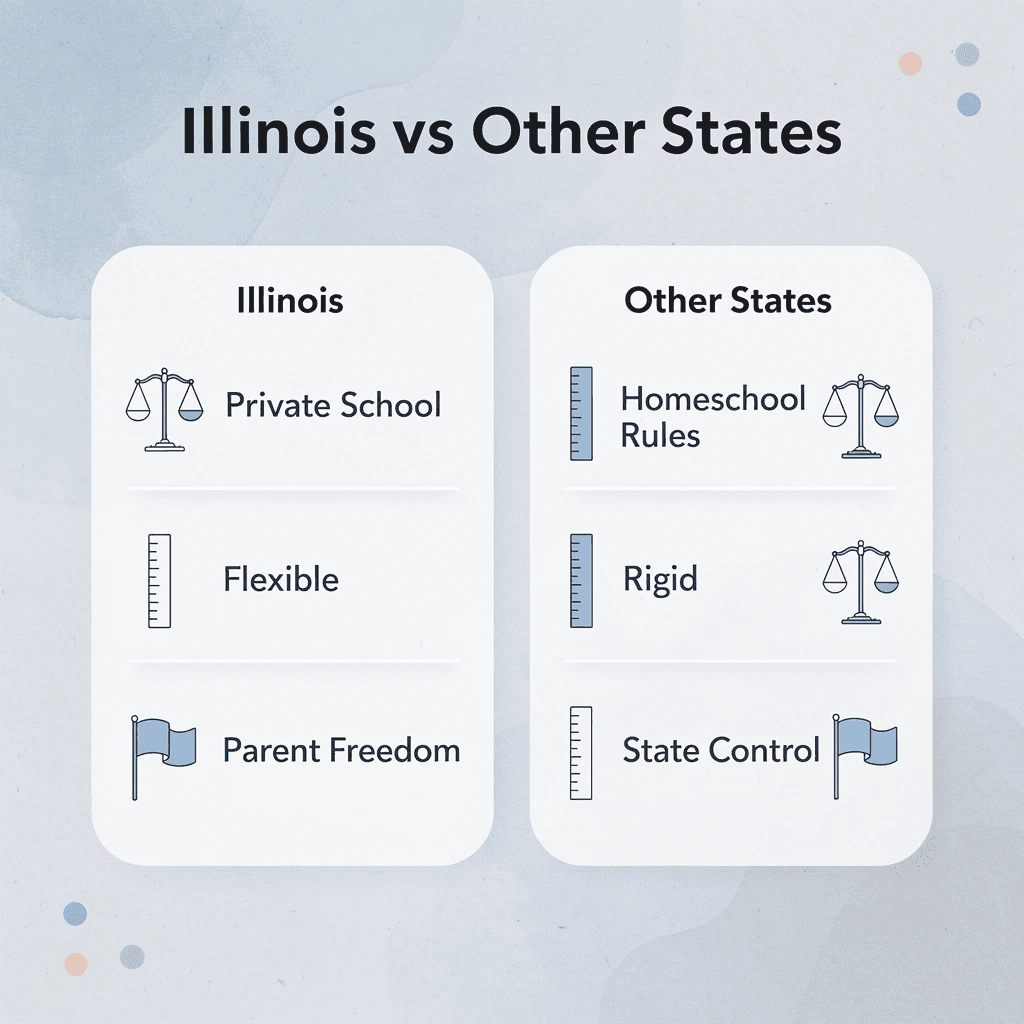
⚠️ Warning: While this flexible approach offers significant freedom, it also means parents must understand the legal boundaries and ensure they're operating within the private school framework to maintain compliance.
1. Homeschools function as private schools
Your home becomes a legally recognized private educational institution the moment you start teaching. No state agency checks this status, issues certificates, or maintains records of you as an educator. In the eyes of the law, you are treated the same as a small private school. Private schools in Illinois have considerable freedom: they set their own standards, choose their own materials, and determine how to measure success.
2. Zero registration or notification required
You don't file paperwork with the state board of education, your local district, or any government agency to start homeschooling. If your child currently attends public school, you must withdraw them from the district in writing. After that, you start teaching. Capitol News Illinois reported that about 200,000 students are homeschooled statewide, but the state doesn't maintain a database because tracking isn't legally required. Nobody monitors whether you're teaching, so the entire educational outcome depends on your consistency and commitment.
3. Instruction must happen in English
The law requires English as the language of instruction for core subjects such as math, science, and language arts, though it does not prohibit foreign-language instruction or bilingual materials. This requirement ensures students can function effectively in an English-speaking society. Families who speak other languages at home often maintain both languages, using English for schoolwork while preserving heritage language skills through conversation and cultural activities.
4. Subject coverage mirrors basic private education
Illinois requires instruction in language arts, mathematics, science, social studies, fine arts, and physical education. The law does not specify what this instruction entails in practice.
How flexible are Illinois homeschool teaching methods?
You could teach science through nature walks and kitchen experiments or use formal textbooks and lab kits. Both approaches work as long as learning happens. However, you cannot ignore entire subject areas: a child who receives no math instruction would fail to meet the legal standard.
What helps children stay engaged with required subjects?
Many homeschooling families find that meeting subject requirements becomes easier when children stay engaged. Young learners often perform well when lessons connect to their interests.
Platforms like My Coloring Pages let families generate custom coloring sheets that reinforce letter recognition, number concepts, or science vocabulary while keeping hands busy and minds focused. The ability to create unlimited designs on demand means you're never searching for the right worksheet when a child wants to learn about dinosaurs or practice spelling their name.
5. No mandated schedule, hours, or attendance tracking
Illinois doesn't require 180 days per year, attendance logs, or a traditional school calendar. You could do school year-round with frequent breaks, compress learning into four intensive days per week, or adjust daily hours based on your child's energy and attention span. This works well for families with non-traditional work schedules, children with health challenges, or parents who prefer project-based learning. The only constraint is that instruction must be ongoing and substantial, not occasional or sporadic.
6. Testing and assessments remain optional
The state doesn't require standardized tests, portfolio reviews, or progress reports. You decide how to measure your child's learning through formal assessments, narrative evaluations, or observation of skill development. Many homeschoolers use testing to identify knowledge gaps or prepare for college admissions, though it's optional. Without outside benchmarks, you bear sole responsibility for ensuring your child learns what you teach.
7. Special education services aren't automatically provided
If your child has learning disabilities or special needs, removing them from public school means losing access to IEPs and district-provided therapies unless you negotiate continued services. Some districts allow homeschooled students to participate in special education programs, speech therapy, or occupational therapy, but they're not legally required to do so. Parents typically pursue private evaluations and therapies, join support groups for special needs homeschoolers, or adapt the curriculum to support their child's learning.
8. Oversight only occurs if educational neglect is suspected
School districts or child welfare agencies can inquire about your homeschool only if someone reports suspected truancy or educational neglect. They verify that instruction exists, not your curriculum or your child's test scores. Most families never face scrutiny because they're clearly teaching. If questioned, lesson plans, work samples, or a description of your educational approach usually satisfy investigators. The legal risk isn't homeschooling itself, but failing to educate while claiming to homeschool.
9. Legal precedent protects your right to teach at home
People v. Levisen (1950) established that parents may legally educate their children at home if the instruction is comparable to that provided by private schools. This precedent remains the legal foundation on which Illinois operates today. When proposed legislation sought to add registration requirements and oversight mechanisms, Chalkbeat reported that over 40,000 witness slips were filed in opposition, demonstrating how strongly homeschooling families protect their freedom to choose. Knowing these nine legal parameters tells you what the state requires, but not how to set up a homeschool that works for your family.
How to Homeschool Legally in Illinois
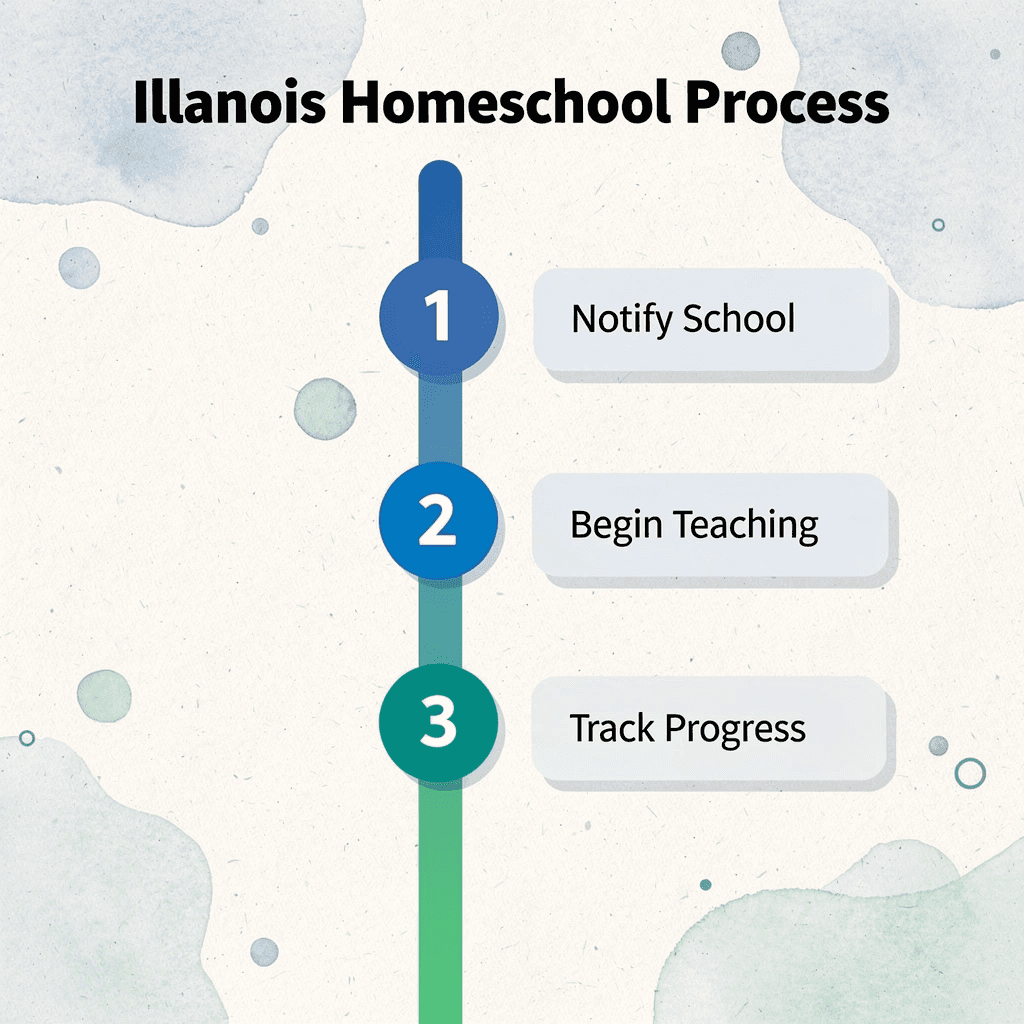
You start by telling your child's public school in writing that they will no longer attend. Then you begin teaching required subjects at home. Illinois doesn't require you to fill out forms, get approval, or show proof of your qualifications before you start. Once you teach language arts, math, science, social studies, fine arts, and physical education, you are operating a legal homeschool.
🎯 Key Point: Illinois has no pre-approval requirements - you can start homeschooling immediately after notifying your child's current school.
⚠️ Warning: While starting is simple, you must teach all six required subjects to maintain legal compliance throughout the school year.
"Illinois doesn't require you to fill out forms, get approval, or show proof of your qualifications before you start." — Illinois homeschool requirements
Required Subject | Must Include |
|---|---|
Language Arts | Reading, writing, grammar |
Mathematics | Age-appropriate math concepts |
Science | Basic scientific principles |
Social Studies | History, geography, civics |
Fine Arts | Art, music, or creative expression |
Physical Education | Physical activity and health |
What challenges exist beyond legal compliance?
Following the law and succeeding are two different things. You can do everything the law requires and still see your child lose interest, push back against lessons, or fall behind in their development. The law specifies what subjects to teach, but not how to teach a six-year-old to read or keep a second-grader engaged during maths worksheets.
Step 1: Understand the legal structure
Illinois law treats your home as a private school the moment instruction begins. Under 105 ILCS 5/26-1, private education at home has the same legal standing as a brick-and-mortar private academy. You need not apply for special permission or register with a homeschool board, as those systems don't exist in Illinois. This means you set your own standards, choose your own materials, and determine when and how learning happens.
Step 2: Withdraw your child from current enrollment
If your child attends public school, submit a written statement to the district office requesting a withdrawal to homeschool. The district cannot deny this request, require a meeting, or demand an explanation of your educational plan. Keep a copy for your records. You can begin teaching immediately with no waiting period or exit interview.
Step 3: Set up required subjects
The law requires ongoing instruction in reading, language arts, mathematics, science, social studies, fine arts, and physical education, but doesn't define what counts as instruction, how many hours to spend on it, or what mastery looks like. You could teach science through backyard observations and kitchen experiments, or purchase a formal curriculum with textbooks and lab kits. Both satisfy the legal requirement as long as learning occurs. This flexibility accommodates different teaching philosophies, though you cannot ignore subjects you find difficult or uninteresting.
Step 4: Choose your curriculum
This step lacks legal weight but determines whether your homeschool functions effectively. The state doesn't approve curricula or require specific programs. You're choosing from thousands of options ranging from structured boxed curricula that script every lesson to completely child-led approaches with no formal materials. For second-grade learners, most families need something that builds foundational skills in reading and maths while keeping children engaged enough to complete daily work.
How can you make learning more engaging for young children?
Young children learn best when abstract ideas connect to real activities they can touch and see. A math lesson about counting becomes concrete when a child colors groups of objects while practicing number recognition. Our My Coloring Pages platform lets you generate custom coloring sheets that reinforce whatever concept you're teaching—letter formation, skip counting, or identifying shapes. You create unlimited on-demand designs that match your child's current interests and learning needs, rather than searching for worksheets or paying for workbooks used once.
Step 5: Create a simple learning routine
Illinois doesn't require school hours, attendance logs, or daily schedules, but children thrive on predictable structure. One to two hours of focused academic work, followed by hands-on practice and real-world learning activities, creates sustainable momentum without burning out the parent or the child. Short, consistent sessions work better than long study blocks. Your routine should match your family's energy patterns and other commitments, not replicate a traditional school day.
Step 6: Keep basic records
The state doesn't require you to keep records, but documentation protects you if anyone questions whether instruction is happening. Save samples of completed work, keep lists of books read, note activities and field trips, or write brief progress observations every few weeks. This evidence demonstrates regular teaching if a school district or child welfare agency inquires about your homeschool. But knowing how to follow the law doesn't tell you which curriculum works for your child or how to choose among thousands of competing programs and philosophies.
How to Choose the Right Homeschool Program in Illinois
Match curriculum to your child's actual skill development, not their age or grade level. A seven-year-old who reads at a fourth-grade level but struggles with basic addition needs materials reflecting both realities, not a single boxed curriculum labeled "Grade 2." Illinois law gives you complete freedom to adjust levels across subjects—the state doesn't require a set pace, testing, or grade progression. Your only legal obligation is to cover the required subjects.
🎯 Key Point: Illinois homeschool laws prioritize subject coverage over grade-level progression, giving you maximum flexibility to customize your child's education.
💡 Pro Tip: Create a skills assessment chart for each subject to track your child's actual abilities rather than relying on age-based expectations.
"Illinois law gives homeschooling families complete freedom to adjust curriculum levels across subjects without requiring set pace or grade progression." — Illinois State Board of Education
Subject | Child's Skill Level | Recommended Action |
|---|---|---|
Reading | Above grade level | Use advanced materials |
Math | Below grade level | Focus on foundational skills |
Science | At grade level | Follow the standard curriculum |
What factors determine homeschool program success?
Success depends on being honest about three things: your child's current abilities, how much structure you need to stay consistent, and whether the teaching method matches how your family actually works. Most homeschooling parents change programs within the first three months because they misjudge one of these factors.
What should you assess before choosing grade levels?
Ask whether your child reads smoothly enough to work independently or still needs help with phonics and reading aloud. Check if they understand place value and basic maths operations, or if they count on their fingers to add single numbers. Notice whether they need to hear ideas multiple times before remembering them, or if they learn quickly and become bored with repetition. These observations matter more than what grade level a curriculum claims because they show where teaching must start.
How do Illinois homeschoolers handle different skill levels across subjects?
Many families find that their child learns at different levels in different subjects. According to research from the National Home Education Research Institute (2023), homeschooled students often work two or more grade levels apart in different subjects. This flexibility is impossible in classrooms where students are grouped by age. Illinois homeschoolers can adjust levels freely because the state has no pacing rules. You can use third-grade maths while teaching fifth-grade reading without explanation.
What teaching methods can you realistically sustain?
Traditional textbook programs require daily explanations and pacing. Online platforms ease your workload but demand student self-direction. Hands-on methods like Montessori engage students through physical materials but require substantial preparation. Literature-based learning builds skills through reading and discussion, but needs you to facilitate conversations and connect texts to learning objectives.
The big question isn't which method sounds best, but which one you can sustain five days a week for nine months. A working parent needs a different approach than one at home full-time. A family with multiple children needs materials that allow independent work. Most successful homeschoolers use a mix of methods: textbooks for maths, real books for history, and hands-on projects for science.
How do you handle resistance to traditional lessons?
When children resist sitting through lessons, the problem often lies not in what you're teaching but how you're teaching it. Young learners in the JK-1st grade range need movement and hands-on engagement to maintain focus.
Abstract ideas become real when children can color, cut, trace, or move objects while learning. Platforms like My Coloring Pages let you generate custom coloring sheets that reinforce whatever skill you're teaching: letter formation, number recognition, or vocabulary building, turning practice into something children want to complete.
What should you look for in program structure and guidance?
Good programs have clear lessons that build on each other, practice that reinforces learning, and simple parent directions requiring no teaching experience. Avoid programs with unclear instructions, missing answer keys, or disjointed lessons. If you feel confused about what to do next or how to explain something, the program lacks sufficient guidance.
How can you test programs before making a commitment?
Test programs before buying a full year of lessons when possible. Many companies offer sample lessons or money-back guarantees within the first month. Parents who skip this step often discover too late that the teaching style doesn't match their child's learning needs or that the daily time commitment exceeds their schedule. The goal is to find a program that guides you clearly enough to maintain consistency without feeling overwhelmed. But picking the right program structure only matters if it includes content worth teaching.
10 Best Homeschool Programs in Illinois
Illinois lets you choose any curriculum without state approval, but that freedom can be confusing when faced with hundreds of programs claiming to be the best. What works depends on whether you need a strict daily schedule or loose flexibility, whether your child learns better with textbooks or hands-on activities, and whether you can teach every subject confidently or need video instruction to fill gaps.

🎯 Key Point: The most expensive or popular program isn't necessarily the right fit for your family's learning style and daily routine.
"The best homeschool curriculum is the one that matches your family's actual capacity and your child's learning preferences, not the one with the most marketing buzz." — Homeschool Research Institute

The programs below represent different teaching philosophies and levels of commitment. Match the right structure to your actual daily reality, not whatever sounds most impressive.
⚠️ Warning: Don't choose a high-maintenance curriculum if you're already stretched thin with work or other commitments - it will lead to frustration and inconsistent learning.
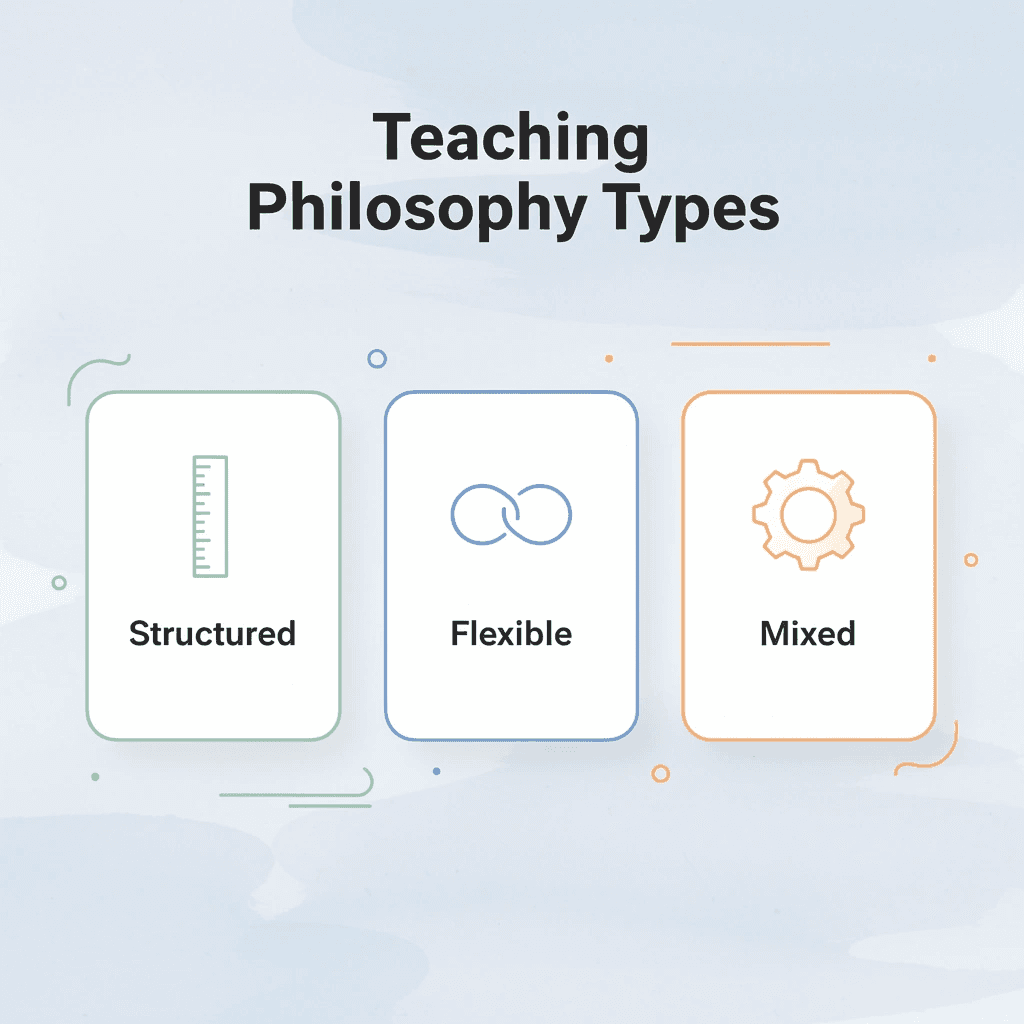
1. Calvert Homeschool (Structured, School-at-Home System)

Calvert provides fully written lesson plans requiring minimal preparation, including tests, answer keys, and detailed teacher guides for inexperienced parents. The workbook-based approach builds maths and reading skills through repetition and incremental skill development. Children who thrive with predictable routines and clear expectations do well with this format.
The strict structure creates problems when children learn concepts faster than the pace allows or need more time on difficult topics. Parents who prefer spontaneity or want to follow their child's interests find Calvert limiting. It works best for those seeking a traditional school-at-home experience with minimal decision-making required.
2. The Good and the Beautiful (Gentle, Engaging Learning)
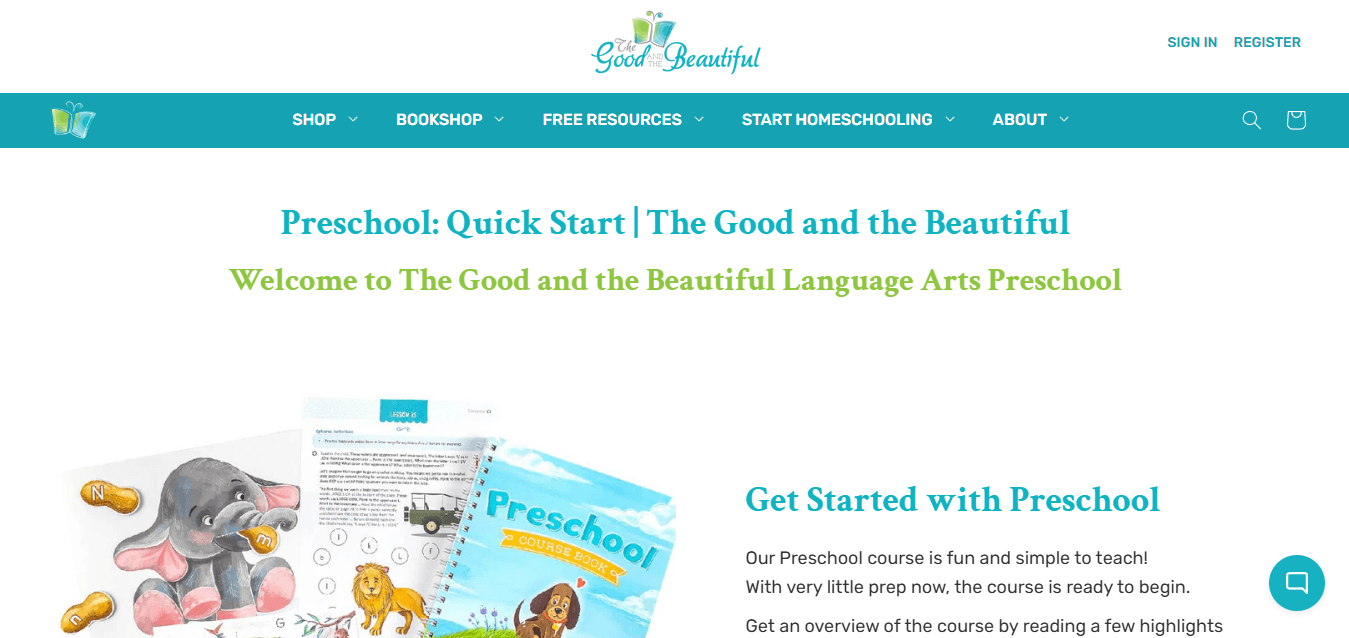
This literature-based program uses beautiful illustrations, nature themes, and integrated reading and writing lessons to make learning feel natural. The visually appealing books encourage independent reading, and lessons flow naturally without complicated setups or extra materials. The approach emphasizes enjoyment over testing, reducing stress for families concerned about pushing too hard too soon.
What challenges might families face with this curriculum?
The challenge comes when you need clear ways to measure progress, or when you struggle with the program's Christian worldview woven throughout the content. Some parents find the gentle pacing too slow for advanced learners. It suits families who prioritize relationship and creativity over academic acceleration and who can assess learning through conversation rather than formal testing.
3. Abeka (Strong Academic Structure)
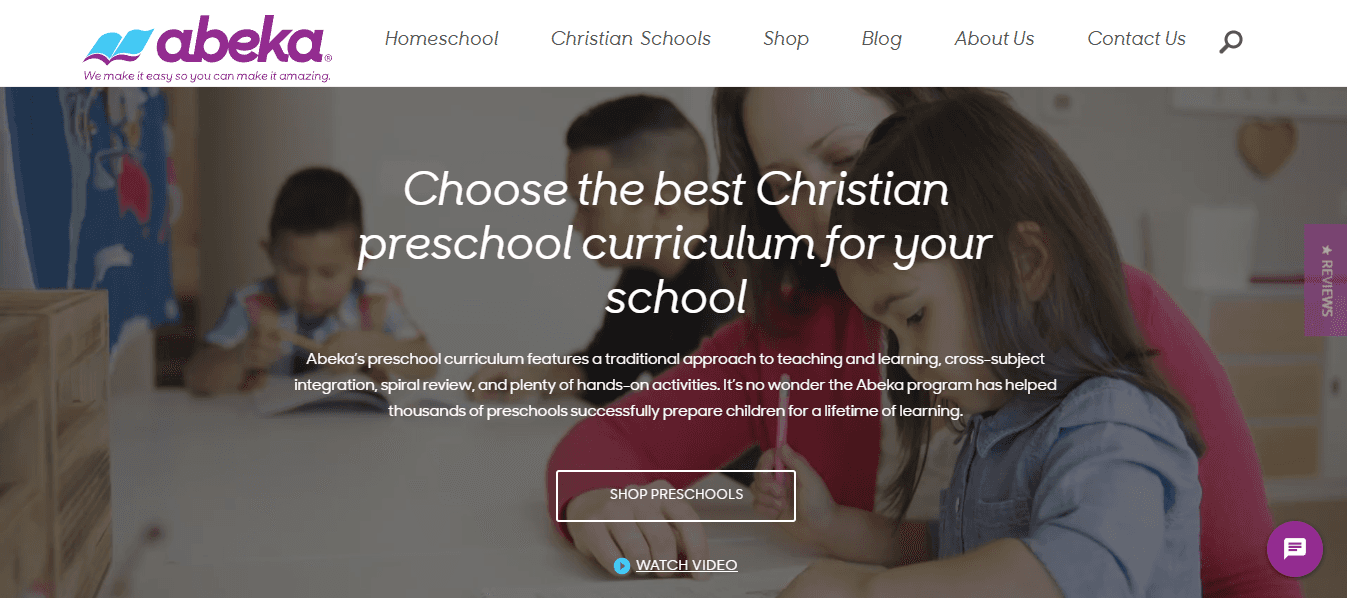
Abeka provides traditional textbook education with strong phonics instruction, step-by-step math lessons, and teacher-led classes. The curriculum includes scripts for direct instruction, followed by independent practice. High expectations for each grade level establish clear college-preparatory goals.
According to Multisori, over 3.7 million students learning from home in the U.S. in 2023 reflects growing demand for programs that maintain strong academic standards without requiring physical school attendance.
What challenges should parents expect with Abeka?
You must do all the teaching yourself. Abeka expects you to explain ideas, check your child's work daily, and maintain organization through structured lessons. Children who struggle to sit still or need movement may find this format challenging. It works well when you have time to teach actively, and your child responds to clear rules and structured expectations.
4. Time4Learning (Online Self-Paced Platform)
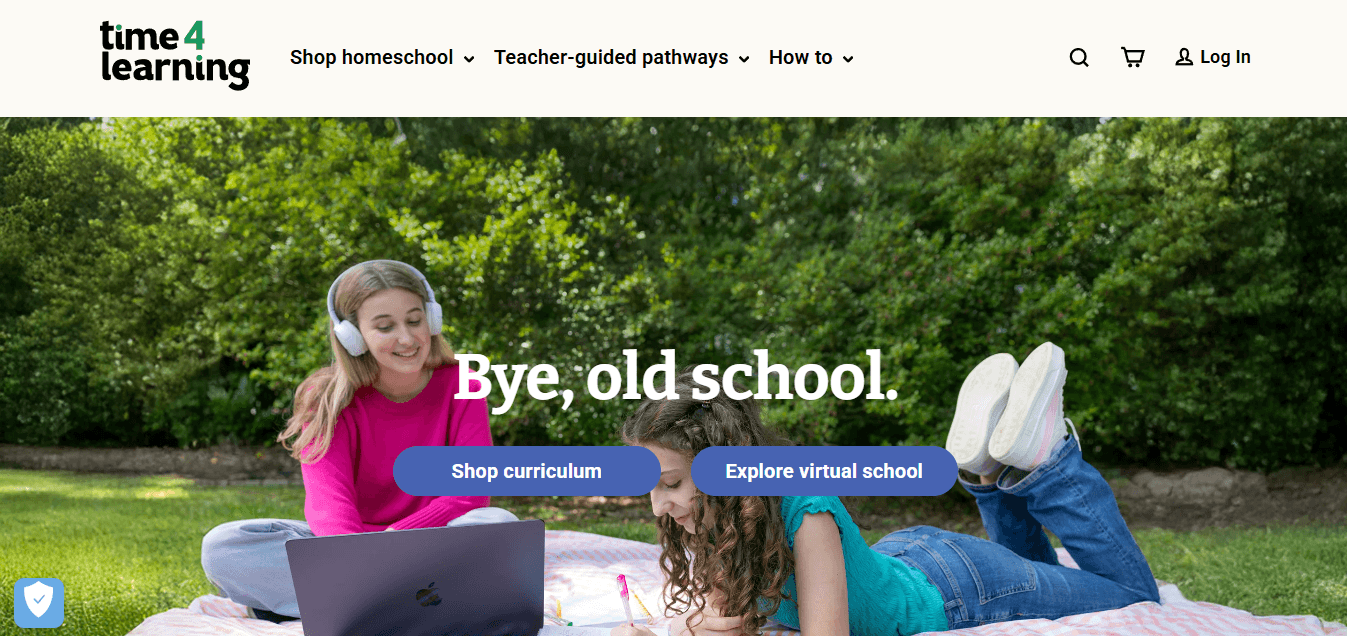
Time4Learning uses video lessons to teach core concepts, reducing your role to supervising learning. Automatic grading and progress tracking manage assessments across the main subjects. Working parents favor this option because children complete lessons independently during the day, then review the work together in the evening.
The program requires children to view screens for extended periods and follow multi-step directions independently. Young learners who need movement or hands-on engagement often lose interest in computer-only learning. While it addresses parents' time constraints, it creates a dependence on technology and demands strong self-control.
5. Singapore Math Combined with Language Arts Program
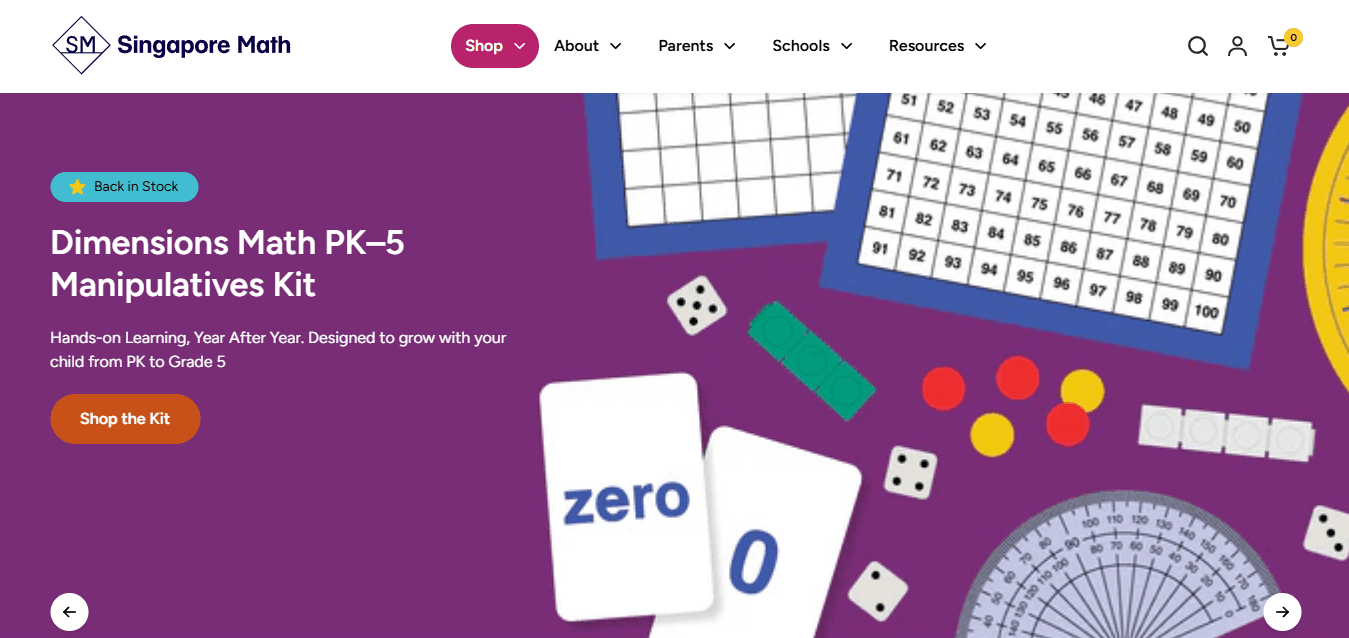
Singapore Math builds math thinking through problem-solving rather than memorization, using visual models that help children understand why procedures work. Its global reputation for developing strong math foundations attracts families who prioritize analytical thinking over rote calculation. You'll need to pair it with a separate language arts curriculum since Singapore Math covers only mathematics.
The teaching method requires you to understand the visual models well enough to explain them clearly. Parents who struggled with maths themselves sometimes find the approach confusing at first, though most report that working through it alongside their child deepens both their child's and their own understanding.
6. Memoria Press (Classical Education)

Classical education moves through three stages: grammar (memorization), logic (analysis), and rhetoric (expression). Memoria Press focuses on Latin, reading, grammar, and critical thinking through organized memory work and discussion. The goal is to develop disciplined minds capable of complex reasoning rather than minds that perform well on quick tests.
This approach requires substantial parent involvement in leading discussions and maintaining consistent memory practice. Families who value intellectual tradition and slower pacing find it satisfying. However, it struggles when parents lack time for daily conversation-based learning or when children need more hands-on activity than the book-heavy format provides.
7. Oak Meadow (Holistic, Creative Learning)

Oak Meadow uses storytelling, art projects, and nature-based activities to teach through experience rather than textbooks. The Waldorf-inspired approach reduces testing pressure and emphasizes creative expression, with lessons often occurring outdoors or involving hands-on projects that make abstract ideas tangible.
The artistic focus requires materials, preparation time, and comfort with uncertainty about students' grade-level skills. Parents who need clear benchmarks or who worry about falling behind academically may feel uncertain about their child's progress. It works when you trust that learning happens through exploration and don't require outside validation of achievement.
8. Easy Peasy All-in-One Homeschool (Free Online Option)

Easy Peasy provides complete daily lesson plans for free, making homeschooling affordable for everyone. The Christian-based content covers all necessary subjects with a simple structure that specifies daily tasks. However, the platform lacks polish, offers limited customization, and requires internet access.
The quality varies by subject, with no customer support or money-back guarantee. It works well for families seeking an affordable full curriculum who can supplement weak areas with library books or other free resources. Since there's no financial commitment, you won't feel locked into your choice, and you can easily discontinue use if it doesn't suit you.
9. BookShark (Literature-Based Curriculum)
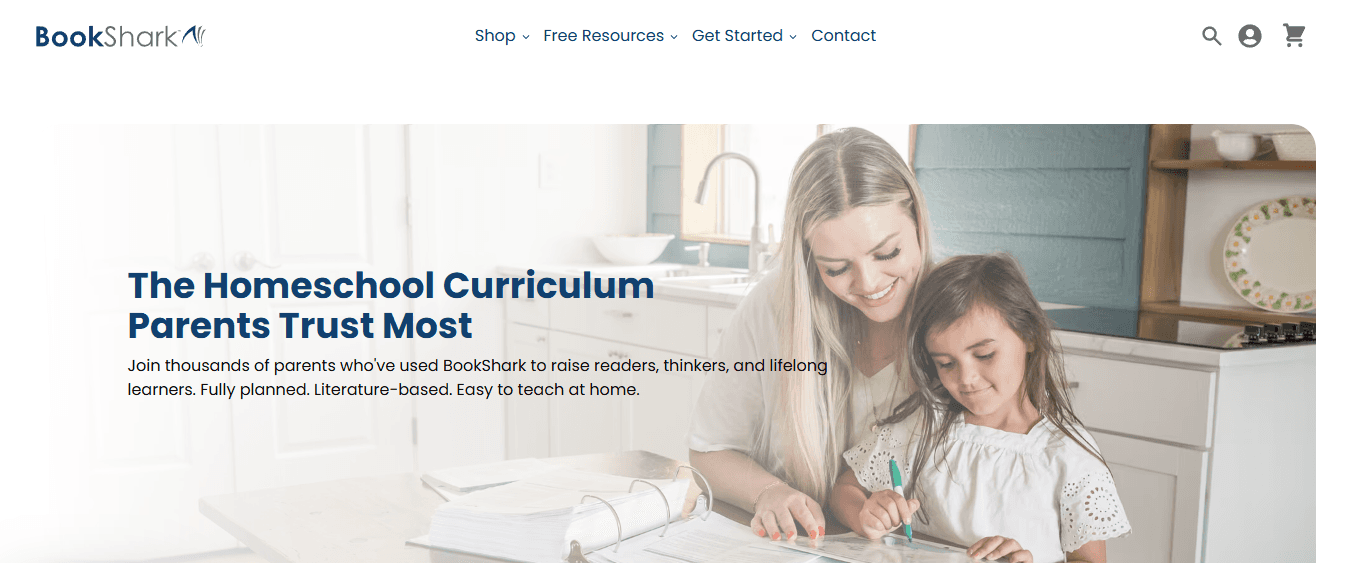
BookShark builds learning through real books instead of textbooks, using novels, biographies, and historical accounts to teach reading comprehension, writing, and critical thinking. Detailed instructor guides facilitate discussion and connect books to learning objectives.
The reading-heavy approach requires strong literacy skills or patience to read aloud extensively if your child isn't fluent yet. It works best for families who prefer narrative-based learning but struggle when children resist reading or when parents need more structure than discussion-based learning provides.
10. Khan Academy Combined with Printable Worksheets
Khan Academy offers free video lessons covering math and science concepts. You can combine these videos with printed practice worksheets to create a customized hybrid system, selecting exactly what your child needs without paying for a packaged curriculum that includes unwanted subjects.
What challenges come with designing your own curriculum?
You must handle all curriculum design work yourself, responsible for identifying what your student needs to learn, sequencing concepts, and ensuring nothing important is skipped. This works well if you have a strong educational background and time to research content and scope, but it can overwhelm parents who need clear guidance about what to teach next.
How can you keep young children engaged during lessons?
Many families find that keeping young children interested during lessons matters more than which curriculum you choose. A second-grader who resists worksheets often needs a different learning approach, not different material.
Abstract ideas become real when children can color, trace, or move objects while learning. Platforms like My Coloring Pages let you create custom coloring sheets that support whatever skill you're teaching, whether letter formation, number recognition, or vocabulary building. Instead of battling through another worksheet while your child squirms, our platform helps you create designs that match their interests and turn practice into something they want to complete.
Mixing programs instead of choosing one
Most experienced homeschoolers use pieces from multiple programs rather than following one system exclusively. They might use Singapore Math for mathematics, The Good and the Beautiful for language arts, and Khan Academy for science, combining each program's strengths while avoiding its weaknesses.
The risk is creating a sense of disconnection, with nothing tying together, and you're constantly switching between different teaching philosophies. Successful mixing means selecting two or three core programs that share similar educational values, then adding targeted resources for specific skills.
Why should you test programs before committing?
Sample lessons show whether a program's teaching style works for your family before you commit hundreds of dollars to a full year. Most curriculum companies offer preview packets, money-back guarantees within 30 days, or used curriculum at low prices. Parents who skip this step often discover too late that the daily time commitment exceeds their schedule or their child refuses to engage with the format.
How should you test under realistic conditions?
Test during typical conditions, not ideal circumstances. Use the program during a normal week when you're tired, when other responsibilities compete for attention, and when your child is in an average mood. If it works during normal chaos, it will work in the long term.
When should you consider switching homeschool programs mid-year?
Switching curriculum halfway through the year might feel like failure, but continuing with something that doesn't work will lead to worse results. You might need to change if you fight about schoolwork daily, your child is falling behind, or you dread teaching so much that lessons keep getting postponed. The money already spent matters less than the time wasted using ineffective materials.
How do you distinguish between adjustment friction and curriculum mismatch?
The challenge is distinguishing between normal adjustment friction and fundamental mismatch. Every new curriculum requires a few weeks of adaptation. If resistance persists for more than a month or your child disengages over time rather than warming up, the program probably isn't right. Illinois's lack of testing requirements means you can switch freely without worrying about alignment to state standards. But choosing a strong curriculum only matters if you can implement it consistently without burning out.
Related Reading
- Homeschool Room
- Homeschool Report Card Template
- Homeschool Room Ideas
- Homeschool Vs Public School
- Language Arts Homeschool Curriculum
- Homeschool Preschool
- Texas Homeschool Requirements
- How To Homeschool Your Kids
- How To Homeschool In Texas
- Homeschool Coop
- Pre K Homeschool Curriculum
- Florida Homeschool Requirements
- 1st Grade Homeschool Curriculum
- Colorado Homeschool Laws
- Georgia Homeschool Laws
- 6th Grade Homeschool Curriculum
Download 69,890+ free coloring pages for homeschooling in Illinois
Choosing Calvert, Time4Learning, or any program establishes the basic structure. Learning happens through practice, real-world use, and changes built around that core structure. Most homeschool failures stem from treating curriculum as a complete system rather than the foundation you build on.
🎯 Key Point: Curriculum completion doesn't equal learning mastery - your child needs active practice beyond the workbook.

The problem arises when lessons appear to be finished after closing the workbook. Your child completes the math page, reads the chapter, fills in the worksheet—everything appears done on paper. Two weeks later, they cannot recall concepts or apply skills in new situations. The curriculum delivered content, but learning didn't stick because it remained abstract and separate.
"Learning happens through practice and real-world use - treating curriculum as a complete system is where most homeschool programs fail."
💡 Tip: Use coloring pages as active reinforcement tools that help concepts stick through visual practice and creative application.
Layer practice that actually reinforces
Mastery requires repeated application in varied contexts. Math fluency comes from daily problem sets that spiral through previously learned operations, not just this week's new skill. Reading comprehension deepens when children answer questions about multiple texts using similar strategies. Spelling and writing improve through consistent practice that connects letter patterns to actual composition, rather than isolated word lists.
Most families underestimate how much targeted practice young learners need before concepts move from short-term memory into long-term retention. The gap between understanding something once and using it independently requires more repetition than a single curriculum provides. When practice feels like punishment, learning stops, even if the child complies.
Families often use printed worksheets for reinforcement because they're inexpensive and screen-free. The limitation emerges when your child loses interest in generic practice sheets or when you need something connected to their current fascination. Platforms like My Coloring Pages let you generate unlimited custom designs that turn repetition into something visual and personally relevant. Instead of fighting through another multiplication drill identical to yesterday's, you create practice sheets featuring dinosaurs, space themes, or whatever captures your child's attention, making the same essential repetition feel fresh.
Connect learning to observable reality
Abstract ideas become real when children see them working in their world. Maths lessons about fractions make sense when your child measures ingredients for cookies and discovers that two quarter cups equal one half cup. Reading skills develop faster when children tell stories to siblings or write letters to grandparents. Science lessons about plant growth build understanding when you watch seeds sprout in your kitchen, not merely by studying pictures in a textbook.
Real-life learning happens when your child calculates unit prices at the grocery store, identifies leaf shapes and tree types on nature walks, follows step-by-step instructions while cooking, and watches chemical changes occur. This everyday learning becomes clear when you connect it to what they learn in school.
Adjust components without abandoning systems
When something isn't working, most parents either push through with frustration or scrap the entire program. The effective approach involves identifying which specific component fails and replacing only that piece while keeping everything else intact.
If your child understands maths concepts but struggles with timed drills, swap in different practice materials while keeping core instruction. If reading comprehension is strong but handwriting creates daily battles, separate those skills and address writing through different methods while continuing the reading program unchanged. Illinois homeschoolers can make these adjustments freely because no external authority requires you to use complete programs or maintain consistency across vendors.
Diagnose problems accurately before making changes. Track what happens during lessons for a full week. Notice whether resistance appears during new concept introduction, independent practice, or specific subject areas. Identify whether the issue is content difficulty, teaching format, time of day, or session length. Precise diagnosis lets you adjust the right variable instead of changing everything and creating new problems.
Related Reading
- 5th Grade Homeschool Curriculum
- How To Homeschool In California
- North Carolina Homeschool Laws
- Homeschool Art Curriculum
- Accredited Homeschool Curriculum
- Homeschool Reading Curriculum
- Illinois Homeschool Laws
- California Homeschool Laws
- 2nd Grade Homeschool Curriculum
- Alabama Homeschool Laws
- 4th Grade Homeschool Curriculum
- Science Homeschool Curriculum
- Georgia Homeschool Requirements
- 3rd Grade Homeschool Curriculum
- Michigan Homeschool Laws